





















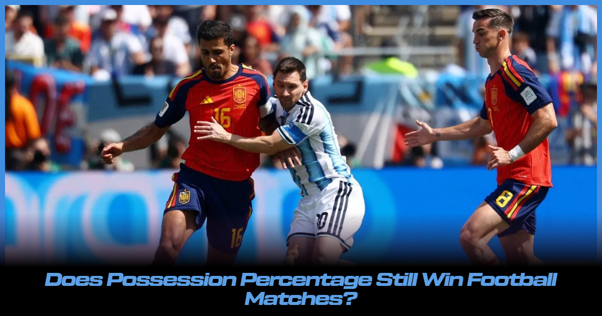
Possession percentage has been an important yet misguided metric in the world of football. Why? Picture a jam-packed stadium on an important UEFA Champions League night. The home side has 72% possession, with over 500 passes completed, pinning the other team for almost the entirety of the game. Yet, the big screen in the stadium shows the scoreline 1-2 at the end of 90 minutes. The visiting manager walks off smiling, well aware of the fact that his team had been chasing shadows for most of the match, yet were able to take the result in their favour due to minute mistakes from the hosts in the centre of the park.
Fans who have watched football know how this feels. A misplaced pass in a dangerous area or an attempt to play a risky pass, that leads to the opposition team counter attack and score swiftly, while their own side being in control for 80 minutes goes in vain. Over the years, possession percentage has been worn as a badge of honor by teams, but now, it feels more like an optical illusion.
The Illusion of Control
One needs to understand that keeping the ball doesn’t necessarily mean hurting the opposition. A sideways pass and a penetrative pass into the final third are both counted as keeping the possession. A team that passes for safety, protecting it from the opposition, rather than playing it forward to create something meaningful, will always have a beautiful metric to show at the hand of the game, but the end result might not go their way when the match is over.
There’s evidence to match up to that, as in the Qatar World Cup 2022, we saw that teams who had less possession sometimes outperformed the teams with a higher volume of possession percentage, in spite of being the inferior side in terms of quality.
Having more of the ball helps when a fairly superior side competes with a relatively weaker side in a UEFA Champions League or in a domestic league, where they do it to wear out their opposition. However, in a single crunch knockout tie, a team without bite despite having much of the possession, will lose out to a team who are compact defensively and have the ability to hit on the break.
Read Also: CAF Announces Coca-Cola As Official Competition Sponsor Of The TotalEnergies AFCON 2027
Directness Is The Proven Formula In Modern Football
We have witnessed that modern football has been constantly getting braver, faster, and more direct than ever before. Managers across the top leagues get their teams to press higher and maintain high backlines, to quickly turn over possession in a bad spot for the other team, as is evident in our Football Analysis section. A possession-based team, losing the ball in such a way can open up wide spaces to attack, where the opposition can hurt them the most. In recent seasons, fans have seen FC Barcelona transition from a heavy-possession based side to a more direct side under Hansi Flick, who press aggressively and just kill the other team on every mistake committed. Fast breaks and errors lead up to more chances of scoring nowadays, with suddenly the 70% possession metric looking like a mere illusion if there’s no urgency.
Why Does Possession Still Matter?
To write off possession completely would be heinous as worshipping it blindly. There are teams who still rely on heavy possession-based football, where every player has to undertake real exhausting work. The defenders and midfielders getting back and forth to recycle the ball, does make their legs go away in the final stages of the game, which opens up cracks for a counter-hungry team. However, it does help to protect a tired backline in the final few minutes of the match, or calm down a hostile crowd that makes life hell for the visiting team.
What we want to say is that sterile possession will never outweigh purposeful possession. Portugal, for example, in the recent 2026 FIFA World Cup were accused of sterile possession, where they seemed to just pass it safely, mostly sideways, without any real sense of purpose. Their midfielders did end the game with a good passing rate, but neither the forwards got their required supply, nor they could find the goal that would prove to be decisive, and is even backed up in our Football Ratings.
Teams with a stacked squad, reeking of excellent quality, and with a clear structure, often deploy possession-based tactics over a full season of play and even manage to win games comfortably, because sustained pressure eventually reaps benefits. However, the outcome of a match solely depends on who took their chances better and who defended like their life depends on it?
So What’s The Final Verdict?
The simple message that we want to convey is that purposeful possession will always help in the long run. Players need to be brave enough to play a dangerous defense-splitting through ball and create opportunities for scoring, rather than playing it safe, waiting for the right time to create a gap. Because at the end of the game, nobody remembers the 80% possession you kept in the game. Fans go wild when the ball goes into the back of the net, which ultimately decides who gets their hand on the trophies.
Possession is a good tool to have, but it does not guarantee success every time. In a game which is decided by fine moments of nerve, timing, and precision, what a team does with the ball will always hold more value than how long they keep it. Just as a wise old man once said, “They can take the ball home with them. I took 3 points.”