


















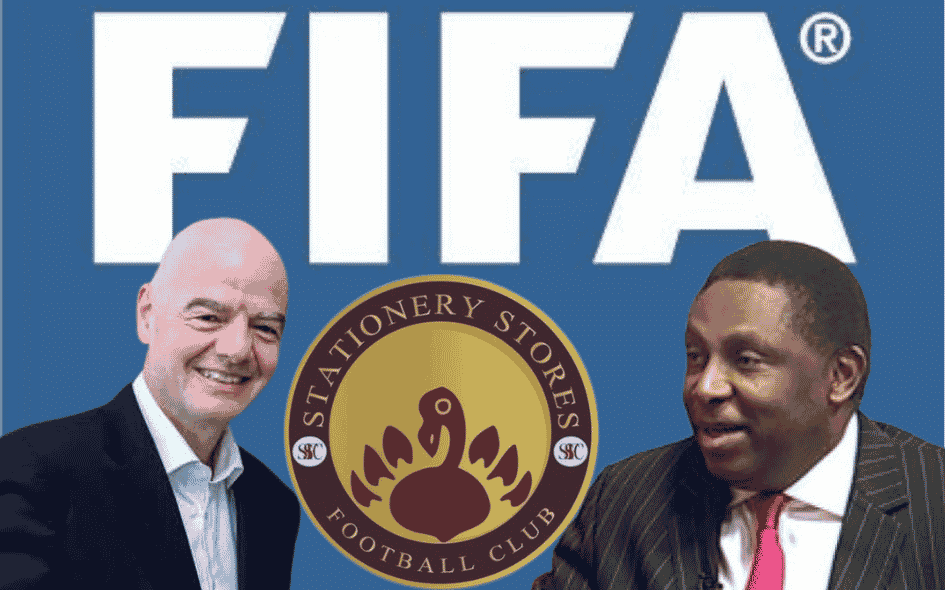
Chairman of Stationery Stores Football Club of Lagos, Mr. Adetilewa Adebajo, has petitioned world football governing body FIFA, calling for the historical recognition of his late father, Israel Adebajo, for his role in Nigeria’s affiliation with the organisation and urging an urgent review of the country’s football governance structure Completesports.com reports.
In a memorandum dated 25 July 2026 and addressed to FIFA President Giovanni Vincenzo Infantino, Adebajo also called for the harmonisation of the Nigerian Football Federation (NFF) and the Nigerian Football Association (NFA), which he argued has created a dual governance structure that has hindered the development and commercialisation of Nigerian football.
Adebajo, who described Stationery Stores as the oldest surviving private football club in Nigeria, said the memorandum was intended to open a structured dialogue with FIFA on historical recognition, governance clarity and a reform pathway for Nigerian football.
He urged FIFA to review, critique and, where appropriate, endorse a proposed reform framework before it is presented to the Federal Government of Nigeria and other football stakeholders for possible implementation.
Stationery Stores Chairman Seeks Recognition For Israel Adebajo
A major part of the memorandum is Adetilewa Adebajo’s request that FIFA formally recognise the contribution of his late father, Israel Adebajo, alongside Sir Adetokunbo Ademola and G.K.J. Amachree, to Nigeria’s emergence within the international football system.
According to Adebajo, Nigeria’s application for FIFA affiliation was submitted through the Confederation of African Football (CAF) in 1959 and subsequently ratified at the FIFA Congress in 1960.
Also Read: NFF Board Resignation: Stationery Stores Welcome Development, Call for FIFA Normalisation Committee
He said Sir Adetokunbo Ademola, then Chief Justice of Nigeria and a leader of the Olympic Movement in the country, worked with Amachree, described as the first chairman of the indigenous Nigerian Football Association, and Israel Adebajo, the association’s first treasurer, to make Nigeria’s FIFA affiliation a reality.
Adebajo further argued that his father’s contribution should receive particular attention because Israel Adebajo was also the founder of Stationery Stores Football Club in 1950.
“Stationery Stores Football Club is the oldest surviving private football club in Nigeria today founded in 1950,” the memorandum stated.
Adebajo claimed that his father subsequently developed and co-sponsored the Nigerian national team’s first global tournament appearance at the 1968 Mexico Olympics, adding that Stationery Stores supplied nine starting players to that historic team.
He also stated that the club has provided six captains to the Nigerian national team over the years.
“We therefore urge FIFA to expedite action on the recognition of the role of Israel Adebajo a football icon in Nigeria, Sir Adetokunbo Ademola and G.K.J. Amachree in the role they played with Nigeria’s FIFA affiliation,” he wrote.
Adebajo Raises NFF-NFA Coexistence Concerns
Adebajo’s memorandum also focused heavily on what he described as a contradiction between the NFF’s international role and the NFA’s position within Nigeria’s domestic legal framework.
He argued that the Nigerian Football Association Act remains part of Nigerian law and establishes the NFA as a corporate body, with provisions relating to government funding and ministerial directives.
At the same time, he said the NFF functions as the body dealing with FIFA and CAF on international football matters.
In Adebajo’s view, the coexistence of the two structures has created institutional ambiguity, with one body handling international football relations while another retains a legal and financial foundation within the country’s public-law framework.
Also Read: Change Is Coming To Nigerian Sports, Finally!! — Odegbami
“The coexistence of the NFF a legal nonentity in Nigeria, as the operational body for FIFA and CAF relations and the NFA as a legal entity under Nigerian public law has produced ambiguity that undermines clarity, accountability, and confidence in football governance,” he stated.
He argued that the arrangement should be reviewed against FIFA’s governance principles, particularly those relating to accountability, institutional independence and the proper administration of football.
Governance And Nigerian Football Decline
Adebajo said the governance issue was not merely theoretical, arguing that Nigeria’s failure to qualify for the 2026 FIFA World Cup, despite Africa having a record 10 places at the tournament, was evidence of the country’s declining football fortunes.
He also pointed to what he described as the persistent poor performance of Nigerian clubs in CAF competitions.
According to the Stationery Stores chairman, the club’s own decline from top-flight football was another illustration of the challenges confronting private football clubs in Nigeria.
“The governance question is not abstract. Africa sent a record ten teams to the 2026 FIFA World Cup, and Nigeria was not among those representatives. For a country with Nigeria’s football tradition, infrastructure base, talent pool, and population, that absence strongly suggests that structural weakness in administration
has become a sporting handicap,” Adebajo said.
“As the oldest surviving football club in Nigeria Stationery Stores Football Club no longer plays in the top leagues. Why? The fundamentals of FIFA governance; independence of member associations, integrity of competitions, protection against undue influence, independent refereeing
and disciplinary bodies, have not been upheld in the last thirty years in Nigerian football administration.
“Secondly the tried and tested model to achieve commercial success in football, which has been
demonstrated by the European leagues and FIFA’s recent US$15 billion revenue haul form the 2026 World Cup, has been stifled by football administrators in Nigeria. With minimum expenses of over US$1.0 million to play a season in the Nigerian Premier League, a winning team will at best get US$100,000 in prize money.
“There are no provisions for TV Rights, Sponsorship, Merchandising the basics for a successful commercial model. This puts private legacy clubs like Stationery Stores at a disadvantage, as majority of the clubs are
owned by the sub national state governments, that fund and subsidize their teams with taxpayer funds and use the clubs as a political conduit. Football in Nigeria for the last 30 years in Nigeria remains a loss-making venture, subsidized by state governments, using taxpayers’ funds and high net worth football enthusiast.
Stationery Stores Chairman Warns Of Player-Transfer Problems
The memorandum also raised concerns about the growing emphasis on player transfers and what Adebajo described as the proliferation of unregulated football academies.
He alleged that weaknesses in player registration and international transfer mechanisms had contributed to young Nigerian footballers becoming vulnerable to exploitation, including human trafficking and modern slavery.
“The sad part of contemporary Nigerian football is the rush to make money from player transfers,” he wrote.
Adebajo further alleged that football administration in Nigeria was affected by “pre-determined outcomes, interference, and corruption”, while also raising questions over government funding and political involvement in football.
He cited what he described as an approved budgetary allocation for World Cup preparation and attendance despite Nigeria’s failure to qualify for the 2026 tournament.
He also criticised what he described as interference by the National Sports Commission in the running of the domestic league, including an alleged attempt to determine players’ salaries.
The claims contained in the memorandum were presented by Adebajo as part of his argument for fundamental restructuring of Nigerian football governance.
New Football Governance Model Proposal
As part of his proposed reform pathway, Adebajo called for professional football clubs to play a greater role in the administration, financing and strategic development of Nigeria’s domestic leagues.
He argued that membership of the football association should be linked to football-club ownership rather than political appointment.
He also called for the repeal of what he referred to as Act 101 and the creation of a new legal charter and legacy-protection framework for historic football clubs.
According to the proposal, a legally coherent football association operating within Nigerian law while maintaining credible relations with FIFA and CAF would create a stronger foundation for sponsorship, media partnerships and commercial investment.
The memorandum identified five broad principles for reform: greater involvement of professional clubs, a new legal framework, commercial viability, transparent and independent governance, and the adoption of established international football models.
Also Read: The Warning That Sacked NFF Officials Ignored: Full Text Of Speech By Shehu Dikko…..
“We are not reinventing the wheel or experimenting. These are tried and tested models adopted and perfected by the European football leagues and FIFA,” Adebajo stated.
He argued that Nigeria’s economy has sufficient capacity to support a commercially successful football industry if the appropriate legal, regulatory and governance structures are established.
Stationery Stores Chairman Makes Five Requests To FIFA
Adebajo concluded his memorandum with five specific requests to FIFA.
First, he asked the organisation to review and acknowledge the historical role of Israel Adebajo, Sir Adetokunbo Ademola and G.S.K. Amachree in the process that led to Nigeria’s FIFA affiliation in 1960.
Second, he urged FIFA to examine the implications of what he described as Nigeria’s continuing dual NFF-NFA structure.
Third, he requested a structured engagement between FIFA, Stationery Stores and other credible stakeholders to review, critique and endorse the proposed reform framework.
Fourth, he asked FIFA to indicate the appropriate process through which such a framework could be formalised and supported before being presented to the Federal Government and Nigerian football stakeholders.
Finally, he requested an urgent appointment with FIFA for a preliminary engagement on the issues raised in the memorandum.
Adebajo said Stationery Stores was approaching FIFA from a position of historical responsibility and a desire to restore Nigerian football to a sustainable path.
“Stationery Stores Football Club as the oldest surviving club in Nigeria today, submits this memorandum with a keen sense of historical responsibility,” he wrote.
He concluded by urging Infantino to support a process that would translate discussions about African football development into concrete reforms in Nigeria.
“We are of the opinion that our reform plan of action presented after consultation with key Nigerian football stakeholders, can deliver the desired results, only if it is supported with a Review, Critic and Endorsement process by FIFA,” Adebajo stated.


1 Comment
A lot of revelation is this petition but will the disgraced FIFA president consider it?