










































































































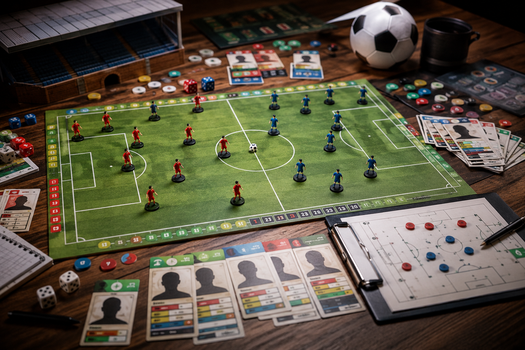
Football fans are used to analysing games long after the final whistle. Should the manager have changed formation earlier? Was that expensive summer signing really necessary? Could the full-back have pushed higher? For people who enjoy that side of the sport, a board game can turn those discussions into decisions.
Sports-themed board games have become much more sophisticated than simply rolling dice and moving a plastic player towards a goal. Some put you in charge of transfers and stadium development. Others recreate individual matches through positioning, tactics and risk management. Players who want to explore how different tabletop games work can also turn to https://gamerules.com/, which covers rules and guides for a wide range of board, card and sports games. And a few titles step outside football altogether while preserving the same competitive instincts that make sport compelling.
For supporters looking for something to play between matches, these are some of the best sports-themed board games worth considering.
Superclub: Build a Football Powerhouse
Few football board games attempt to capture as much of club management as Superclub.
Each player becomes the manager of a top-flight club with the objective of turning an ordinary team into a dominant one. That means choosing formations, scouting players, developing youngsters, improving facilities and making decisions in the transfer market. The official game supports two to four managers, with expansions available for larger groups.
The appeal for football supporters is obvious. The game is not only about winning the next fixture. You also have to think several steps ahead. Spending heavily on one player might strengthen the starting eleven immediately, while investing in scouting or training can create benefits later.
That tension feels familiar to anyone who has followed a real club through a transfer window.
Superclub is therefore particularly well suited to groups of football fans who enjoy debating how clubs should actually be run.
Eleven: Football Management for Strategy Fans
If Superclub provides an accessible route into management, Eleven: Football Manager Board Game moves deeper into the administrative side of the sport.
Designed by Thomas Jansen, Eleven places players in charge of developing a football club over a six-week season. Responsibilities include transfers, staffing, sponsorship, stadium improvements and board meetings before attention turns to match day. The game supports one to four players and typically takes around 60 to 120 minutes.
Matches are not disconnected from what happens during the week. Your squad, tactical choices and previous decisions influence what you can do when Friday arrives.
That makes Eleven a particularly strong option for fans of football management video games. Instead of controlling players directly, you live with the consequences of decisions made days earlier.
There is also a solo mode, making it one of the more interesting choices for someone who wants a substantial football-themed game without always assembling a group.
Subbuteo: The Tabletop Football Classic
No discussion of football games on a table would feel complete without Subbuteo.
Unlike management-focused games, Subbuteo puts the physical action at the centre. Players flick miniature footballers around a pitch in an attempt to move the ball, construct attacks and score against their opponent.
The game has survived across generations and remains available in modern editions, including national-team, club and UEFA Champions League sets.
What keeps it interesting is the skill element. Learning how hard to flick a player, how to approach the ball from an angle and how to build a move requires practice. Two experienced players can produce something that feels far closer to a miniature sport than a conventional board game.
For football fans who prefer dexterity to spreadsheets and transfer budgets, Subbuteo remains difficult to beat.
Read Also: EPL: Crouch Predicts Chelsea To Stun Arsenal At Emirates
UND1C1: Football as a Tactical Battle
UND1C1 approaches football from another direction. It is a two-player tactical board game in which each participant acts as a coach and moves a full team represented by chips across the pitch.
Matches combine positioning with strategy cards, individual player characteristics and tactical choices. According to the publisher, games generally last around 45 to 60 minutes and are designed for players aged 11 and above.
This makes it particularly attractive to fans who spend real matches thinking about space.
Instead of focusing mainly on finances or club infrastructure, UND1C1 asks how you are going to approach the opposition in front of you. Where should players move? When should you commit to an attack? Which tactical card is worth using now rather than saving?
It is essentially the whiteboard in the manager’s office turned into a competitive tabletop game.
Blood Bowl: Football Through a Fantasy Lens
Football purists may raise an eyebrow at Blood Bowl, but that is part of its charm.
Games Workshop’s long-running title takes the structure of a team sport and drops it into the Warhammer universe. The result combines coaching, positioning, dice, player abilities and deliberately exaggerated physical contact.
The current Third Season Edition was introduced in 2025 with revised rules, two teams, a double-sided pitch and an official 200-page rulebook.
It is closer to fantasy American football than association football, but many of the decisions will still feel familiar to sports fans: creating space, protecting important players, taking calculated risks and exploiting weaknesses in the opposition.
It also demonstrates why understanding a game’s system matters. Sports board games can range from five-minute dexterity contests to detailed simulations, and checking resources such as GameRules.com can be useful when exploring unfamiliar board games, card games and sports before deciding what fits your group.
Heat: Pedal to the Metal for Fans of Sporting Strategy
A football fan does not necessarily need a football-themed game.
Heat: Pedal to the Metal recreates motor racing through hand management. One to six players control cars while deciding how aggressively to push their engines, when to manage heat and how to approach corners. A championship system also allows several races to form a season.
The setting may be different, but the appeal is surprisingly similar to football tactics. Going flat out all the time is rarely the best strategy. Players have to judge when to attack, when to conserve resources and when an opponent is vulnerable.
That mixture of planning and competitive tension has made Heat a useful choice for sports fans who want to move beyond football without abandoning the strategic element they enjoy.
Flamme Rouge: Simple Rules, Clever Racing
Cycling game Flamme Rouge offers another good example.
Each player controls two cyclists, a Rouleur and a Sprinteur, attempting to get one across the finish line first. Movement is card-driven, but positioning and exhaustion turn a simple racing concept into a tactical problem. It supports two to four players and usually takes around 30 to 45 minutes.
Football supporters may appreciate how important timing becomes. Attack too soon and your riders can lose momentum. Wait too long and someone else may create an unbeatable gap.
It captures one of sport’s most universal lessons: having the ability to attack is different from knowing when to attack.
Which Football Board Game Should You Choose?
The best choice depends on what part of football you enjoy most.
For transfer-window obsessives and aspiring sporting directors, Superclub and Eleven provide the deepest management experiences. Fans who want to recreate action directly on the pitch should look towards Subbuteo or UND1C1. Blood Bowl is the obvious alternative for groups that enjoy fantasy, miniatures and unpredictable matches.
Heat and Flamme Rouge, meanwhile, show that a sports board game does not need a football licence to appeal to football supporters. Both revolve around timing, competition, positioning and risk — qualities that also decide real matches.
That is ultimately what the best sports-themed board games get right. They do not simply reproduce the appearance of sport. They give players difficult decisions and then make them live with the result.
In other words, they recreate the part every football fan already knows well: believing you could have made the better call.