.svg.png)



























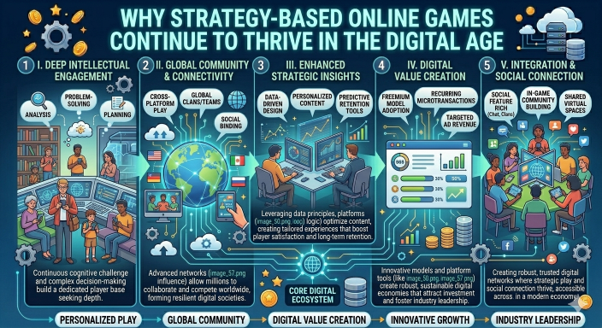
There is a question worth asking about any form of entertainment that has been around long enough to survive significant technological change: what is the thing it offers that other experiences cannot easily replace? For film, it is probably narrative immersion at scale. For live music, it is the unrepeatable shared moment. For strategy-based online games, the answer is surprisingly specific: it is the experience of being genuinely right about something difficult.
That experience — of making a correct assessment in a situation where the answer was not obvious, of reading circumstances accurately and acting on that reading, of understanding a system well enough to navigate it better than someone who understands it less — is what keeps players coming back to strategy-based online games long after the novelty of any particular game has worn off. It is not easily simulated by games built around different principles, and it is not replaceable by passive entertainment of any kind. And it is, quietly, the reason that strategy-based online games have maintained their appeal through decade after decade of changing technology and shifting consumer habits.
The digital age has brought enormous change to how games are made, distributed, and played. But it has not changed what makes strategy-based online games worth playing. If anything, it has made those games more accessible, more connected, and more sophisticated without touching the core experience that drives their enduring popularity. Understanding how and why requires looking at the specific forces that have shaped the genre — and at the platforms that have learned to deliver what serious players actually want.
The Core Appeal: Why Skill-Based Gaming Holds Its Audience
The gaming industry has spent considerable effort over the past decade studying player retention — what keeps players engaged with a game over months and years rather than weeks. The findings, replicated across dozens of studies and billions of player-hours of data, consistently point in the same direction: strategy-based online games retain players at significantly higher rates than games where outcomes are primarily determined by chance or by how much money a player spends.
The reason is not complicated once you examine it. Games where skill determines outcomes create a feedback loop that chance-based games cannot replicate. A player makes a decision, observes the consequence, understands the connection between the two, and adjusts their approach for next time. That cycle of decision, consequence, and learning produces something that psychologists recognize as intrinsic motivation — the kind of engagement that comes from the activity itself rather than from external rewards. Players who experience it keep playing not because the game is pushing them to but because they genuinely want to see how much better they can get.
This dynamic also explains why the communities around strategy-based online games tend to be more substantial and more durable than communities around other gaming categories. When a game rewards genuine understanding, players have real knowledge worth sharing. Strategy forums, tutorial content, discussion of different approaches to common situations — these emerge naturally because the knowledge is real and useful. A player who learns something from a community discussion and applies it successfully has a concrete reason to stay in that community and contribute to it. The collective knowledge base grows over time, which makes the game richer for everyone who engages with it seriously.
Mobile Technology and the Expansion of the Audience
For most of gaming history, strategy-based online games occupied a relatively defined niche. The players who engaged with them seriously were dedicated, knowledgeable, and willing to invest the time and hardware that serious engagement required. The audience was loyal but not particularly broad.
The smartphone changed that in ways that are still unfolding. Mobile technology brought capable computing to people who had never owned gaming hardware and who would not have described themselves as gamers. It put strategy-based online games in the pockets of commuters, waiting room occupants, lunch break fillers — people who had genuine appetite for engaging entertainment but who had never had access to it in a format that fit how they actually lived. What developers discovered when they built serious strategy-based online games for mobile platforms is that this audience was far larger than anyone had predicted.
The Android ecosystem has been particularly important in this expansion. Because Android runs across hardware at every price point, it extended gaming access to markets and demographics that premium devices had not reached. Strategy-based online games optimized for mid-range Android hardware — games that ran smoothly on devices two or three generations old, that loaded quickly on variable network connections, that saved progress reliably so that an interrupted session could be resumed without penalty — found audiences in markets where the gaming industry had previously had minimal presence.
The result has been a dramatic broadening of who plays strategy-based online games. The category is no longer defined by a specific demographic of dedicated enthusiasts. It encompasses players across age groups, income levels, and geographies who share one characteristic: they found a game that genuinely engaged them, and they kept coming back because the experience of improving at something difficult turned out to be worth making time for.
The Particular Value of Traditional Game Formats
Within the broader category of strategy-based online games, those built on traditional game formats occupy a distinctive and particularly strong position. Traditional card games, board games, and other classic competitive formats carry something that newly designed digital games rarely have immediately: a proven track record of genuine engagement.
A traditional game that has maintained a serious player following across decades has done so because it consistently delivers the experience that keeps players engaged — genuine decisions with real consequences, a probability structure that rewards understanding, a competitive environment where the better player tends to win over time. These qualities are not accidental. They are the result of extended real-world testing across many thousands of player-hours, with the elements that did not work gradually falling away and the elements that did becoming more central to what the game is.
When these games move to digital platforms, they bring their tested quality with them. A mobile version of a traditional strategy game is not starting from zero on player engagement — it is delivering an experience that players already know produces the kind of satisfaction that keeps them coming back. That head start on proven engagement is a significant advantage in a market where most new digital games spend months or years discovering whether their design actually works at scale.
The digital transition also adds something genuinely valuable to these traditional formats: it removes the practical barriers that once limited who could play them. Games that required specific opponents in specific locations, physical materials that could be lost or damaged, familiarity with rules that were difficult to learn without guidance — all of these constraints dissolve when the game moves online. The strategic core travels intact; the friction disappears.
Bola Tangkas in the Digital Era
Bola tangkas offers a clear illustration of how a traditional strategy game can maintain its essential character while expanding its reach through digital platforms. The game is built on five-card draw poker mechanics — players receive a hand of cards and make decisions about which to hold and which to exchange in pursuit of the strongest achievable combination. The mechanics are accessible to a new player within a single session. The strategic depth is genuine and substantial.
The decisions bola tangkas presents require real probability reasoning. Assessing which cards to hold means estimating the likelihood of achieving different hand combinations from the current position, weighing the value of a certain lesser outcome against the uncertain possibility of a stronger one, and making consistent choices based on principles rather than impulse. Players who develop their understanding of the game’s probability structure perform measurably better over time than those who play by feel alone. That consistent, measurable relationship between understanding and performance is the foundation of the game’s strategic credibility.
Bola tangkas also carries the cultural weight that comes from genuine community embedding over a long period. For Indonesian players, this is not simply a game available on a platform — it is a gaming tradition with real history, a community with accumulated knowledge and competitive culture, and an experience that connects contemporary play to decades of serious engagement by players who took the game seriously enough to develop real expertise. That cultural continuity gives digital bola tangkas a depth of meaning that newly designed games cannot manufacture.
Tangkasnet: Delivering Strategy-Based Online Games with Integrity
Tangkasnet has built its reputation within the Indonesian bola tangkas community by taking the right things seriously. The starting point was always the game itself: the mechanics had to be authentic, the probability structure had to be correct, and the relationship between skill and outcome that experienced players had developed expertise in through physical play had to be preserved in the digital format. Experienced players are not easily fooled by superficial similarity. They know the real game, and they will reject quickly any digital version that gets the strategic core wrong.
The platform’s approach to strategy-based online games reflects a clear understanding of what this audience values. These are players who are not looking for a game that makes them feel like they are winning regardless of how they play. They are looking for a genuine competitive environment where the quality of their decisions actually matters. Tangkasnet delivers that environment — which is why it has earned the trust of players who have been playing bola tangkas seriously for years and who have no patience for platforms that compromise on the authenticity of the experience.
Mobile performance has been a consistent investment area because it directly affects the quality of the strategic experience. Strategy-based online games require a level of attention and decision-making that is disrupted by poor performance. A connection that drops during an active round, an interface that lags during card selection, a loading time that fragments the session — these are not minor inconveniences for a player trying to make careful, considered decisions. They break the concentration that serious strategic play requires, and they erode the trust between player and platform that is essential for sustained engagement.
The breadth of device support tangkasnet maintains reflects an understanding of who its players actually are. Indonesian players access strategy-based online games predominantly through Android smartphones, and the hardware range in active use is wide. A platform that optimizes only for current flagship devices effectively excludes experienced, engaged players whose hardware is a few years old. Consistent, reliable performance across the real device range — not the aspirational device range — is what makes a platform genuinely available to the community it serves.
Community and the Social Dimension of Strategic Play
Strategy-based online games generate a particular kind of community — one built around genuine knowledge rather than simply shared enthusiasm. When a game rewards understanding, the players who develop that understanding have something real to contribute to others. The experienced bola tangkas player who explains why a particular holding decision is correct in a given probability situation is providing something concretely useful. The player who receives that explanation and applies it successfully has a reason to stay engaged with the community and to contribute what they learn in turn.
This knowledge-building quality of strategic gaming communities produces a level of community durability that other gaming categories rarely achieve. Players who are embedded in communities built around games they are genuinely developing expertise in have multiple reasons to stay: the game itself, the competitive relationships they have built, and the accumulated knowledge they have access to through community participation. Those layers of investment compound over time into the kind of loyalty that sustains platforms through the inevitable fluctuations of the gaming market.
For bola tangkas specifically, the online community extends a social tradition that was always central to the game. Physical bola tangkas was played in social settings where players interacted, observed each other’s decisions, and built relationships around shared engagement with the game. Online communities maintain this social dimension in a different form — the medium has changed, but the function of shared engagement around a game worth taking seriously has not.
The Technology Enabling the Next Phase
The conditions supporting strategy-based online games continue to improve. Network infrastructure is expanding — 4G coverage is reaching more of the regions where gaming appetite is strongest, and 5G is beginning to reduce the latency barriers that matter for real-time competitive play. Hardware capabilities are advancing with each generation of mid-range Android devices, narrowing the gap between what premium and budget hardware can deliver.
Artificial intelligence is beginning to reshape the single-player dimensions of strategy-based online games in meaningful ways. Adaptive AI opponents that respond to individual player tendencies and maintain genuine strategic challenge across different skill levels represent a significant improvement over static difficulty settings. For players developing their understanding of games like bola tangkas outside of competitive play, opponents that actually force growth — that present situations the player has not encountered before and cannot handle with existing approaches — are substantially more valuable than opponents that simply follow predictable patterns.
Cloud infrastructure is developing in ways that could eventually make device specifications largely irrelevant for mobile gaming. If processing happens on remote servers and streams to the device, the question of whether a specific phone can run a specific game cleanly becomes less pressing. For markets where hardware upgrade cycles are long, this could extend the reach of rich strategy-based online gaming experiences to players whose devices currently limit what they can access.
An Audience That Will Keep Growing
Strategy-based online games thrive in the digital age for reasons that are not going to change. The experience they offer — genuine decisions with real consequences, skill that develops over time and produces better outcomes, competition that rewards understanding rather than luck — addresses an appetite that is broadly human rather than specific to any demographic or era. Players who discover that experience once tend to look for it consistently. Platforms and games that deliver it authentically tend to build communities that last.
Tangkasnet, building on the bola tangkas tradition with a platform designed to deliver that experience well on the devices and connections that Indonesian players actually use, is part of a broader story about what happens when strategy-based online games are taken seriously and delivered with integrity. The game has been worth playing for decades. The digital format has made it accessible to more players than ever before. And the community that has formed around serious bola tangkas play continues to develop the strategic tradition that has always been the game’s foundation.
The digital age has changed many things about how games are made and played. It has not changed what makes strategy-based online games worth playing. It has only made them easier to find, easier to access, and available to an audience that is larger and more diverse than at any previous point in the history of the genre. That is not a trend that is likely to reverse.