























For the Falconets of Nigeria, the task on Sunday is simple enough. They need to beat New Caledonia to keep their tournament alive. The circumstances surrounding that task, however, are what’s more complicated.
Nigeria have collected just one point from their opening two matches after losing 2–0 to Spain and playing out a goalless draw with China PR. That makes Sunday’s meeting with New Caledonia a must-win affair. With Spain already through to the knockout stage and China sitting on four points, the Falconets have left themselves with little room for error in their final Group F fixture.
On paper, facing New Caledonia is also the kind of fixture the Falconets should win comfortably, but the size of that victory could also prove important. A win would take the Falconets to four points. Whether that is enough to finish second will depend on what happens between China and Spain, but Nigeria’s current goal difference means there is a clear incentive to win by as many goals as possible. A convincing result could strengthen their claim to second place if China loses, while also giving them a healthier position in the race among the four best third-placed teams should they finish behind China.
In this piece, Completesports.com’s ALLI FESOMADE examines how Nigeria must approach New Caledonia’s deep defensive structure, secure the victory they need and strengthen their position ahead of the FIFA U-20 Women’s World Cup knockout stage.
Two Teams, Diffrent Stakes
The stakes are therefore rather different for the two teams. For New Caledonia, this tie is the final chapter of their first appearance at the FIFA U-20 Women’s World Cup. The Oceania side arrived in Poland as one of six debutants. China defeated them 5–0 before Spain matched the largest winning margin in tournament history with an 11–0 victory. Those results have not told the entire story of their campaign, particularly the performances of goalkeeper Elizabeth Aben, who made 22 saves against Spain.
Also Read: 2026 U-20 WWC: Aduku Reflects On Falconets’ Draw Against China
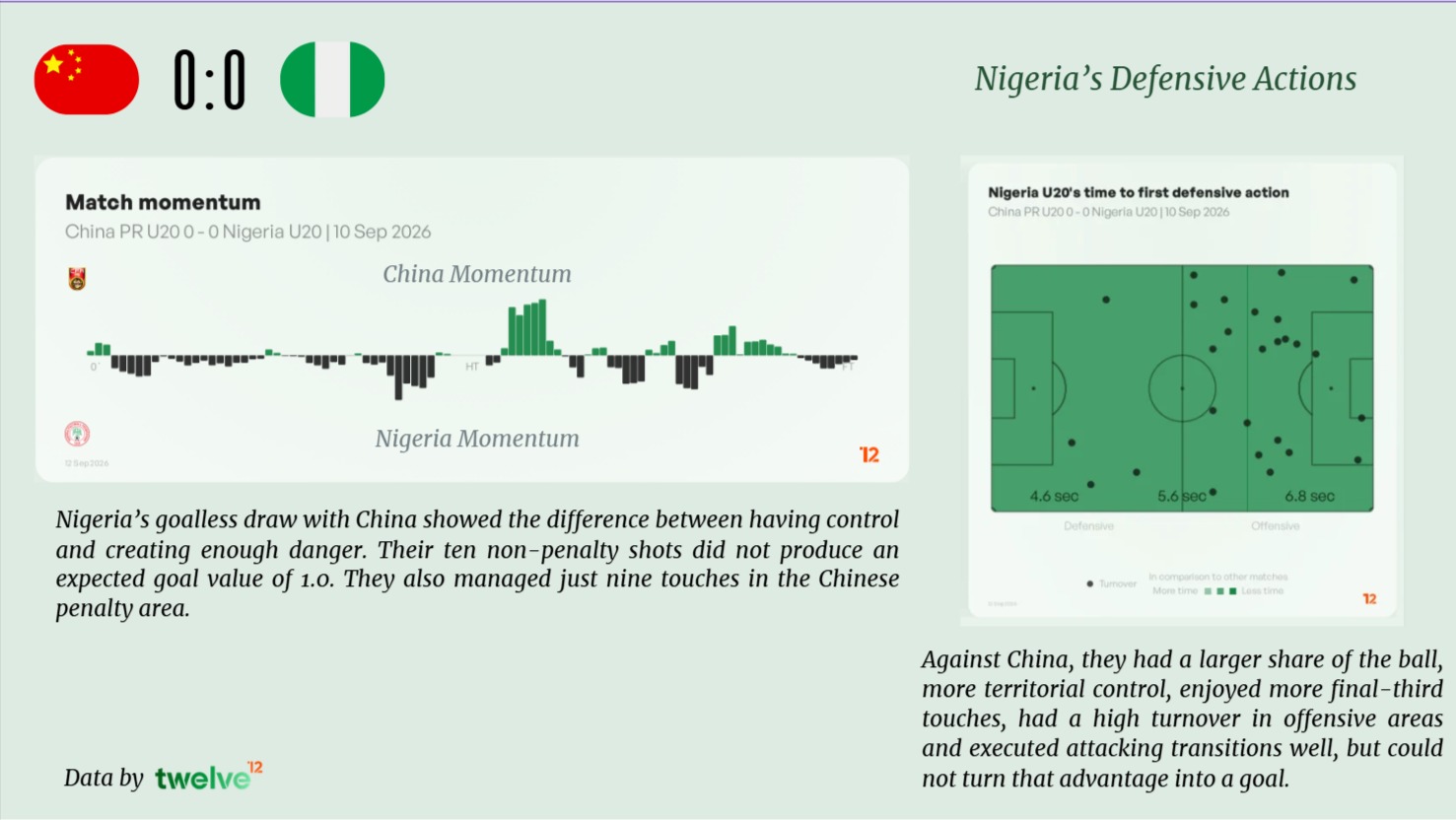
In Nigeria’s case, the Falconets are one of only three teams to have appeared at every edition of the competition since its inaugural tournament in 2002 and have only failed to reach the knockout rounds twice. Against Spain, Nigeria spent much of the game defending without the ball. Against China, they had more possession and territorial control but could not turn that advantage into a goal.
Understanding the Opponent
New Caledonia have spent large portions of this tournament protecting their penalty area, allowing opponents to dictate where the game is played while keeping most of their players between the ball and their goal. That should suit Nigeria, but it also presents the question of whether the Falconets can turn control into penetration.
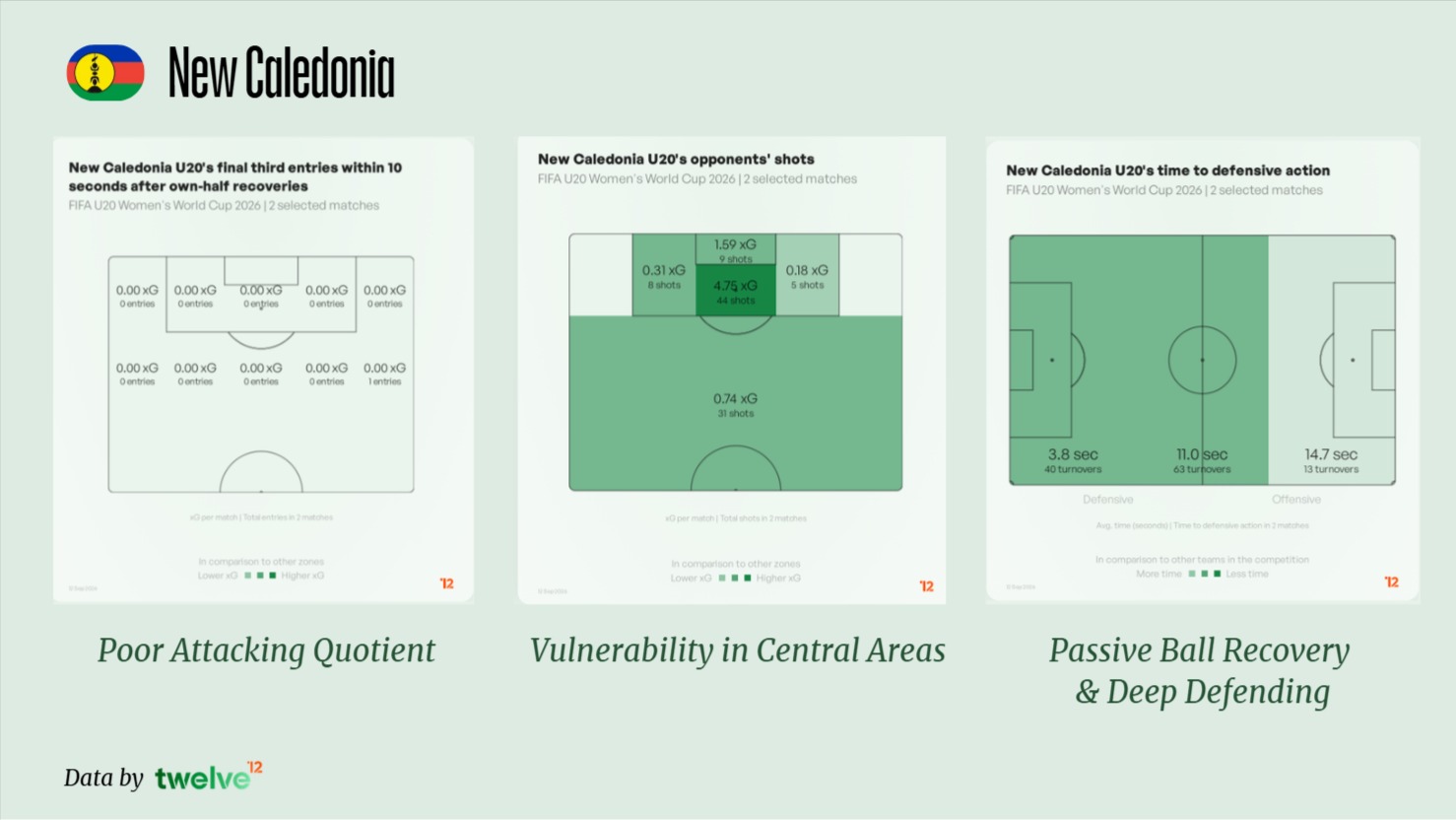
New Caledonia tend to win the ball back so deep inside their half rather than high up the pitch, with defensive actions happening just about twenty metres from their goal. They are happy to give opponents space to pass the ball around in front of them if it means keeping their penalty area protected.
How quickly New Caledonia react after losing the ball depends on where they lose it. When they lose possession while attacking, it takes them about thirteen to fourteen seconds to make their first attempt to win it back, suggesting that their first priority is to retreat and regain their defensive shape. However, if possession is lost in their half, they react much faster, making their first defensive action in under five seconds.
Furthermore, on average, their opponents tend to complete twenty-six passes before New Caledonia attempts a tackle or interception, pointing to a very passive defensive setup and understandably so considering the quality of opposition they have come up against. They often retreated into either a 3-4-3 or a 4-1-4-1 shape, both of which accounted for fifty percent of their playing time across the tournament.
New Caledonia also has a zero percent final-third recovery rate, meaning they have not been able to win the ball back in the opposition’s final third. Therefore, they are not a team that likely wants to chase Nigeria around the pitch and are more likely to wait for the Falconets to come to them. For Nigeria, that means patience could be just as important as speed. Nigeria moving the ball from side to side will not be enough. They will need to create gaps in New Caledonia’s defensive shape and then attack quickly before those gaps disappear.
Where Can Falconets Expose New Caledonia?
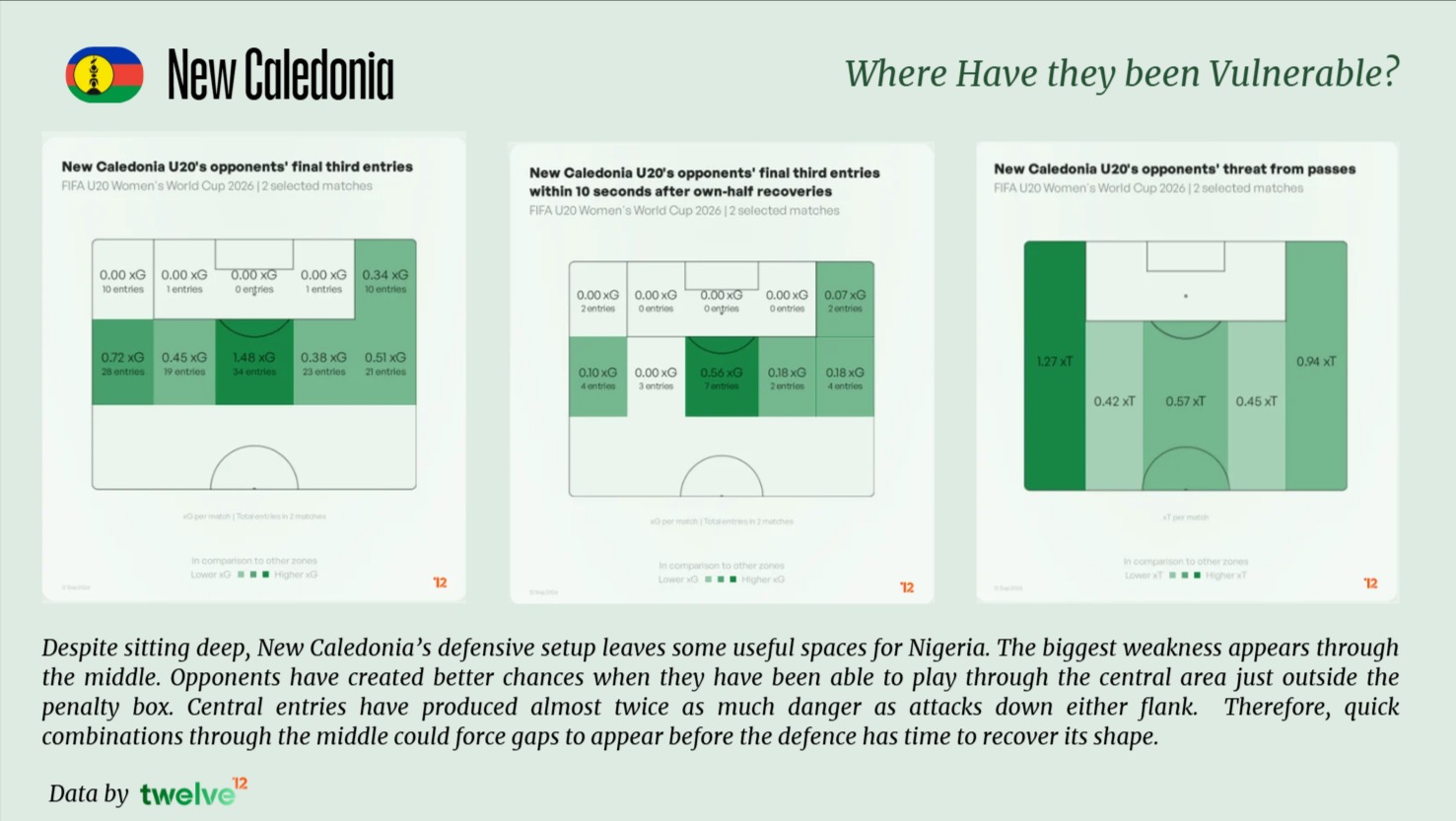
Despite sitting deep, New Caledonia’s defensive setup leaves some useful spaces for Nigeria. The biggest weakness appears through the middle. Opponents have created better chances when they have been able to play through the central area just outside the penalty box. Central entries have produced almost twice as much danger as attacks down either flank. Therefore, quick combinations through the middle could force gaps to appear before the defence has time to recover its shape.
Their right side also appears more vulnerable than the left. Opponents have created more threat from passing moves down that side, compared to the left. About half of the entries into the New Caledonia penalty area have also come from crosses. Nigeria can therefore switch between central combinations and deliveries from wide areas or half spaces rather than relying on one route.
Also Read: U-20 WWC: Benfica Forward Akekoromowei Joins Falconets Teammates In Poland
What Happens When Falconets Loses the Ball?
New Caledonia is unlikely to have the speed or quality to turn many recoveries into dangerous attacks, but Falconets must be careful. They tend to look forward quickly after winning the ball, with about two-thirds of their passes from the middle of the pitch being played forward. They also use long passes regularly, suggesting that their first thought is often to get the ball away from pressure rather than build patiently through midfield.
However, those attacks rarely develop into dangerous situations. Only about ten percent of their recoveries have led to a final-third entry within ten seconds. That should give Nigeria some freedom to commit numbers forward provided the Falconets leave enough players behind the ball to deal with the first pass.
Falconets’ Possession Problem
The bigger concern is actually what Nigeria does with ball possession. Nigeria’s goalless draw with China showed the difference between having control and creating enough danger. Their ten non-penalty shots did not produce an expected goal value of 1.0. They also managed just nine touches in the Chinese penalty area. Contrast that with the game against Spain, where Nigeria had only twenty-three percent ball possession, but their quicker attacks after winning the ball produced five entries into the box within ten seconds of them winning the ball back.
New Caledonia should give Nigeria far more territory than Spain or China did, so the Falconets are likely to spend long periods with the ball. The challenge will be avoiding the same problem they had against China, where control did not lead to enough clear chances. They need to get the ball in and around the box more often, combine around the central area or wide spaces and make their final pass or cross count.
New Caledonia’s Known Strategy
As we wrap up, New Caledonia have shown they can go for long periods by staying deep, but that approach has not brought them any points or helped their goal difference.
The debutants would likely be happy with one point from this game and talk about three if they can pull off a heist. It is Nigeria’s Falconets that should find those openings early and keep attacking them.
With their tournament on the line, this is a game where possession and their expected control of the match must turn into better chances, while hoping the factors they no longer control align. Nigeria can do their part by finding the goals needed to give themselves the best possible chance of staying in the competition.