










































































































































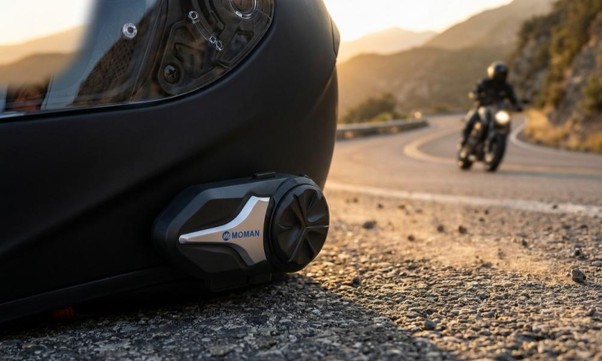
A mesh motorcycle intercom lets riders talk in a group without relying on a phone signal or a fixed group leader. Instead of maintaining one connection path, compatible units create a flexible communication network that can adapt as riders move closer together or farther apart.
This makes a mesh motorcycle intercom especially useful for touring groups, club rides, off-road trips, and rides where the group naturally spreads out. It can make communication easier, but riders should still understand how the technology works and when it is the right choice.
Source: Moman
What is a mesh motorcycle intercom?
If you are wondering what a mesh motorcycle intercom is, it is a wireless communication method in which each connected headset can help pass audio through the group. The connected riders form a network rather than depending on one central device to manage everyone.
For example, imagine five riders traveling in a line. If the first and last riders are too far apart for a direct connection, the riders in the middle can help carry the signal between them. This can maintain communication over a larger and less predictable riding formation.
The exact range still depends on terrain, weather, rider position, interference, and the design of the headset. Buildings, hills, dense trees, trucks, and sharp turns can all affect wireless performance.
How does it differ from traditional Bluetooth intercoms?
A traditional motorcycle intercom often connects riders in a fixed pairing order. It may work well for a rider and passenger or a small group that stays close together.
Mesh systems are designed for more flexible motorcycle mesh communication. When one rider leaves the group or moves temporarily out of range, the remaining riders can often continue talking without manually rebuilding every connection.
Once the rider returns to range, some systems can reconnect automatically. This is useful during fuel stops, missed turns, or rides where people change their position in the group.
However, not every Bluetooth intercom supports true mesh communication. Check the product specifications instead of assuming that any multi-rider headset can create a self-adjusting network.
Why do riders choose mesh technology?
The main advantage is convenience for groups. Riders do not have to stop and pair every headset again when the group changes shape.
Mesh can also make ride communication feel more natural. Instead of waiting for a push-to-talk response, riders can share short messages about hazards, turns, road conditions, or rest stops as they happen.
A motorcycle intercom with full-duplex communication is particularly useful when a rider and passenger need to talk naturally. For larger groups, mesh can add the flexibility needed when riders are not always traveling side by side.
The technology is not only for large clubs. Two or three riders who take long trips on winding roads may also appreciate easier reconnection and less setup.
What should you look for in a mesh intercom headset?
A mesh intercom headset should be evaluated as both a communication device and a piece of riding equipment. Group capacity and advertised range matter, but they are not the only features that affect real-world use.
Consider the following before choosing one:
- Group capacity: Check how many riders can join the mesh network at one time.
- Connection stability: Look for automatic reconnection features and real-world feedback on performance around turns or obstacles.
- Voice quality: Wind-resistant microphones and clear speakers help riders communicate without turning the volume too high.
- Battery life: Confirm whether the quoted battery time applies to intercom use, music, or standby time.
- Controls: Large buttons or a glove-friendly dial are easier to use than small controls.
- Helmet compatibility: Make sure the speakers, clamp, adhesive mount, and microphone fit your helmet style.
- Audio priorities: Decide whether you need simultaneous navigation, music, phone calls, or intercom communication.
The best motorcycle mesh intercom is not always the one with the longest advertised range. A simple, stable system that fits your helmet comfortably and supports your normal group size may be the better choice.
Related: Top 10 AI Photo Enhancers In 2026: Free vs Paid Tools Compared
Can every helmet use a mesh intercom?
Most riders do not need to buy a new motorcycle helmet with mesh intercom built in. Many standalone units attach to the outside of a full-face, modular, open-face, or adventure helmet with a clamp or adhesive mount.
Inside the helmet, thin speakers sit in the ear pockets, while a boom or wired microphone is placed near the mouth. Installation is usually straightforward, but speaker placement is important for voice clarity and comfort.
A motorcycle helmet mesh intercom may also refer to a helmet sold with its communication system already integrated. This can provide a cleaner appearance, although it may limit your ability to change brands or upgrade the unit later.
Before buying, check whether your helmet has speaker recesses, enough room for wiring, and a shell edge that supports the chosen mounting method.
Use mesh communication safely
Mesh communication should support the ride, not distract from it. Keep messages short and focused on useful information such as hazards, route changes, fuel stops, or rider check-ins.
Set up pairing, volume, and phone settings before leaving. Avoid changing complicated settings while moving, even if the unit is designed for glove use.
Do not use continuous conversation or loud music to fight tiredness. If you feel fatigued, stop in a safe place and take a break. Keep intercom volume low enough that you can understand speech without making the overall ride louder than necessary.
Is mesh right for your ride?
A mesh system is a strong option for riders who travel in changing groups, cover winding routes, or want fewer reconnection steps during a trip. It is also useful when group members may occasionally drop back, stop, or take different positions in the formation.
For a rider and passenger who always travel together, a standard Bluetooth intercom may already meet the need. For larger groups, a mesh system can offer a more flexible and less frustrating way to stay connected.
Conclusion
Mesh technology gives motorcycle groups a more adaptable way to communicate. By allowing riders to form a flexible network, it can make group coordination easier when distance and riding positions change.
Choose a system based on your usual group size, helmet fit, battery needs, and communication habits. With the right setup and sensible use, mesh intercom can help riders stay connected without taking attention away from the road.