








The 2025/26 Nigeria Women’s Football League (NWFL) regular season never really settled into one predictable pattern. Traditional powers stayed consistent and some teams dominated from the first whistle of the campaign. Others faded badly after strong starts and a few teams survived almost entirely on home form.
Debutants and newly promoted sides once again felt the harsh sting of the premiership. One club in particular spent nearly half of its gametime this season trailing in matches but another league debutant pulled off a miracle that broke many long-standing records in the 36-year history of the league.
Managerial changes also happened and while it helped one team massively, two others were not so lucky as they sank in the deep waters of relegation. Some questions were answered during the regular season. Others will spill into the playoffs and perhaps even into next season.
In this piece, Completesports.com’s ALLI FESOMADE thoroughly explains the numbers, trends, turning points, and performances that powered the 2025/26 NWFL regular season through 11 major storylines from across the league.
#11 — Rampant Early & Late Goals
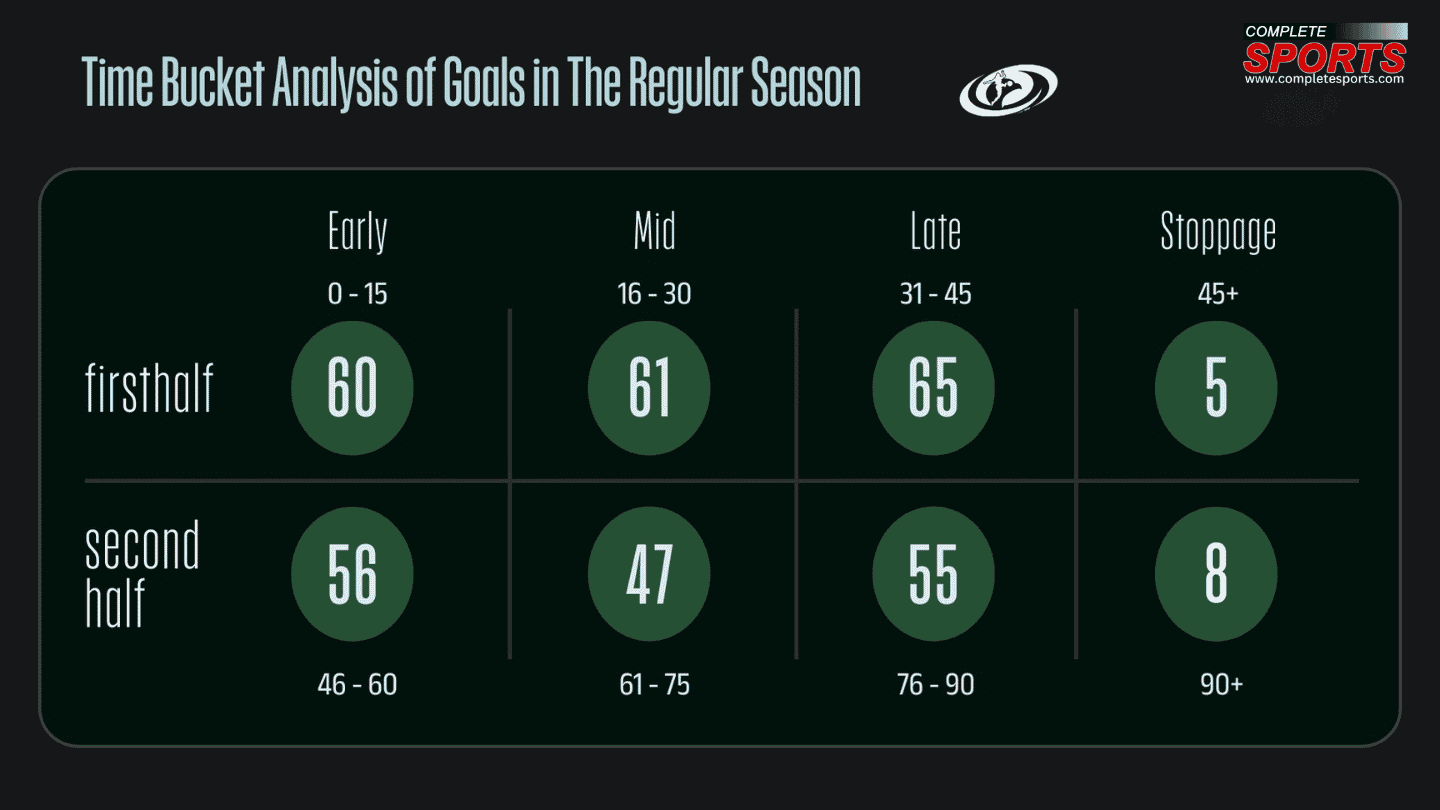
The busiest scoring window in the entire league was the final 15 minutes of the first half. A total of 65 goals arrived between the 31st and 45th minutes, more than any other time period this season.
Looking broadly at when the goals were coming in, the first halves produced 192 goals, excluding walkovers. This is the highest tally over the past three seasons and is understandable given a significant increase in the number of games played.
This season, the teams scored 60 times in the opening fifteen minutes, 61 times in the following fifteen and 5 times in first-half stoppages. Rampant early goals suggested most matches were tilted much earlier but that’s only half the story because late drama also existed.
We started the season with two late match-winners. Blessing Ilivieda scored late to give the defending champions, Bayelsa Queens, their first three points of the new campaign. Elsewhere, Ajoke Akinbo condemned former Flamingos coach Bankole Olowookere to his first defeat with a late goal as Osun Babes face Dannaz Ladies in Lagos.
Across the groups, 63 goals came in the final fifteen minutes and beyond. Pacesetter Queens, Delta Queens, Adamawa Queens and Ekiti Queens all picked up points from late goals. Nasarawa Amazons’ 90+5-minute match-winner over Dannaz Ladies in Lafia, courtesy of Deborah Onyekachi, is another remarkable example fans may rewatch on the club socials.
Overall, teams started both halves strongly (116 early goals) and closed them even stronger (133 late goals). This storyline says plenty about how NWFL matches were played this season. The games opened up before halftime and when defensive concentration dipped the pressure increased and most teams broke.
Before we move to the next storyline, it might interest you to know that only FC Robo and Rivers Angels did not concede any goals beyond the 75th minute. Relegated Sunshine Queens also conceded only once in the opening 15 minutes of their matches and also once in the final 15 minutes.
#10 — Long Stalemates
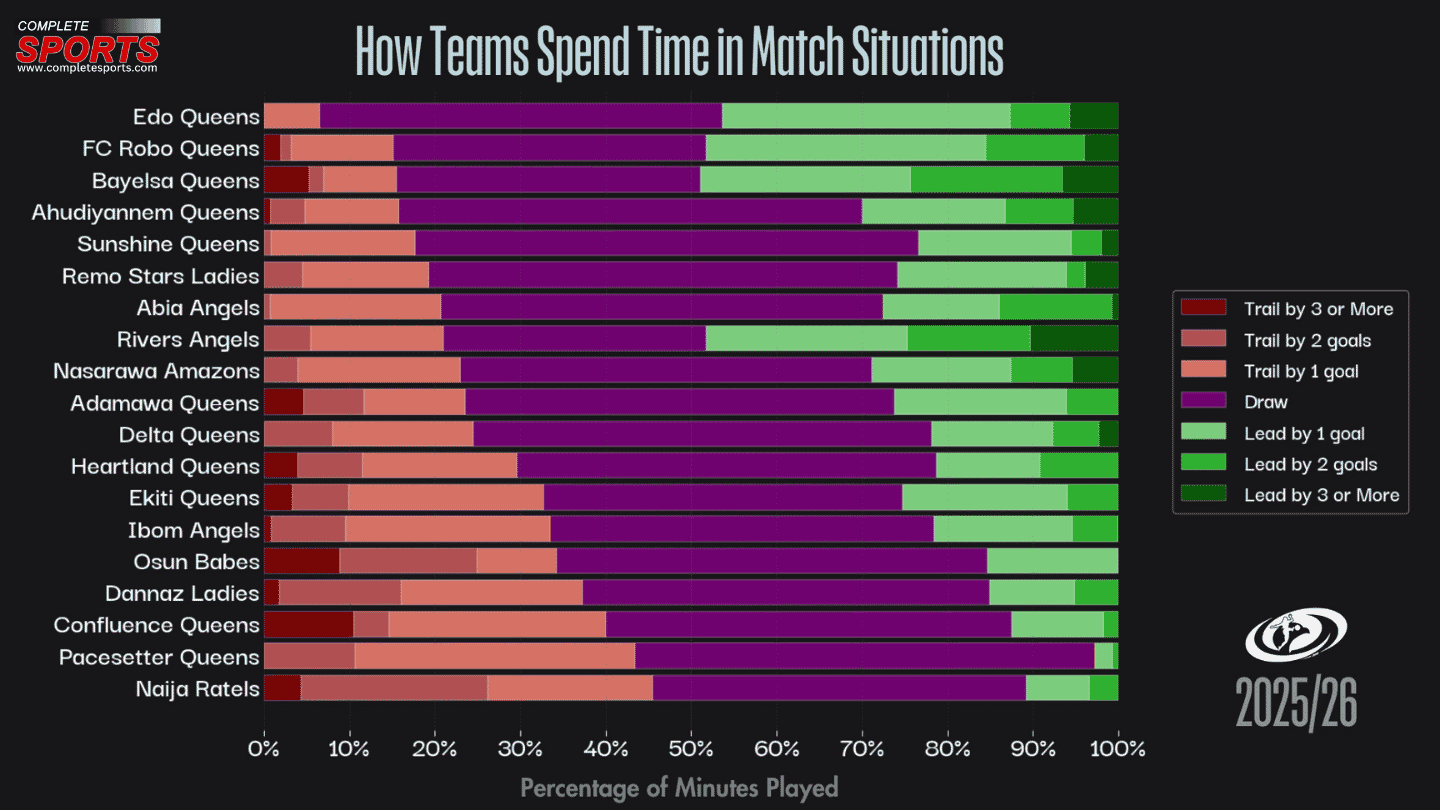
Sometimes, analysing the game state overall can abstract many details, like this one. One interesting pattern observed was that the 2025/26 season was characterised by long stretches of stalemate regardless of team quality. Almost 45 per cent of the clubs spent over 50% of total gametime playing a draw. This happened across all tiers.
Top teams, mid-table teams and relegated teams all had long spells of stalemates. Seventeen (17) goalless draws also added to this metric. This does not automatically mean the football was defensive or tactical. In many cases, it could point toward risk-averse away performances and teams being unable to control game states.
Also Read: EXCLUSIVE: Super Falcons Coaching Eras — Triumphs, Turmoil And Legacy Of Africa’s Queens
If you combine it with the fact that most teams scored early, it shows you just how much action you’d have missed if you had missed the first halves of games played this season. For context, about 41% of matches this season ended as first-half draws and the low number of goalless draws suggests that game state changed often.
#9 — Difficult First Season Trend
Few statistics explain relegation more brutally than the game state distribution. For instance, premiership debutants Pacesetter Queens barely ever led matches. They only had the lead for a combined 39 minutes across all matches played this season. The interpretation of this is that across the 1,440 total minutes played, they were leading for only 2.71% of their campaign. That is astonishingly low and it is therefore no surprise they are relegated.
While it is statistically possible to spend less time in the lead and amass a great point tally, perhaps if the team scored late match-winners and spent an exceptionally high amount of time playing a draw, it is not a practical scenario, especially for a side that scored just seven times all season.
Pacesetter Queens finished with one win, five draws, and ten losses while scoring only seven goals all season. Even more telling, they scored in only six matchdays out of 16 — the second-lowest figure in the league. They further fuel the narrative that the league is often times harsh, cruel and unforgiving to debutants or newly promoted sides.
They join the long, unhappy list of teams like Benue Queens, Saadatu Amazons, Sure Babes, Invincible Angels, Pelican Stars and Osun Babes, among many others, who were relegated within a season of gaining promotion to the premiership.
Like Benue Queens (2024/25), Pacesetter did not have to collapse into relegation; they were positioned for it from the beginning. They simply spent too much time reacting to matches and now, the team that sneaked its way into the premiership has been walked out through the front door.
#8 — Sunshine Queens were Narrowly Relegated Outliers
By midseason, Sunshine Queens had established themselves as the league’s draw specialists and nothing changed even after the second stanza. No team drew more matches than Sunshine Queens, as they finished with seven draws in 18 matches.
But the interesting part is how they got there. Sunshine Queens conceded only 11 goals all season, placing them in the top 5% in the league. At the same time, they scored only 13 goals, one of the poorest returns in the premiership. Even among relegated teams, that number still ranks second.
Also Read: NWFL:Nasarawa Amazons, Abia Angels Clinch Super Six Spots
That balance created a strange season. It is often said and widely believed that defence wins championships, but it takes goals to win matches so the attack has to score first. Having a good defence but poor attack is a difficult reputation to go by.
In a 19-team season, Sunshine’s attack ranked 16th but their defence ranked 2nd. They paired a championship-calibre defence with a relegation-bound attack. This extreme contrast suggests most of their games were low-event football, that their buildups were cautious and their defensive blocks were deep.
The data also reveals that Sunshine Queens often lost narrowly by a margin of one or two goals. One-goal margins made up over 83% of their defeats. Their victories, too, did not deviate from that pattern. The bottom line is, just as they had high tendencies to win when scoring first, they also had high tendencies to lose when conceding first.
Their game state profile explains it even better. Sunshine Queens spent almost 59% of their season playing draws but had a low fighting spirit whenever they went behind. Misturat Olamilekan’s goal within 10 minutes of Similoluwa Okesiji’s 50th-minute opener in the game against RSL was the only equalising goal they managed throughout the regular season.
They also got some managerial changes during the run-in, swapping out Kayode Olujohungbe with Tayo Onilude in an official release reported on April 3. In Onilude’s five-game spell, they fought bravely even with five games to go and three of the top teams still to play. They hauled in 10 points from a possible 15, scoring first each time.
Sunshine Queens secured a final-day victory, but Dannaz’ miracle in Ikenne was one of three results elsewhere that saw them condemned to the Championship once again. It marked a third relegation in five seasons for Sunshine Queens, all of them coming in their first season back in the Premiership.
#7 — FC Robo Red-Hot Portfolio
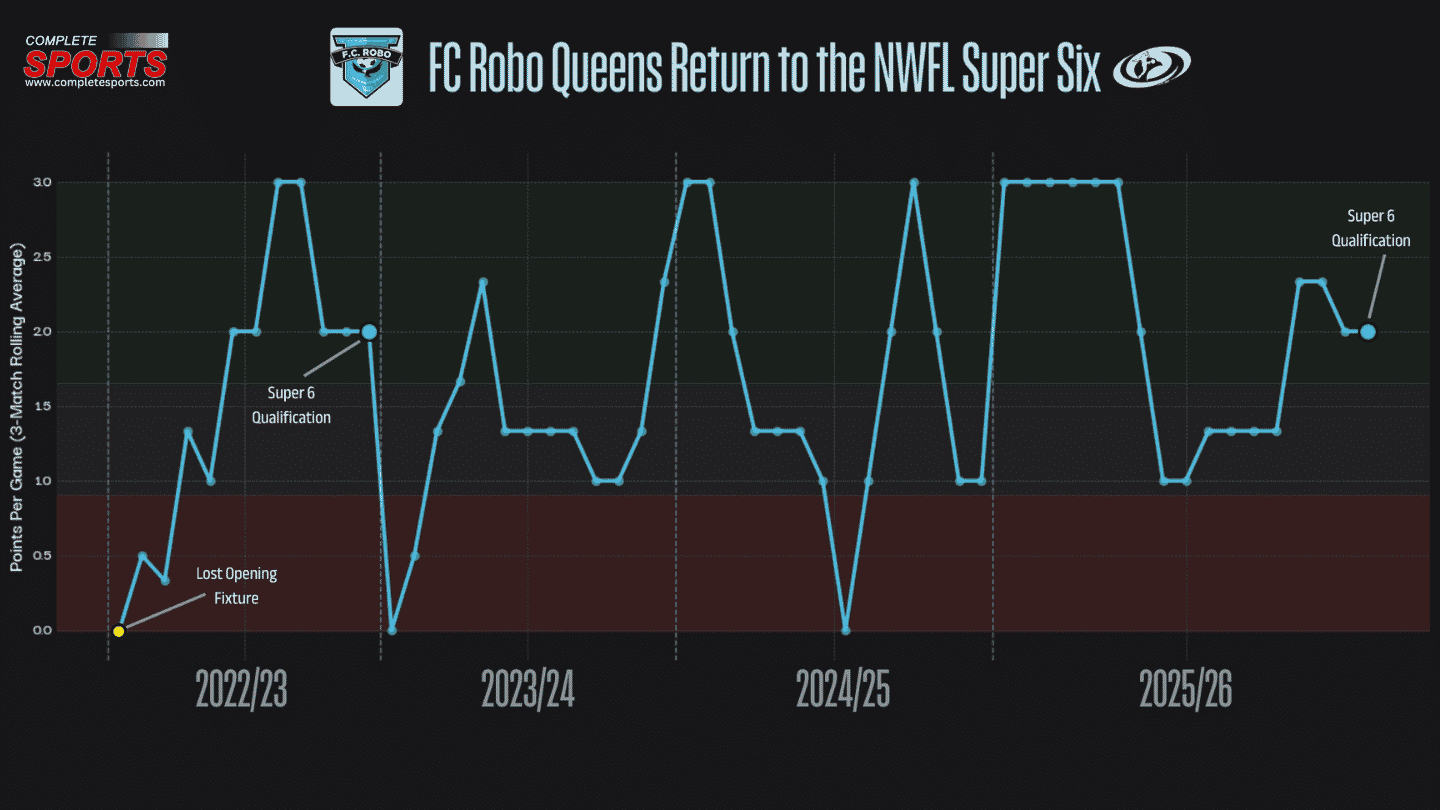
The 2025/26 season marks FC Robo Queens’ first playoff berth since 2023. After a two-season absence from the NWFL playoffs, FC Robo Queens announced their return in grand style with a campaign that showed remarkable balance across both sides of the ball.
Offensively, Robo Queens were among the league’s most dangerous outfits. Their 29 goals scored placed them in the 84th percentile of all teams, tied for the second-highest tally in the league. Only champions Bayelsa Queens found the net more often than they did. A strong +1.33 attacking z-score meant they performed significantly above the average team in the league across both groups.
But where many high-scoring teams sacrifice defensive solidity, FC Queens refused to compromise. They conceded just 13 goals all season, ranking fourth in the league and comfortably in the 73rd percentile. Data positions them as one of the league’s most entertaining sides, playing aggressive attacking football. FC Robo are, however, slightly defensively weaker than other top-title calibre teams.
The most telling statistic, however, lies in how they spent their match minutes. FC Robo Queens led for 48.2% of their total gametime. That’s nearly half the entire season spent in winning positions. Only two teams boasted a higher share of gametime. FC Robo also exhibited good game control. They trailed for just 15.2% of their minutes, the second-lowest among playoff contenders.
FC Robo Queens also built the meanest home ground in the League. Eight wins from eight home games and only one goal conceded while scoring 15. The Lagos Landladies taxed all visiting teams and issued no receipts.
The most impressive part of FC Robo’s campaign was not in the numbers they posted but in the consistency they displayed. They conceded no goal in seven consecutive home games before Ayatsea Hembafan finally broke the streak late in the campaign. FC Robo also sat at the top of Group B for 17 consecutive gameweeks. It was the longest run in any position across both groups, followed closely by Pacesetter Queens, who spent the first 10 weeks bottom of the league.
#6 — Naija Ratels Eventual Collapse
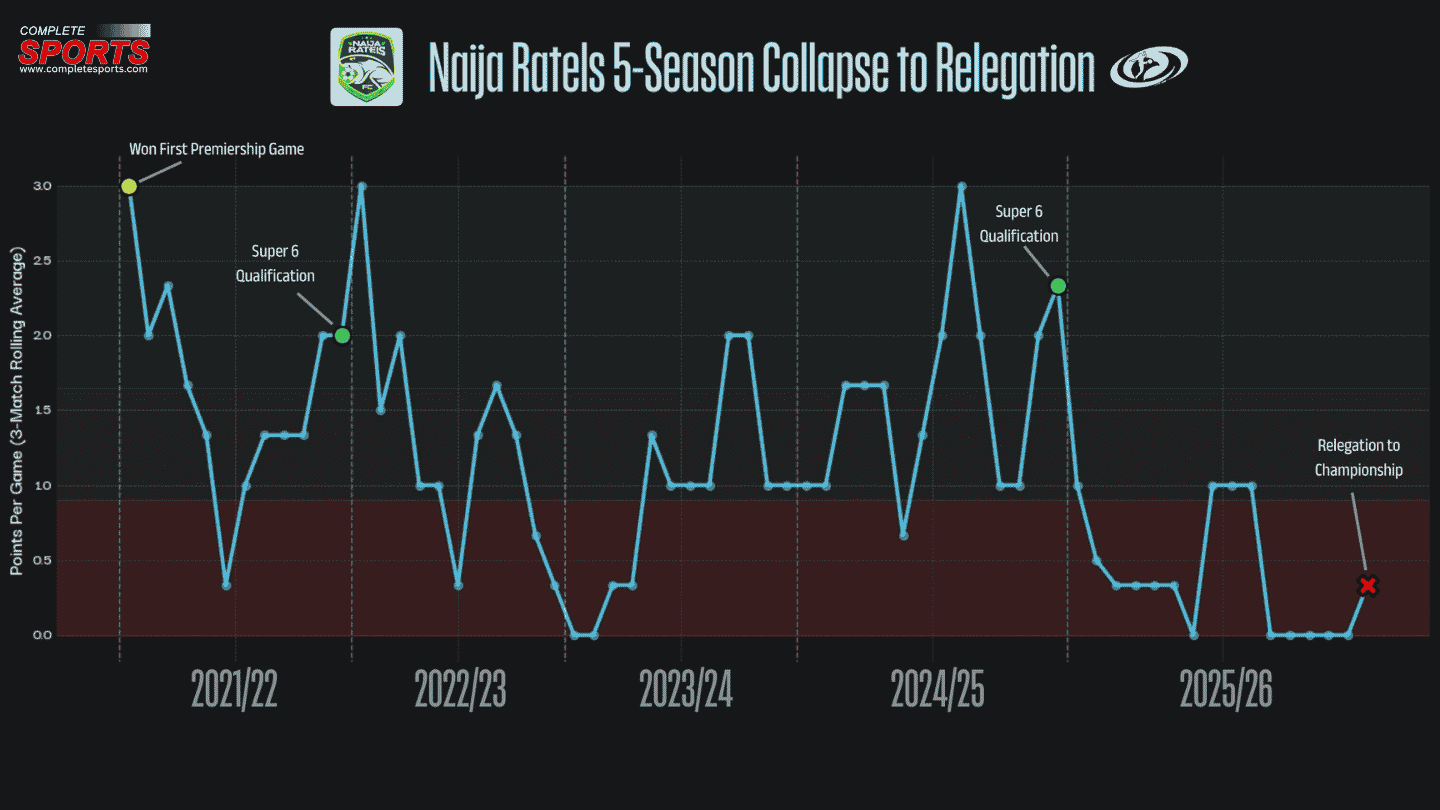
Five seasons after entering the top flight, the Ratels project hit its lowest point. It would be difficult to tag the decline of Naija Ratels as a single catastrophic season or a sudden implosion. The data suggests it was a slow and steady demise spread across five years but hastened by poor transitions.
When Naija Ratels first entered the NWFL Premiership in the 2021/22 season, they arrived with great promise. They finished their debut campaign with a respectable 1.50 points per game, averaging 1.58 goals per match. For a newly promoted side, they were competitive and dangerous and looked like they belonged in the premiership. They even made it to the Super 6 tournament that year. This was the best of all five years spent in the top-flight.
Across the next four seasons, their attacking output and points return began to shrink and the numbers began to tell a story of gradual decay. By 2024/25, their goals per game had dropped to 1.36 and that was still good enough at the time because it helped leapfrog FC Robo into the playoffs in Ikenne.
This season, everything collapsed. They could only manage 0.38 goals per game and 0.38 points per game, a relegation-worthy output. At the same time, their defensive strength collapsed completely. They conceded 33 goals in 16 matches this season, averaging over two goals per game. Then came the seven-game losing streak that effectively buried them. That losing streak that ran from March to April put the final nail in their coffin.
By the end of the 2025/26 campaign, Naija Ratels had spent 45.49% of their season trailing in matches, the highest figure in the league. Nearly half of their season saw them chasing games and when you cannot score and are always chasing, the math is simple.
Managerial decisions like the appointment of Samson Keshi also helped the side last season but like Remo Stars experienced in the NPFL, reports reveal that Naija Ratels have also made poor transitions in the squad changes and have paid the ultimate price.
#5 — Pairing Mismatch Skewed the Competition
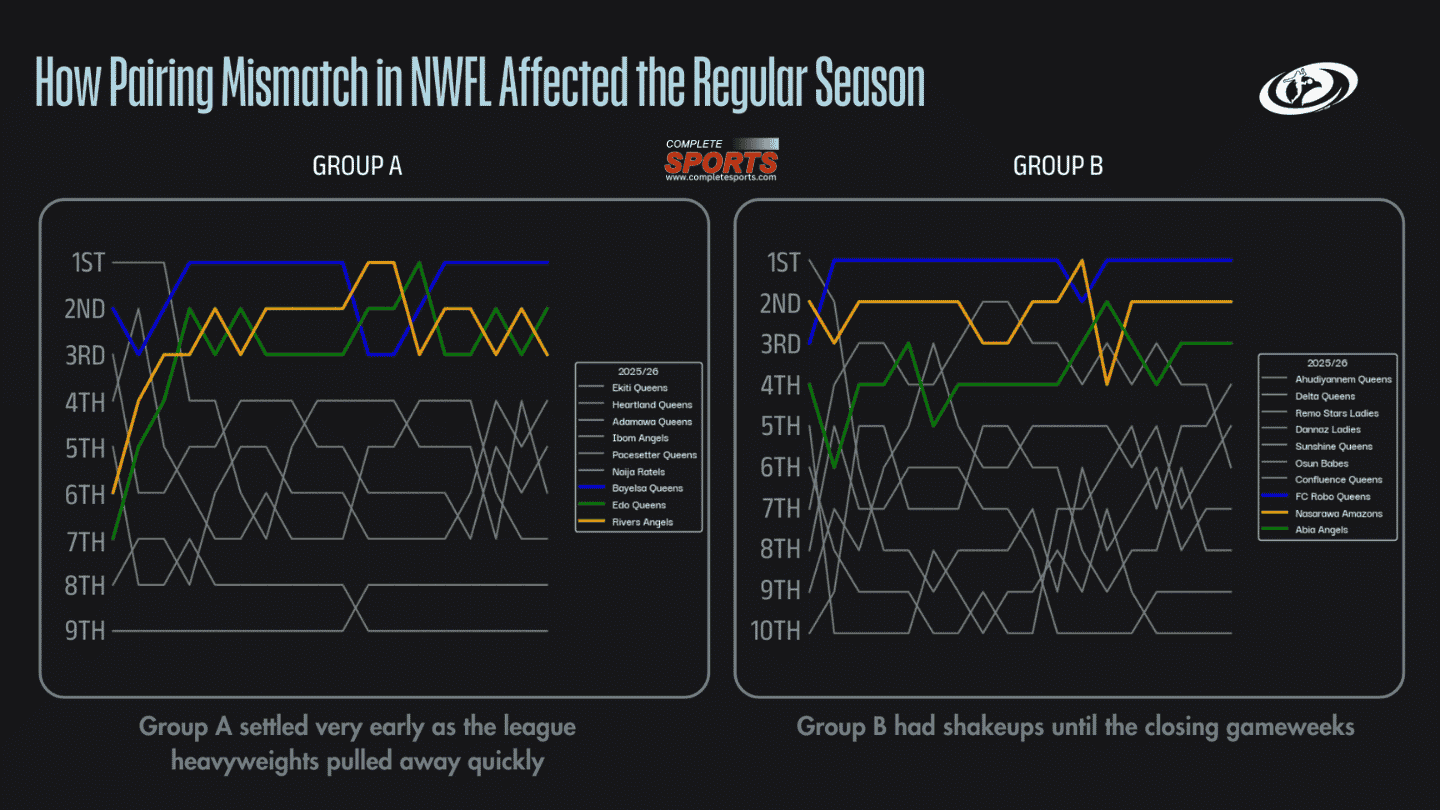
The draws for the league groupings in the regular season are often done randomly and as with all things done that way, sometimes it makes the roster skew left or right. This season, the heavyweights fell in Group A, making it more predictable than Group B. As seen in the standings, the trend chart revealed that Group A settled very early but Group B never really did.
By game week 4, Bayelsa Queens, Rivers Angels, and Edo Queens had already established themselves as the dominant trio in Group A. The gap between the top three and the chasing pack also suggests this mismatch, as it widened quickly in Group A before settling at 12 pts, whereas after GW18 in Group B it was only 3 pts.
From there, they mostly exchanged positions among themselves while the rest chased from behind. The mid-table teams were also clustered early while Naija Ratels and Pacesetter Queens tussled for the window seat in their religious relegation flight.
Group B had all the fun and kept fans on the edge of their seats. Remo Stars Ladies, Abia Angels, Ahudiyannem Queens, Delta Queens, and Dannaz Ladies all moved in and out of playoff contention during different stages of the season. That instability made Group B harder to predict every gameweek. It wasn’t until the closing gameweeks when things were finally decided. The playoff spots were settled in the penultimate game week but the survival battle carried on to GW18.
#4 — The League Heavyweights Still Hold the Aces
The league heavyweights Bayelsa Queens, Rivers Angels, and Edo Queens mastered the art of game control, each demonstrating dominance in their own distinct way. Bayelsa and Rivers operated with a ruthless edge and were the best at game control. Across the league, the defending champions spent 48.96% of their season being ahead, while Rivers was a close second at 48.26%, meaning both were leading for nearly half their entire campaigns.
Also, once they scored first in matches, the games were effectively over. Bayelsa won 91.7% of those games, and Rivers had a perfect 100% record. This clinical ability to seize and protect a lead is what separates contenders from good teams.
Bayelsa, in particular, set the standard for balance and was very fluid in goalscoring. They recorded 18 first-half goals and 17 second-half goals, with almost every strike carrying weight. Bayelsa also balanced their late goals, scoring 8 times in the closing 15+ minutes of each half. Only one of their 35 goals can be deemed a consolation.
Edo Queens conceded just 11 goals in 16 matches but that’s not even the bombshell. What’s more impressive is how rarely they trailed. Edo Queens spent only 6.53% of their season behind in matches. That’s equivalent to about 94 minutes all season.
That is absurdly low over an entire campaign but it’s not the first time Edo Queens would do such a thing. In the 2024/25 season, out of 1,260 minutes played, Edo Queens were only behind for a minute (99.9% of gametime without trailing). Janet Akekoromowei scored an 89th-minute matchwinner in Lafia to break that streak.
Even when they were not spectacular going forward, they stayed stable. This season, they also kept eight clean sheets and produced a six-game winning streak during the middle stretch of the season.
Speaking of clean sheets, the league distribution peaked at around 8 clean sheets. Oloko Fatima and the unrelenting Abia Angels ranked highest with 10 clean sheets (same as relegated Sunshine and Bayelsa). Remo Stars Ladies (5) won the most clean sheets on the road as well. Some mid-table teams like Ekiti Queens (6), Heartland (6) and Delta Queens (5) also had a good number of clean sheets, but the league heavyweights still hold all the cards with 8 and above.
Playoffs are a different beast and these heavyweights set the tone for a massive showdown when the top six teams meet to decide who wears the crown in a marathon round-robin contest.
#3 — Osun Babes Post-Bankole Debacle
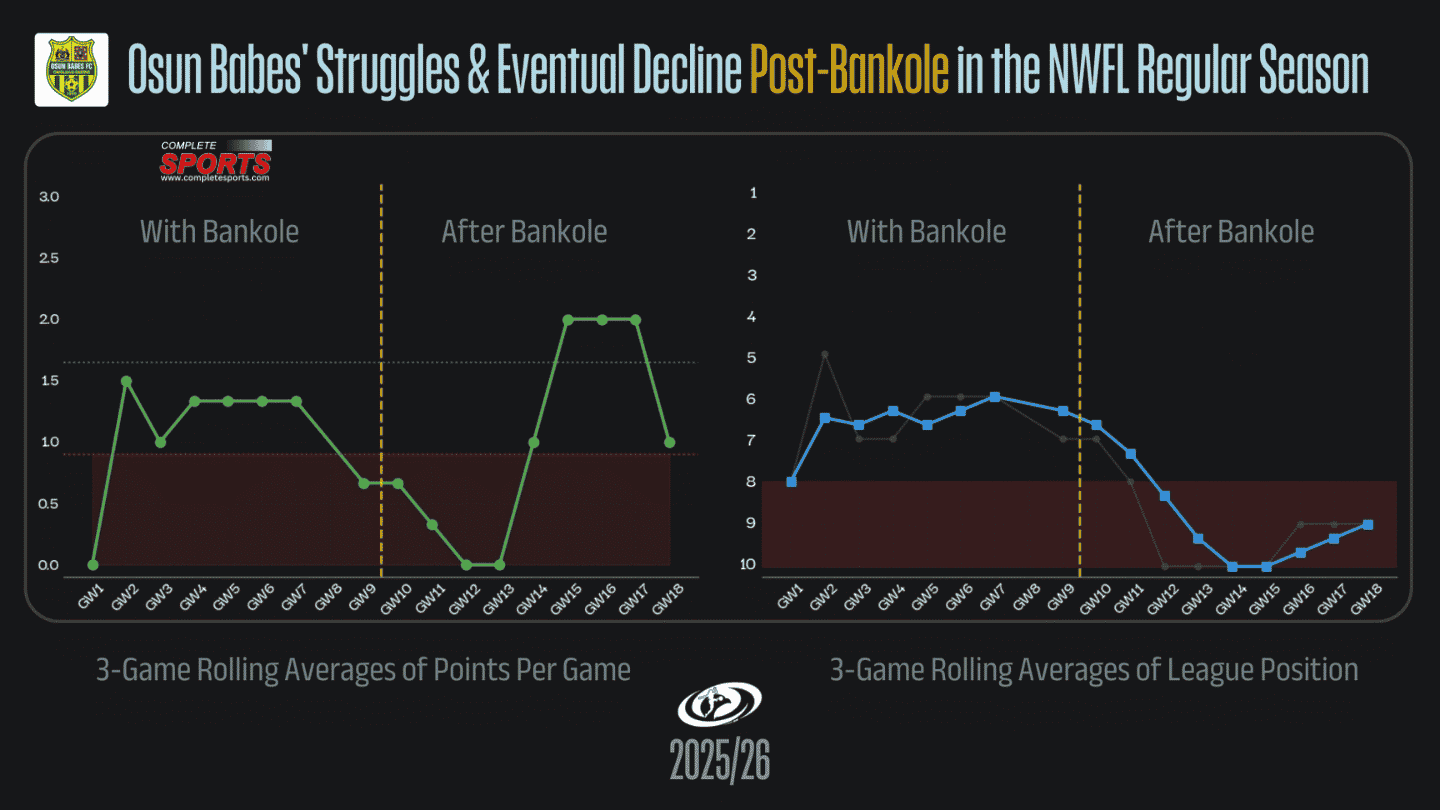
The season changed completely for Osun Babes after the departure of former Flamingos coach Bankole Olowookere. They lost four straight matches during a brutal stretch between March and April. Their PPG dropped below the widely accepted survival threshold to 1.00. Their goals against per game nearly doubled, rising from 1.0 to 1.78. Their clean sheet rate fell from 50% to 33.3% and the goal efficiency plummeted to 0.50.
This is a good place to explain what ‘goal efficiency’ means. For this analysis, some derived terms were used to introduce context to team performance. A meaningful goal is termed any strike that changes the game state, whether it is an equalizer or puts the team ahead for the first time. A consolation goal is the opposite and is often categorised as a goal incapable of changing the result. The goal efficiency score then subtracts your consolation rate from your meaningful rate. So, a positive number means the goals tend to matter, and a negative one means teams are scoring too late to make a difference.
Under head coach Bankole Olowookere, they were not spectacular but they were competitive. Through the first nine gameweeks, they collected 9 points from 8 matches excluding walkovers, posting a respectable 1.12 points per game and having a positive goal efficiency value. After Olowookere’s departure, one in every four goals Osun Babes scored was a consolation.
Post-Bankole, Osun Babes also began spending far more time behind. With him, they only trailed for 23.5% of their match minutes. On his departure, the figure ballooned to 43.8%. They were chasing games they could never really catch. The defence was crumbling and they let in five quick goals away to an unforgiving RSL.
Three wins in nine matches Post-Bankole meant they won just as many points as they did under him (W2D3L4). Also, on the surface, the PPG drop from 1.12 to 1.00 seems small but context matters. Osun Babes were already hovering near the relegation zone even at 1.12 PPG, so dropping to 1.00 pushed them over the edge. In fact, every team that finished below them had a PPG of 0.78 or lower.
The issue becomes clearer if you zoom out a bit. Osun Babes’ season was eventful on and off the field. We have discussed from the on-field perspective so far. Osun Babes entered the Premiership through the back door after narrowly missing promotion in previous seasons. Circumstances became messy along the line as complaints of unpaid wages came out in the news. The club would later be fined ₦2.5 million for something as basic as kit violations. Then, in mid-March when Bankole Olowookere left, the club hierarchy denied receipt of a formal resignation letter and declared their manager had “absconded” from his role.
When you layer these off-field issues on top of the on-field numbers, the picture becomes complete. They simply became dysfunctional and their collapse became immediate and measurable. Osun Babes were not the worst team in the league. But they were not good enough to survive a managerial crisis, unpaid wages, and administrative dysfunction all at once.
#2 — Is There a Home Bias in The NWFL, and How Strong is that Bias?
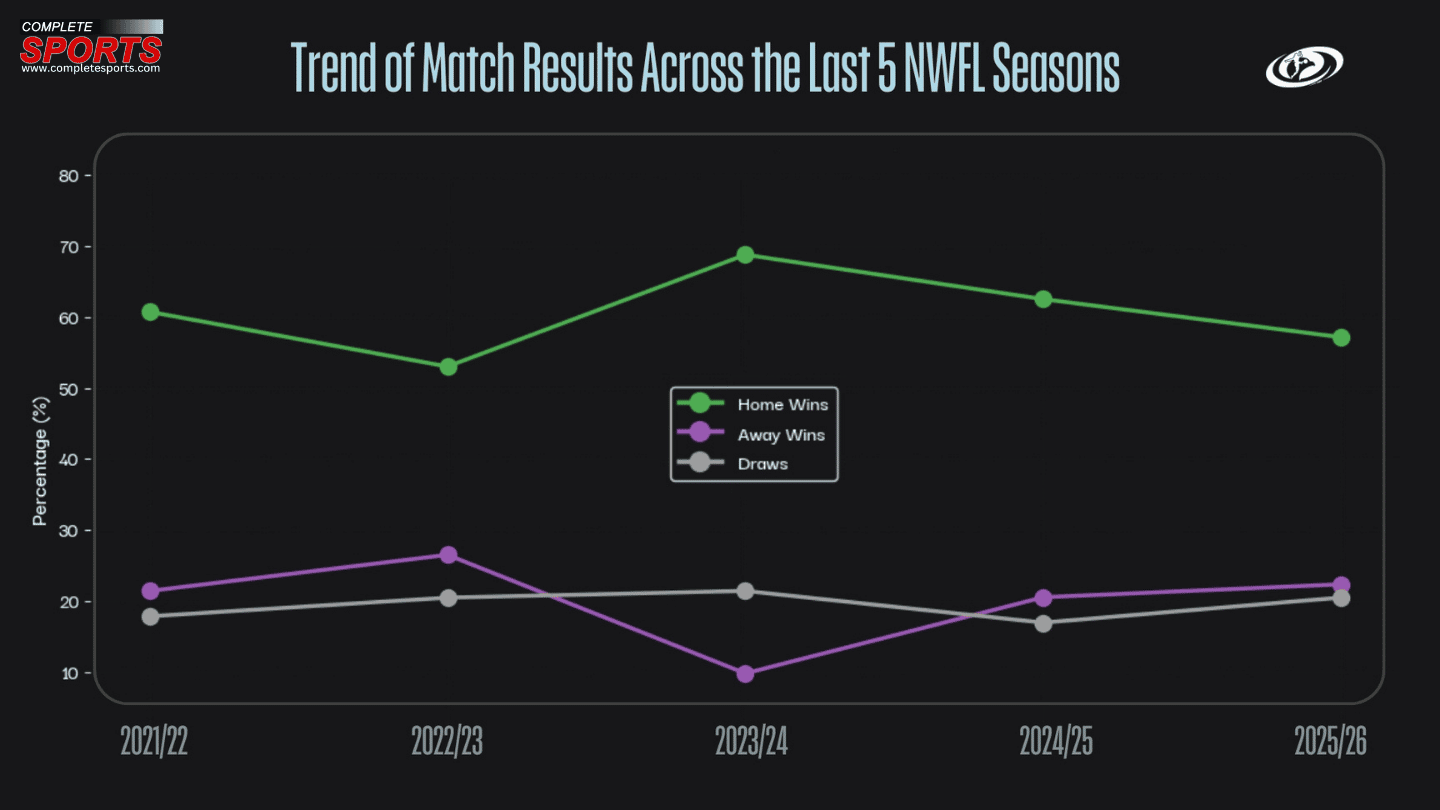
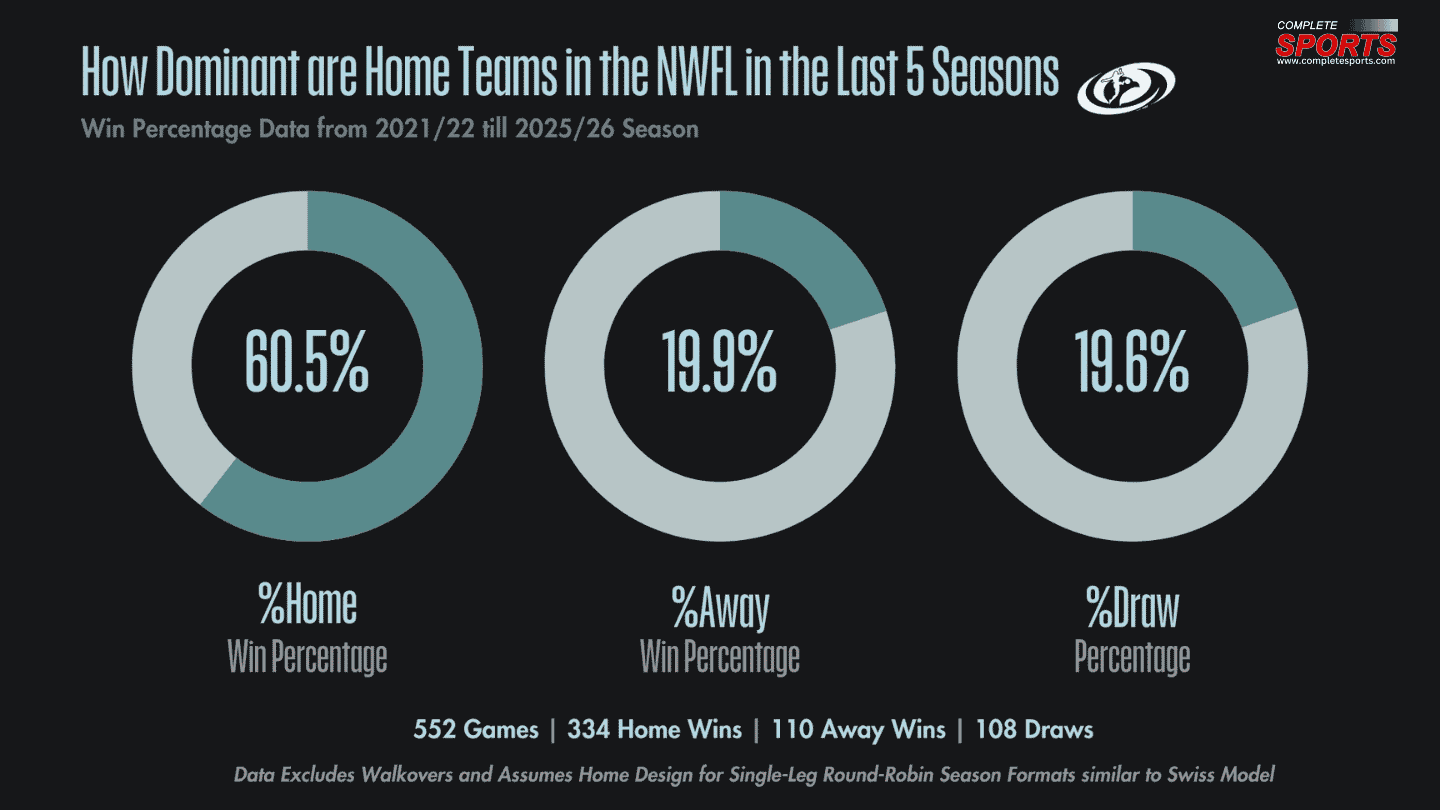
The season also continued one of the clearest long-term trends in the NWFL. Home teams won 57.1% of matches this season, while away sides picked up points in 43.9% of games played (including draws).
Looking across the last five NWFL seasons combined, home teams have won 60.5% of all league matches compared to only 19.9% for away teams. The imbalance became especially severe in 2023/24 when home sides won nearly 69% of all matches while away teams managed fewer than 10% of victories. That can be a troubling margin depending on how you look at it.
The structural reality this season is that the average team collects 63.7% of available points at home but only 28.5% on the road. Teams win more than double the percentage of points at home compared to away, a gap of more than 35%. Therefore, there is evidence that the NWFL has a pronounced home advantage but an additional layer of context is necessary.
The defending champions, Bayelsa Queens, for instance, won every single home match. They scored 21 goals in front of their own fans and conceded just 2. On the road, they collected 13 points, posting a 54.2% away-points percentage. That value is comfortably above the league average, so they were not home-dependent.
The league data this season splits teams into clear cadres. The elite tier like Bayelsa, Edo, Rivers and FC Robo, all boast home points percentages above 90% and points collected away stand above 40%.
The second tier comprised teams whose home records are between 74-85% but collapse away, managing just 12-33% of available points. These teams needed home games to succeed. Nasarawa Amazons, Heartland Queens and Delta Queens fall in this category.
Eastern clubs brought a different story to the league this season, especially in Abia State, where two teams developed contrasting but effective deviations from the usual home-heavy trend. Abia Angels (59% at home and 44% away) posted the most balanced split among playoff contenders, while Ahudiyannem leaned even harder into away form. They were the only side in the league with a stronger away-points percentage (48%) than home-points percentage (44%).
Several teams never won away from home all season. Heartland Queens, Ibom Angels, Naija Ratels, Pacesetter Queens, and Sunshine Queens all stand as examples. Also, teams with home points percentages below 30% (Pacesetter, Confluence Queens, and Naija Ratels) all finished in the relegation zone.
Let us add here that this does not mean the league is not competitive. Looking at the match results across the five seasons, the most common results are single-goal margins. One in every 2.5 games is decided by a single goal and draws occur once in every five matches. Similarly, both teams find the net in just almost 30% of games played.
The narrow margins suggest that while home bias is strong, the actual matches are often tightly contested. In the last five seasons, the data shows that about 61% of the matches are low-scoring (between 0-2 goals), which further supports the competitiveness argument.
The assessment here is that, even with the home bias, we witnessed small signs of progress this season. Away teams won 36 matches compared to the 23 from 2024/25 and far above the 11 recorded in 2023/24. For now, the gap remains large and the NWFL remains a league where home games are essential.
#1 — Adanna Nwaneri’s Relegation Heist with Ahudiyannem Queens
The top spot in this piece spotlights a league debutant who beat all the odds and pulled off the most remarkable turnaround in NWFL history. It belongs to a coach who walked away from her own creation, joined a sinking ship, and dragged it from the bottom of the table to within three points of the playoffs.
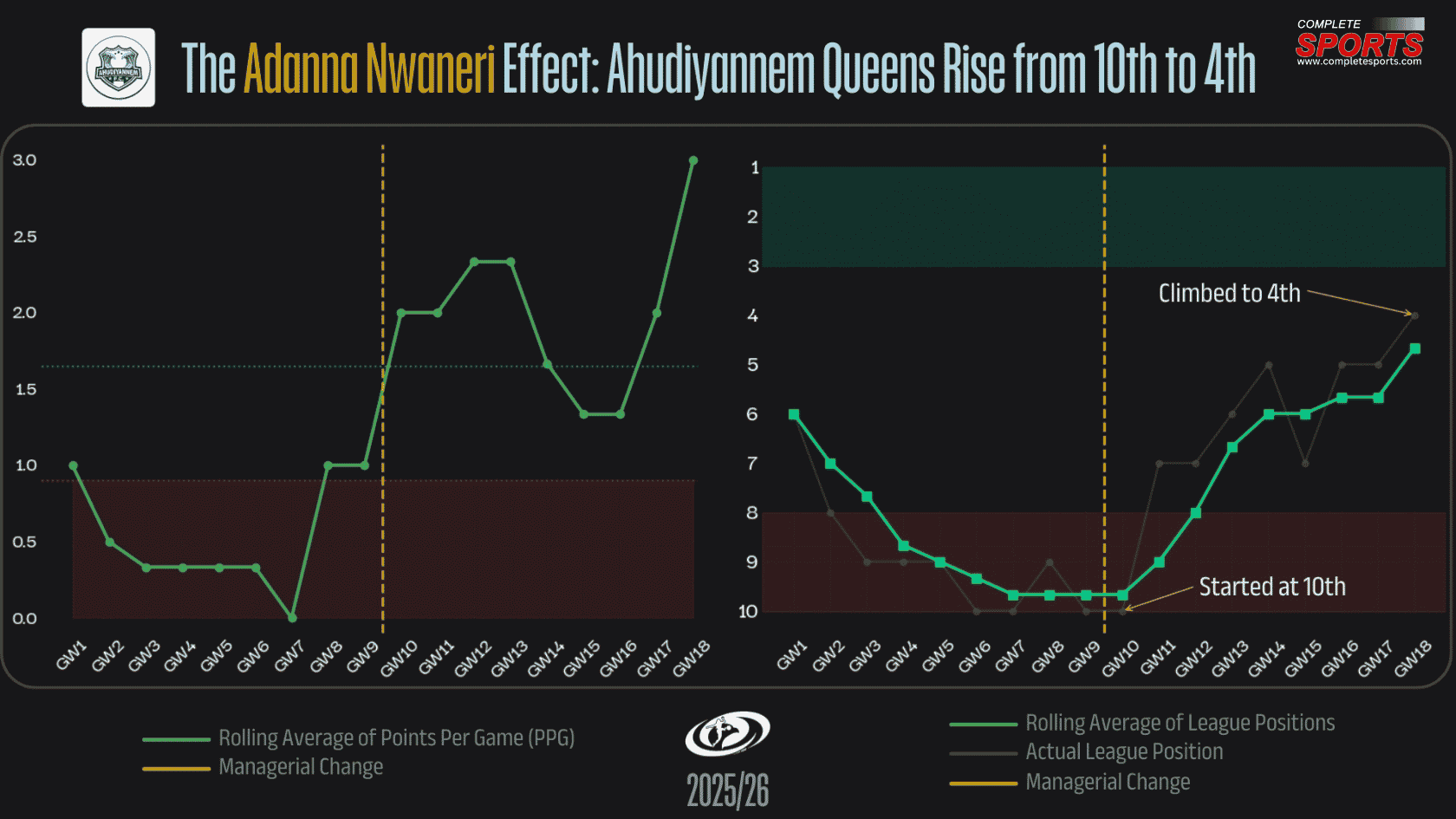
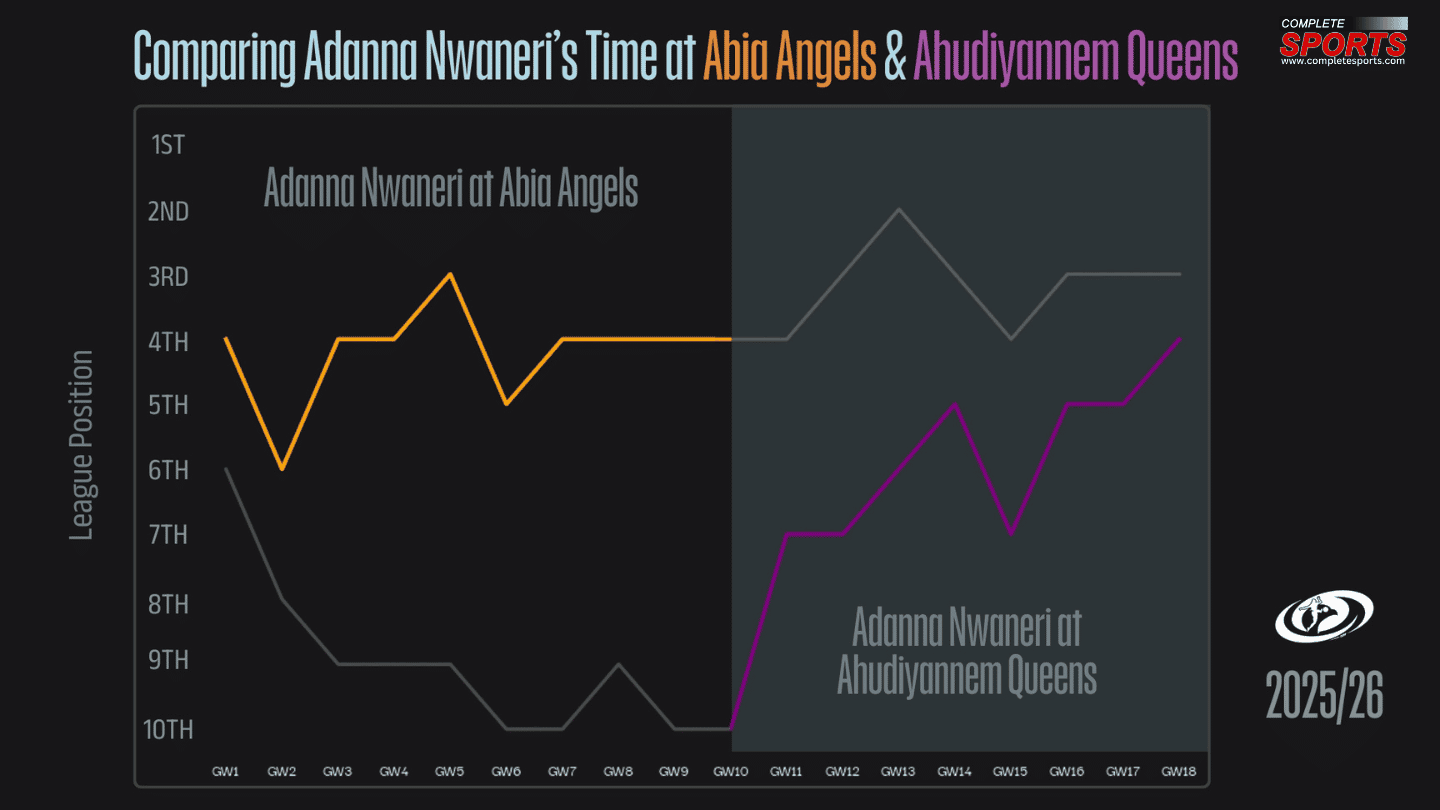
Adanna Nwaneri started the 2025/26 season as the head coach of Abia Angels. Over the first nine gameweeks, Abia Angels stayed on the heels of the Top 3 teams occupying the playoff spots. At the midway point, with Abia Angels comfortably positioned, Nwaneri made a stunning move. She moved six places downwards on the log across town to a neighbouring Ahudiyannem Queens. At that time, Ahudiyannem were last in Group B with just 5 points from 9 matches under Super Falcons legend Ann Chiejinne.
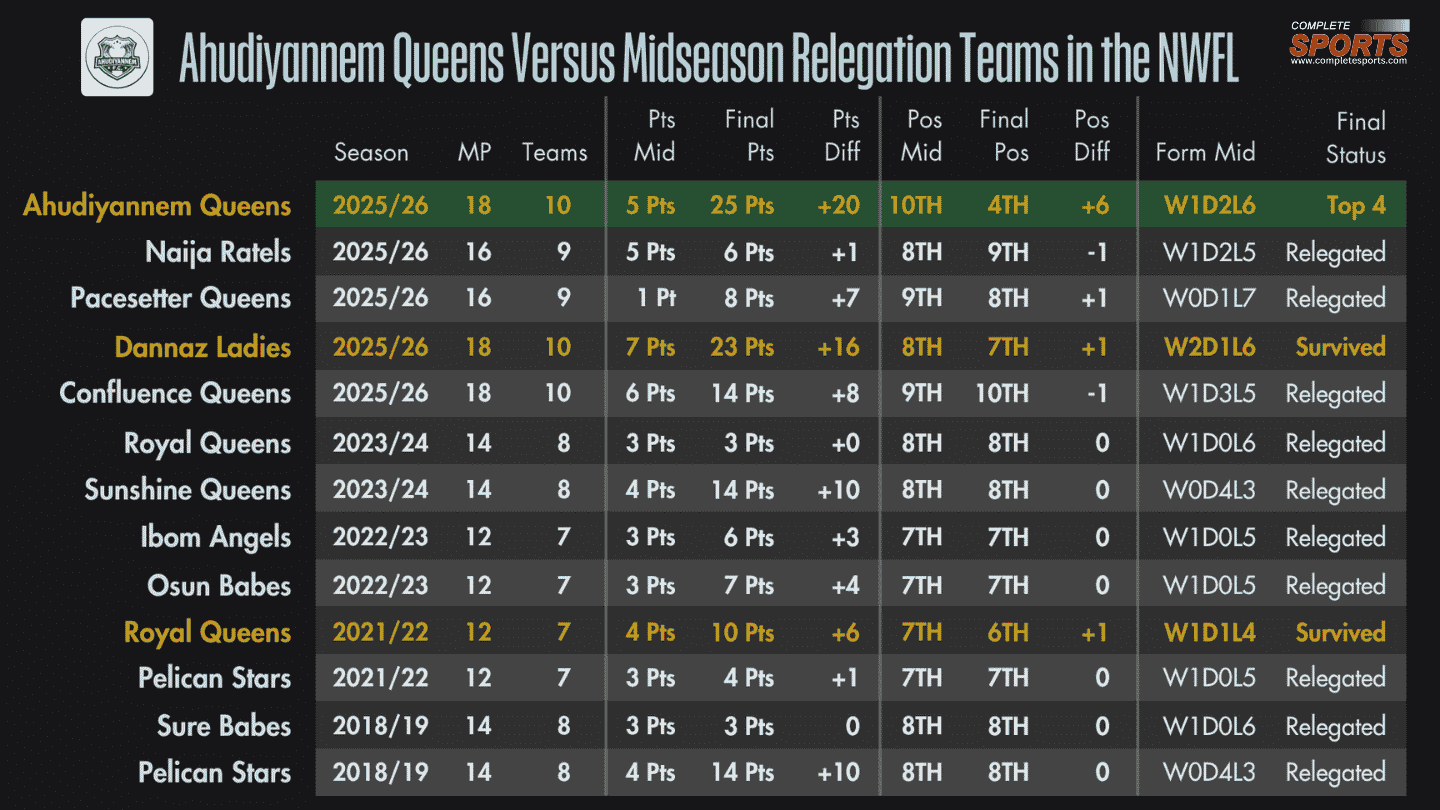
The history of the NWFL offers little hope for such a situation. Data since the early 2010s reveals that relegated teams produce identical halves (or worse) in terms of points earned, goal averages and other team performance metrics when considering half seasons. Also, absent relegation playoffs, teams who find themselves bottom at mid-season end up being bottom at the end of the regular season.
Royal Queens (2021/22) was the first observed exception, collecting six more points in the second half to escape relegation. No team had, however, climbed from the bottom of the league to the corridors of the Super Six and that couldn’t have been the original intention of the club hierarchy when they approached Adanna Nwaneri. They most likely just wanted premiership football next season and reports have it that the club hierarchy paid well in wages.
Adanna Nwaneri’s first move was to bring in reinforcements, most notably striker Mary Lucky, who followed her from Abia Angels. Lucky would finish the season with five goals, each one carrying weight. Under Nwaneri, Ahudiyannem transformed completely. Their ever-plunging points per game moved from 0.56 to a commanding 2.22 and their attacking output moved from 0.89 goals per match to 1.56 across nine games in the second stanza. The efficiency score, which measures how often goals actually change the game state, also rose from 0.0 to 0.64.
To make this much clearer, let’s put it in perspective. In the NWFL Premiership, teams that win below 0.90 points per game consistently faced relegation, while those who won above 1.65 points per game regularly qualified for the playoffs. This means that Ahudiyannem’s 2.22 points-per-game value under Nwaneri would have made them playoff candidates over a full season.
As the attack improved, they also tightened up things at the back, conceding just 0.44 goals per game after the break compared to 1.44 before. Clean sheets also increased by 47%. The final day of the regular season delivered poetic justice. Ahudiyannem faced Abia Angels, Nwaneri’s former employer, in a must-win encounter. Loveth Edeh scored the winning goal as Ahudiyannem finished fourth, just three points from the playoffs.
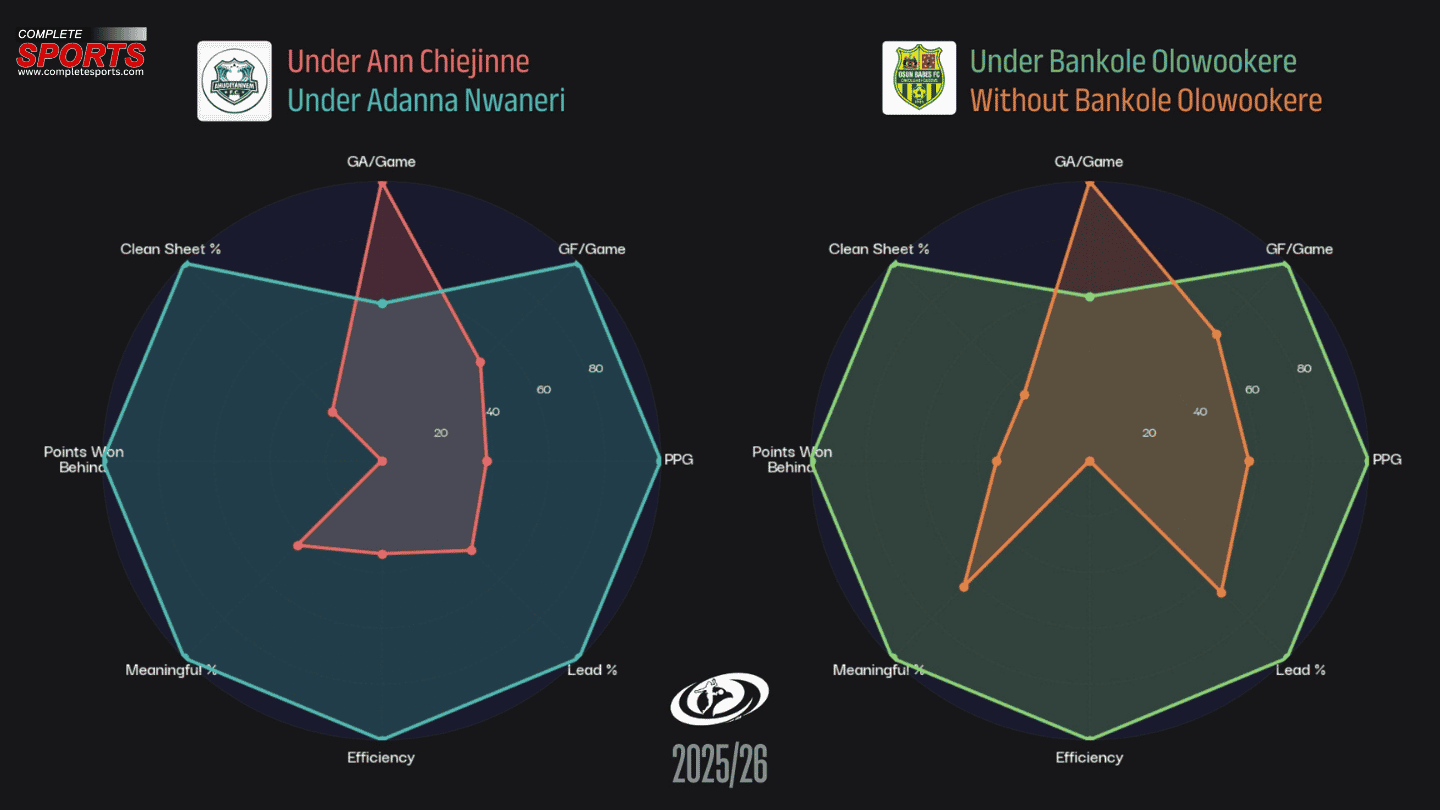
In a league where home teams still win nearly six out of every ten matches, the newly promoted side still found a way to disrupt the expected order, winning more points on the road than they did at home. Under Nwaneri, Ahudiyannem walked into other teams’ mansions and turned over the furniture.
Nwaneri had narrowly missed the playoffs with Abia Angels (23 pts) last season, falling short by five points. This season, she still couldn’t beat her former employers to a playoff spot, but in half the allotted time, she amassed almost as many points as she did last season (22 pts) with a team that stood no chance, producing perhaps the most dramatic storyline of the 2025/26 season and confirming that Adanna Nwaneri is exactly who she says she is!



1 Comment
Point number 1 is astonishing. A future super falcons material, she should be. Paid well. Delivered well. Next season would be interesting to watch her