

















Nigeria’s Super Falcons have long stood as the gold standard of women’s football in Africa, a team defined by dominance, resilience, and an unyielding winning mentality. Across decades, the Super Falcons have not only collected silverware but also shaped the narrative of African women’s football on the global stage.
Yet, behind the trophies and iconic victories lies a compelling story of managerial evolution — a timeline marked by visionary leadership, turbulent transitions, and moments of rebirth. Each coaching era has contributed uniquely to the identity of the Super Falcons, influencing both style of play and squad culture.
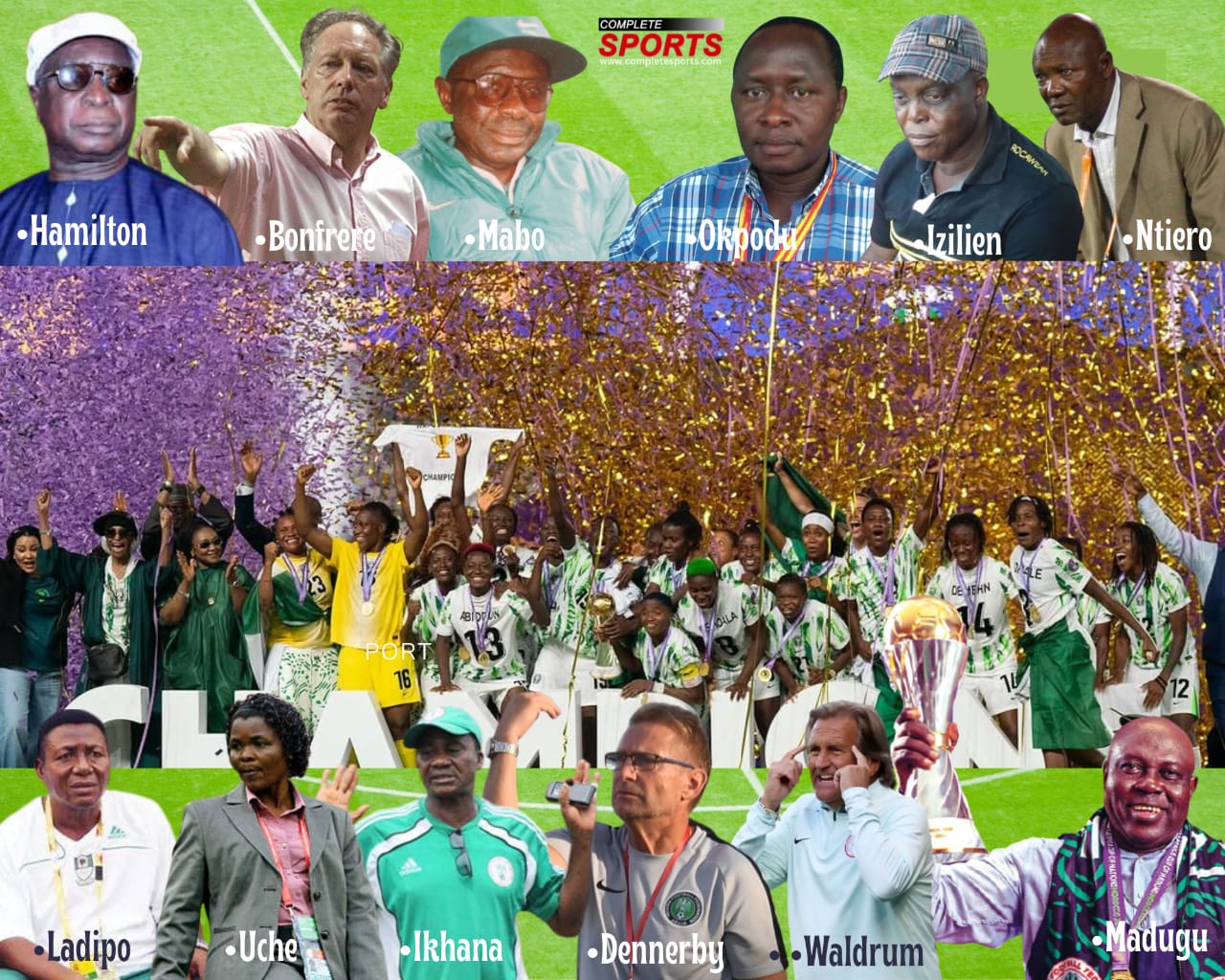
From the golden dominance of the late 1990s to the modern-day resurgence under new leadership, Completesports.com‘s ALLI FESOMADE examines how the Super Falcons have evolved through different coaching regimes, and how these eras continue to define the Super Falcons’ status as Africa’s undisputed queens.
The Super Falcons’ Legacy Of Dominance
The Super Falcons of Nigeria are the most successful women’s football team in Africa. Their journey is full of wins, setbacks, and strong personalities. The Falcons have shown Africa and the world that they are a force in football. From the nineties until today, each coach shaped the team in different ways.
Also Read: Done Deal: Super Falcons Striker Joins Belarusian Club Dynamo Brest
The Hamilton, Bonfrere Eras
Paul Hamilton was the first coach to handle the Super Falcons, but Dutchman Jo Bonfrère was in supervisory charge as the team won the maiden African Women’s Championship (now the Women’s Africa Cup of Nations — WAFCON) in 1991.
The Dutchman also oversaw the Super Falcons’ campaign at the inaugural FIFA Women’s World Cup in China later that year, where they finished bottom of Group C after losing all three matches against Germany, Italy and Chinese Taipei.
Hamilton later took full charge and led Nigeria to the 1995 FIFA Women’s World Cup in Sweden. Nigeria finished bottom of Group B after losing to Norway and England, and drawing with Canada.
Mabo’s Golden Era Sets Super Falcons Benchmark
In the late 1990s, Ismaila Mabo built a golden era. His team won two Women’s Africa Cup of Nations (WAFCON) titles. At the 1999 FIFA Women’s World Cup, Nigeria reached the quarter-finals, the first African team to do so. They also beat Japan at the Sydney 2000 Olympics. Mabo’s success made him a legend in women’s football history.
Transition Troubles And A Return To Glory
Sam Okpodu followed, but his era was tough. Nigeria lost to Ghana at home for the first time. At the 2003 World Cup, the Falcons failed to win a single game. The team struggled, and the federation brought Mabo back. His return reminded fans of the glory days, but the team needed new energy. When Mabo eventually passed, the nation mourned a national treasure.
Titles, Tensions And Emerging Cracks
Godwin Izilien came next. He led Nigeria to the 2004 WAFCON, crushing Cameroon 5–0 in the final. But soon after, the players protested unpaid wages. This showed early signs of the recurring tension between the Falcons and the Nigerian Football Federation. Effiom Ntiero then took charge. His team won the 2006 WAFCON, thanks to Perpetua Nkwocha’s goals. But at the 2007 World Cup, Nigeria finished last in their group.
Mixed Fortunes And Missed Opportunities
Joseph Ladipo (Josy Lad) guided the Falcons to gold at the 2007 All Africa Games. But at the 2008 WAFCON, Nigeria only managed bronze. For the first time, they failed to win the tournament. Then came Eucharia Uche, the first female coach. She won the 2010 WAFCON but couldn’t deliver at the 2011 World Cup and missed the 2012 Olympics.
Dark Days And The Rise Of New Stars
Kadiri Ikhana’s time was one of the darkest. Nigeria finished fourth at the 2012 WAFCON and missed the London Olympics. At this point, new stars like Onome Ebi and Desire Oparanozie began to rise. Edwin Okon’s regime brought hope in 2014, with Asisat Oshoala shining at the WAFCON. Next up was Florence Omagbemi, a former captain, and she led Nigeria to the 2016 WAFCON title.
Global Impact And Renewed Identity
Swedish coach Thomas Dennerby brought a different aura. Dennerby built a wider squad and discovered new talents. At the 2019 World Cup, Nigeria reached the round of 16 under Dennerby. American coach Randy Waldrum followed.
Also Read: Cape Verde Withdraws From Super Falcons Friendly
His time was full of disputes with the federation, but he also found hidden talents. At the 2023 World Cup, Nigeria impressed, beating co-hosts Australia and pushing England to penalties.
Madugu’s Era And A New Generation Of Super Falcons
When Waldrum departed, the Federation looked inward again and Justin Madugu took over as interim coach. In 2024, he led Nigeria to their 10th WAFCON title. They defeated Morocco, Zambia, and South Africa, proving they were still the queens of African football.
Madugu balanced youth and experience and it brought him continental success with the team once again. Under Madugu, stars like Rasheedat Ajibade, Esther Okoronkwo, Ashleigh Plumptre, and Chiamaka Nnadozie carry the torch.
Enduring Greatness Of The Super Falcons
From Mabo to Madugu, each coach left a mark. One lasting truth however, is that the Super Falcons remain Africa’s pride, and their journey is far from over.

4 Comments
If Nigeria is a giant of Africa in football, then it is mainly because of the Super Falcons.
We have to start allocating more resources to this team in particular. Any bonuses and privileges the Super Eagles have should also be extended to them. We need to encourage them and give them every assistance they need. Not wasting it on others who are not serious.
It starts with paying them their owed bonuses to the last kobo.
I am sure Tinubu’s 100000 dollars each to the players have not been fulfilled till today.
Ordinary cape Verde pulled out of friendly and NFF couldn’t find a suitable replacement.
May Gusau not happen to Nigerian football again.
Many African nations played friendlies this week except falcons because we are expected to stream roll over anybody on the continent with our eyes closed.
Peradventure we didn’t make it to semis of this WAFCON and qualify directly for Brazil 2027 and let’s say we reached the quarters at least, the playoff route FIFA introduced for the expanded world cup is littered with plenty dangerous teams across the world.
Our squad is first “old”, then playoff route where Eagles failed at the first hurdle that our friendly-shy and preparation-impotent falcons will desire as another chance is what NFF has signposted for the girls to follow through.
Madugu, unlike waldrum, is not a serious gaffer. He wants to go to the world cup like this abi (and be different from all the local coaches that have failed at the world stage since 1991 according to this CS article).
July is not far. The chickens will come home to roost. Hopefully, he will not be full of regrets if NFF throws him under the bus if falcons flop.
As it is now, doom is inevitable.
No new blood have been tested in friendlies;
No friendlies to begin with;
WAFCON will come up when season has ended and who dares trusts Madugu to have fitness trainers or programme for the girls;
Normal, NFF will still owe falcons by now
Wafcon is top 2 finishers for progression to quarter finals.
We’re in a group having:
Zambia (they just played Canada and Brazil losing 4 nil and 6-1 respectively),
Malawi (who Madugu deprived of having Chioma okafor and just lost 5 nil and 3-2 to Australia and India respectively)
and Egypt (who just beat Saudi Arabia women 2-1 in first of 2 legged fixtures).
Most likely (since we are in group C) if we progress to quarter finals, we are playing any one of
Ghana,
Cameroon,
Mali and
the friendly embarasser Cape verde in group D.
We are expecting a walk in the park against any opponent (the complacency affliction of most champions).
Gusau and NFF care less about success so I’m tampering my expectations on falcons
@Sly, NFF are dry and clueless. The Super Eagles and Falcons can never fly high but will cry under this NFF administration.
One can only sigh because of frustration. Success will die.
The Italian Gusau resigned after calamitous failure. The Nigerian Gusau nko? Failing woefully and sitting tight.
Shamelessly holding on to a job he’s grossly incompetent and negligent at. Owing salaries and bonuses all over the place.
Back to back failure to qualify for world cup. Piss poor admin. Useless technical department.
May NFF Onigbese not find us again in the future!