



Alex Iwobi’s impact for club and country has long divided opinion, often judged through a narrow lens of goals and assists rather than the broader demands of modern midfield play.
As tactical roles evolve and data increasingly shapes football analysis, a deeper look at Iwobi’s numbers this season reveals a player whose influence lies in connection, progression and control rather than headline statistics, Completesports.com reports.
Iwobi Beyond Goals and Assists
In modern football discourse, value is too often reduced to goals and assists. For players whose influence lies between phases rather than inside the six-yard box, that framing can be misleading. Few Nigerian players embody this tension more than Alex Iwobi.
Across the current season, Iwobi’s performances for both Nigeria and Fulham have sparked contrasting interpretations. To some, his numbers appear modest. To others, his importance is obvious in how teams function with him on the pitch. The argument, as the data suggests, tilts towards the latter.
Iwobi’s Club Numbers and Misleading Surface Statistics
At club level, Iwobi has logged over 1500 minutes in the Premier League this season, contributing two goals and two assists. On paper, those figures may appear unremarkable for a creative, wide or attacking midfielder. But such a reading misunderstands his primary function.
Also Read: EXCLUSIVE – AFCON 2025: Super Eagles By Numbers — Record-Breaking Group Stage Performance
Within the Super Eagles’ setup as well, Iwobi has been used more as a connective presence. His numbers point to a player whose value lies in ball progression and chance creation, rather than volume of shooting. His shots per 90 remain low, synonymous with his limited box presence, while his key passes per 90 and expected assists metrics address his role as a provider rather than a finisher.
Super Eagles/ Fulham Midfielder and Ball Progression Metrics
The ball progression data also shows something interesting about Alex Iwobi’s profile. Iwobi consistently ranks well in forward passing and deep completions, progressive carries into dangerous areas and linking phases of play.
In Fulham’s system, he has often been the player who translates defensive stability into attacking shape, often receiving the ball under pressure, turning, and releasing teammates higher up the pitch. Since the start of last season (2024/25), only five players have created more chances than Alex Iwobi per squawka.
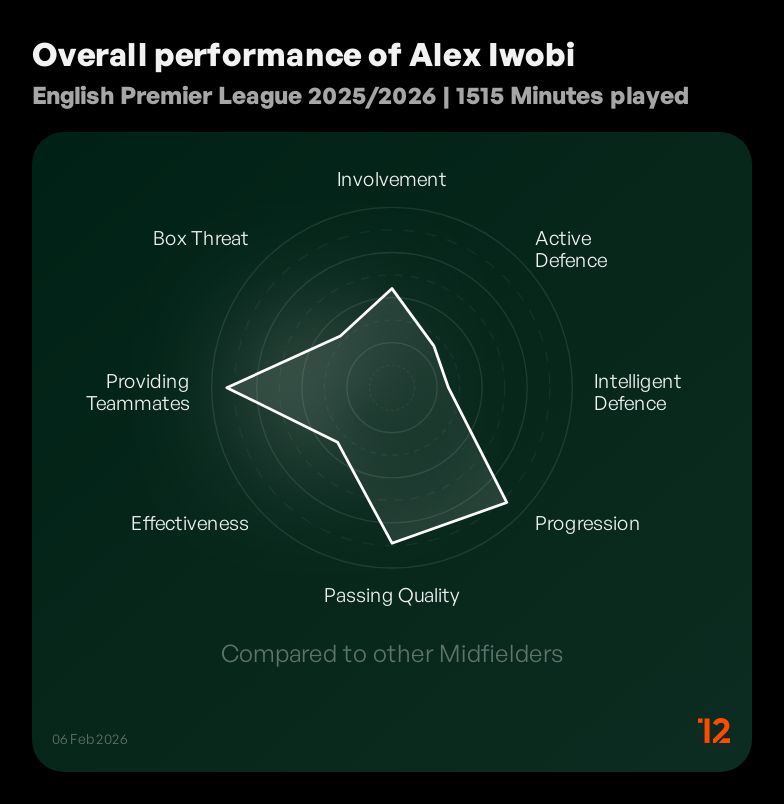
Twelve Football’s radar visualisation captures these three Ps clearly. Alex Iwobi possesses strong scores in passing quality, progression, and providing for his teammates. This radar is that of a facilitator, not a scorer.
Also Read: EXCLUSIVE: How Super Eagles’ Attack Has Evolved: Analysing Seven Editions Of AFCON Data
If you followed the Africa Cup of Nations in Morocco, Iwobi’s role with the Super Eagles follows a similar pattern. At the Africa Cup of Nations, his individual qualities became the backbone of the Super Eagles’ style of play. His constant link-ups with Lookman, line-breaking passes and ability to advance possession were critical to the effectiveness of the team’s playing style. Alex Iwobi constantly completed more than 80% of passes in each of the six games he featured in, completing 344/400 attempted passes in total.
Iwobi and Final-Third Efficiency Debate
One of the recurring critiques of Iwobi has been that he lacks decisiveness in the final third. The data partly supports this but also contextualises it. Looking at his club numbers, Iwobi’s Expected Goal (xG) and xG per 90 figures remain low, confirming that he is not frequently positioned to finish moves. This is not a flaw; Alex Iwobi is more often the player who creates the shot than the one taking it.
Even in a Super Eagles side that valued control and structure, Iwobi has functioned as a stabiliser. He helps Nigeria maintain possession in the final third, recycle attacks, and prevent transitions from breaking down prematurely. He provided two assists in his game against Tanzania and his expected assist contributions and key pass rates were critical to how Nigeria managed games throughout the competition.
Chance Creation and Teammate Conversion
In the Premier League, the data suggest that Iwobi is capable of creating two goals in each game but his actual assists remain low. This is a familiar issue in football analysis, because chance creation is dependent on conversion by others. When those chances are not taken, the creator’s influence disappears from the stat sheet. That dynamic explains why Iwobi’s contributions are often undervalued in conventional match reviews.
Iwobi’s Limitations and Tactical Fit
No assessment of Iwobi’s season would be complete without acknowledging limitations. Alex Iwobi performs below average in his counter-pressing and defensive intelligence, particularly in moments immediately after possession is lost. His defensive activity exists, but it is not his strongest domain.
Also Read: EXCLUSIVE: Why Super Eagles Were So Difficult To Break Down At AFCON 2025 – Data Analysis
The key question, then, is not whether Iwobi defends like a traditional midfielder but whether his teams are structured to accommodate his strengths. When they are, his value becomes clearer. He is also not a dominant box threat but his presence improves collective flow.
Why Iwobi’s Value Extends Beyond Statistics
For both Fulham and Nigeria, Alex Iwobi’s importance is best measured by what he enables, and as football continues to move toward systems over individuals, that kind of influence may finally receive the recognition it deserves.
By Alli Fesomade