























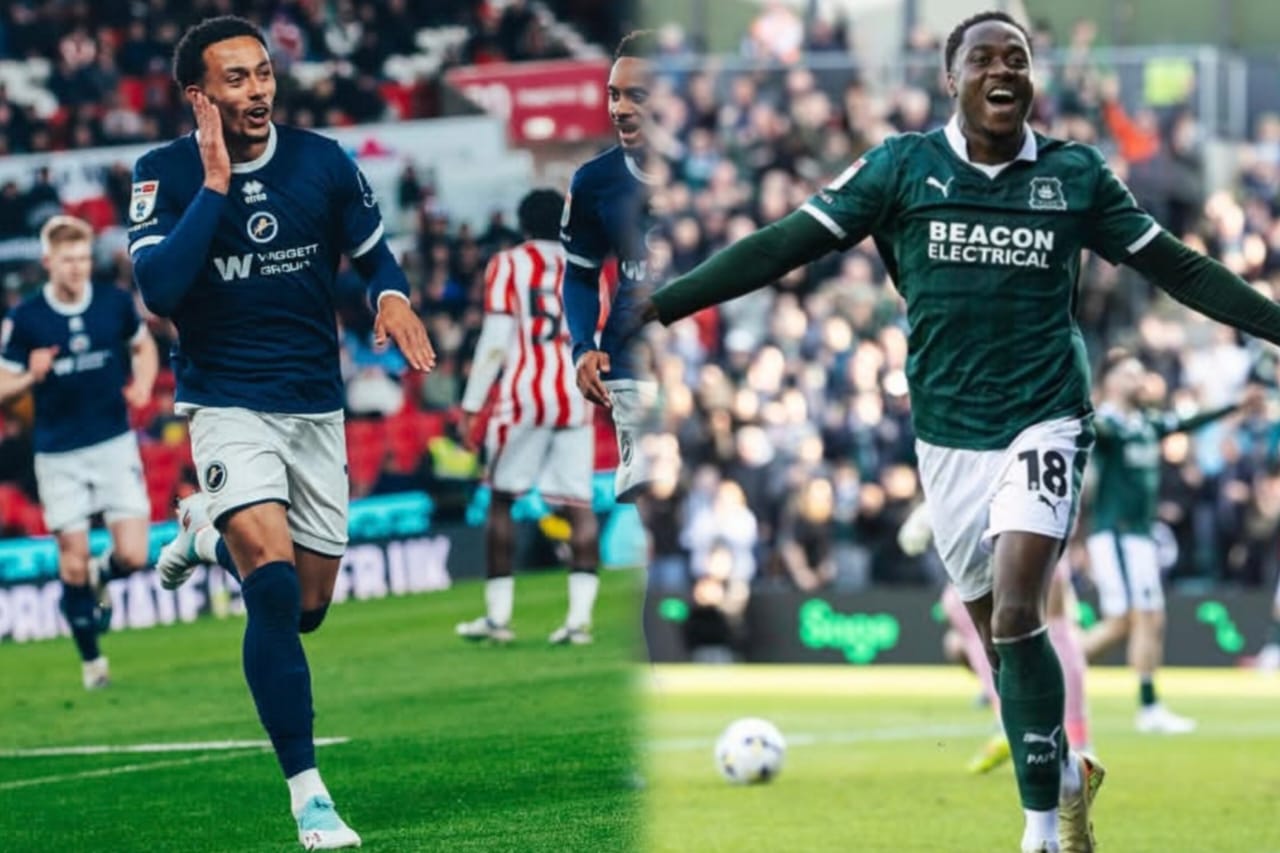
Femi Azeez and Owen Oseni are among the new faces included in Eric Chelle’s latest Super Eagles squad for the Unity Cup 2026 as Nigeria continues to evaluate new profiles ahead of future international competitions. Alongside Arthur Okonkwo, the duo represent part of a wider attempt to expand the tactical options available to the national team beyond its established attacking core.
Nigeria will face Zimbabwe, India and Jamaica in the Unity Cup before taking on Poland and Portugal in June friendlies. While the friendlies squad still contains regular names such as Victor Osimhen, Ademola Lookman, Wilfred Ndidi and Alex Iwobi, much of the tactical curiosity around this window centres on how players like Azeez and Oseni can offer different attacking solutions within Chelle’s evolving structure.
In this piece, Completesports.com’s ALLI FESOMADE analyses both players in detail, examining the attacking qualities that earned them call-ups and the tactical roles they could potentially occupy within the Super Eagles setup.
New Faces Add Tactical Variety To Super Eagles Attack
Femi Azeez and Owen Oseni are not alone. They are among a dozen new faces in the Super Eagles ranks for the Unity Cup. Another foreign-based debutant on the list is forward Zadok Yohanna and midfielder Samson Tijani. For the duo we are focusing on in this piece, the data suggests two very different and very useful weapons are about to enter the Nigerian armoury and we will break it down in subsequent paragraphs.
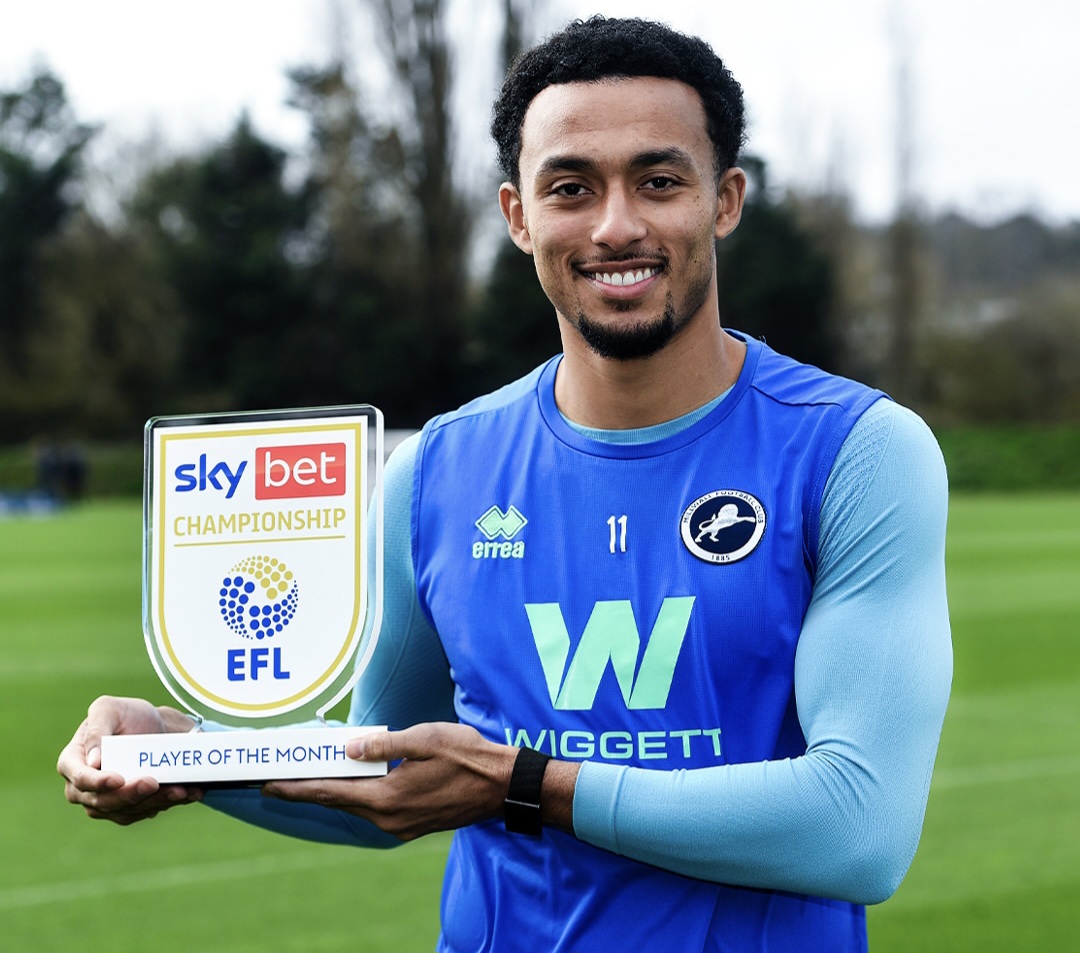
Azeez’s Ball-Carrying Threat Offers New Dimension
At 24, Femi Azeez has established himself as an increasingly influential attacking presence for Millwall FC, where his game has developed around aggressive ball progression and consistent penetration of defensive structures from wide positions. Azeez’s profile is not only made up of brilliant individual dribbling moments but also the accumulation of the actions he takes that constantly drive his team into advanced territory.
Also Read: EXCLUSIVE: Why Michael Kayode’s Premier League Rise Is Intensifying Super Eagles Pursuit
Azeez’s most consistent attacking contribution comes through his ball-carrying from the right side. Once he receives possession, he immediately drives into areas that force defensive units to adjust their shape. Data suggests Azeez prefers to accelerate possession through direct movement into spaces that tend to destabilise the opposition’s defensive setup rather than recycling it or delaying attacks.
A considerable portion of his influence can be seen in the right half-space, where he operates between the opposition full-back and centre-back. From this position, he creates constant uncertainty for defenders because his decision-making is often not predictable. Azeez can continue his ball carrying toward the byline, combine centrally with midfield runners or release passes into the penalty area. Either way, this range of play in a single zone increases the pressure on defensive lines because it removes the comfort of structured marking.
His crossing and final-pass data also reveal the same intent to increase attacking threat. Azeez avoids relying on volume crossing, meaning he avoids spamming crosses into the box. He tends to select moments where his pass can immediately alter defensive positioning, either by forcing recovery runs or by shifting defenders away from central zones. For Nigeria, this type of profile becomes particularly relevant in matches where possession is expected to be high but the opposition is limiting access to central areas.
Against teams that sit deep, where defensive structures are compact and well organised, the ability to break lines through wide carries and half-space penetration becomes a key attacking tool and data suggests Femi Azeez can deliver this. Within the current attacking pool, Samuel Chukwueze still offers explosiveness and experience at the international level, but Azeez’s data suggests a more rounded contribution.
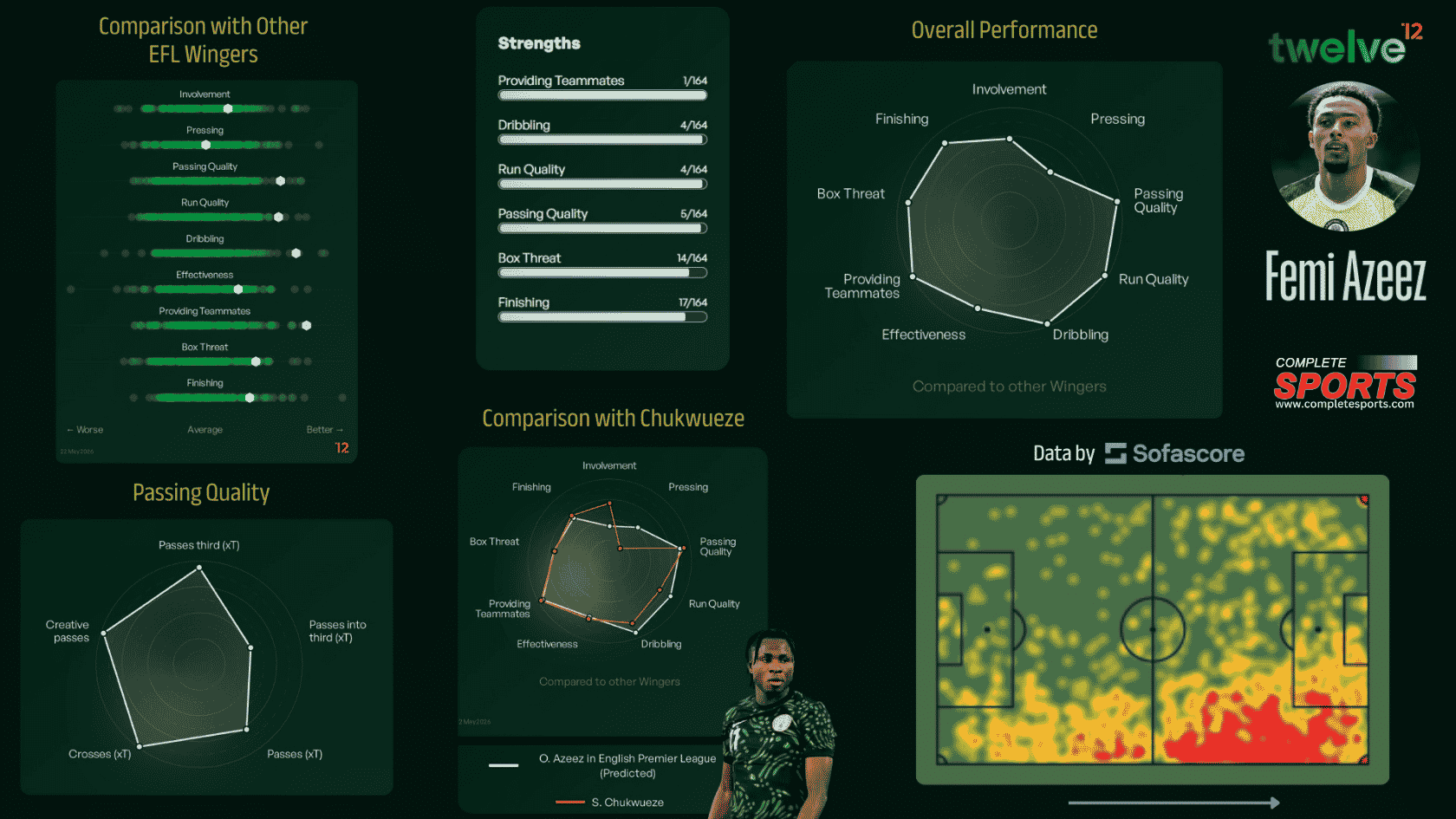
Azeez Vs Chukwueze: Data Reveals Key Differences
In comparing Azeez and Chukwueze, both wingers show strong abilities but Azeez has some specific strengths. The data suggests Azeez is superior in dribbling and run quality, showing more capacity to create opportunities through his movements and technique than Chukwueze.
While their overall effectiveness and passing quality are on par, Azeez’s stands out for his playmaking skills. Chukwueze has slight advantages when it comes to being involved in passages of play, but overall, Azeez’s ability to provide threats and create chances could make him a more valuable asset if he were to transition to the Premier League.
Also Read: EXCLUSIVE: William Osula — Can Newcastle’s Rising Striker Solve Super Eagles’ Succession Puzzle?
Looking at the other side of his game, Azeez’s defensive contribution remains less developed compared to more complete wide players, particularly in sustained pressing phases. This limitation suggests Azeez would be suited to a more specialised role within the Super Eagles setup, with greater concentration being placed on his attacking output while other midfield structures, particularly the presence of Ndidi, provide cover for transitions and defensive stability.
Within that context, Azeez offers Nigeria a direct method of advancing play that does not rely heavily on structured buildup patterns, which can be valuable in matches where rhythm is disrupted or opposition teams force play into wider areas.
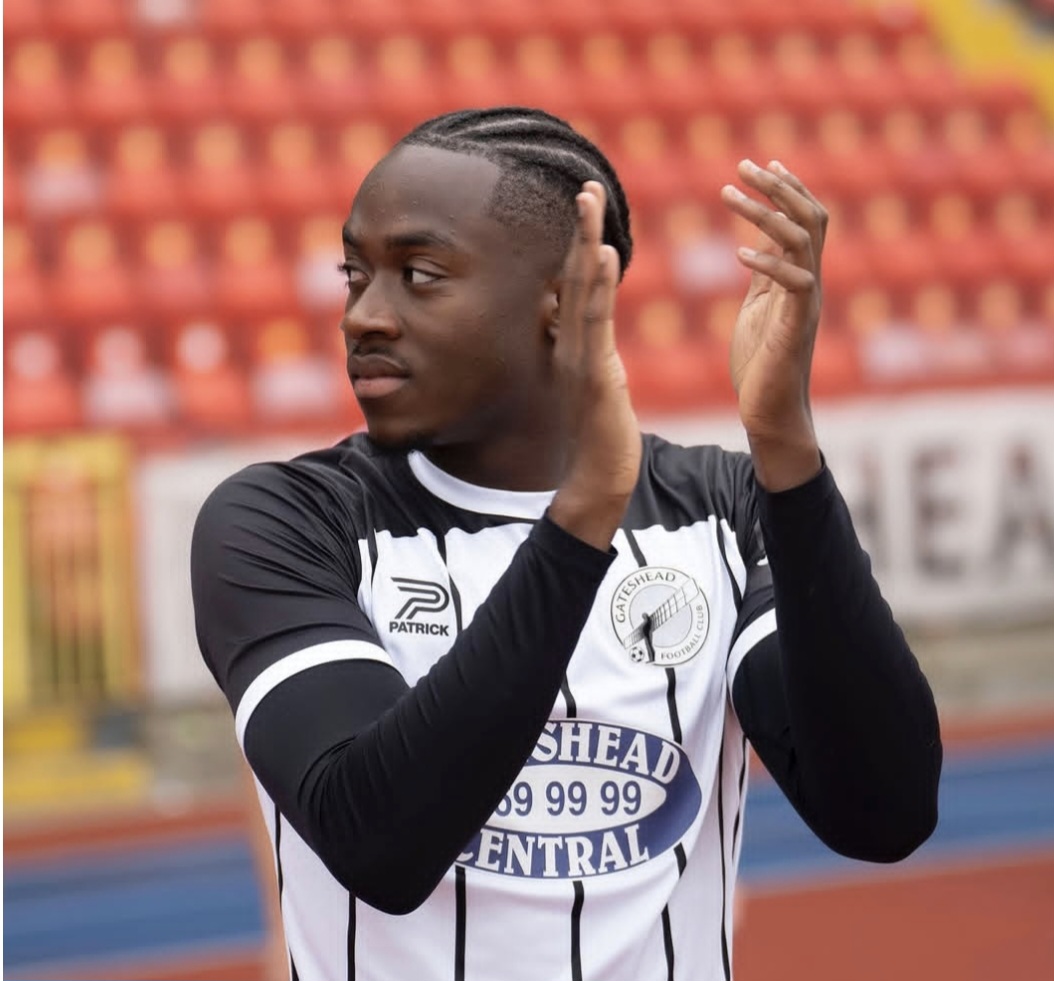
Oseni’s Penalty-Box Instinct Could Solve Finishing Problems
Owen Oseni presents a completely different attacking outlook to Azeez, with his game centred more on being efficient in goal-scoring areas and less on possession involvement. Representing Plymouth Argyle this season, his role has been centred around attacking space rather than controlling phases of play, and his impact is most visible when analysed through positioning and shot execution as opposed to his involvements in buildup sequences.
Oseni’s most notable trait is the quality of his shooting opportunities, as observed in his expected goals per shot profile, which indicates that he consistently finds himself in high-value positions before attempting to score. As opposed to taking low-probability shots from a distance or wide angles, Oseni’s attempts are typically taken from the central areas inside the penalty box where conversion rates are naturally higher.
In the case of Owen Oseni, this efficiency is closely linked to his movement without the ball. Oseni repeatedly times his runs into the spaces behind defensive lines, particularly in the right half-space and central zones around the six-yard area. These movements are often subtle because he focuses on arriving in space after defenders have committed their attention to the ball carrier.
Oseni’s type of forward does not require continuous touches before he influences matches but instead leverages the timing of limited actions. When defensive concentration drops or when the ball is delivered into dangerous areas, his positioning allows him to convert small windows of opportunity into direct goal threats.
However, his data also contains some limitations. His hold-up play under physical pressure is weak, which reduces his effectiveness in phases where the striker is required to connect midfield and attack during build-up. His aerial presence is also limited, which further narrows his role in direct attacking structures. In addition, his pressing contribution is minimal, meaning he is less suited to systems that demand high defensive work from forwards.
These constraints suggest that Oseni is not a player designed for continuous involvement across all phases of play but rather a specialised attacking option whose primary value lies in penalty-box efficiency. Within the Super Eagles’ structure, that would make him a situational forward as opposed to a regular starter.
Oseni’s abilities are particularly useful in matches where Nigeria are creating sustained pressure and need a player whose movement inside the box can convert half-chances into goals.
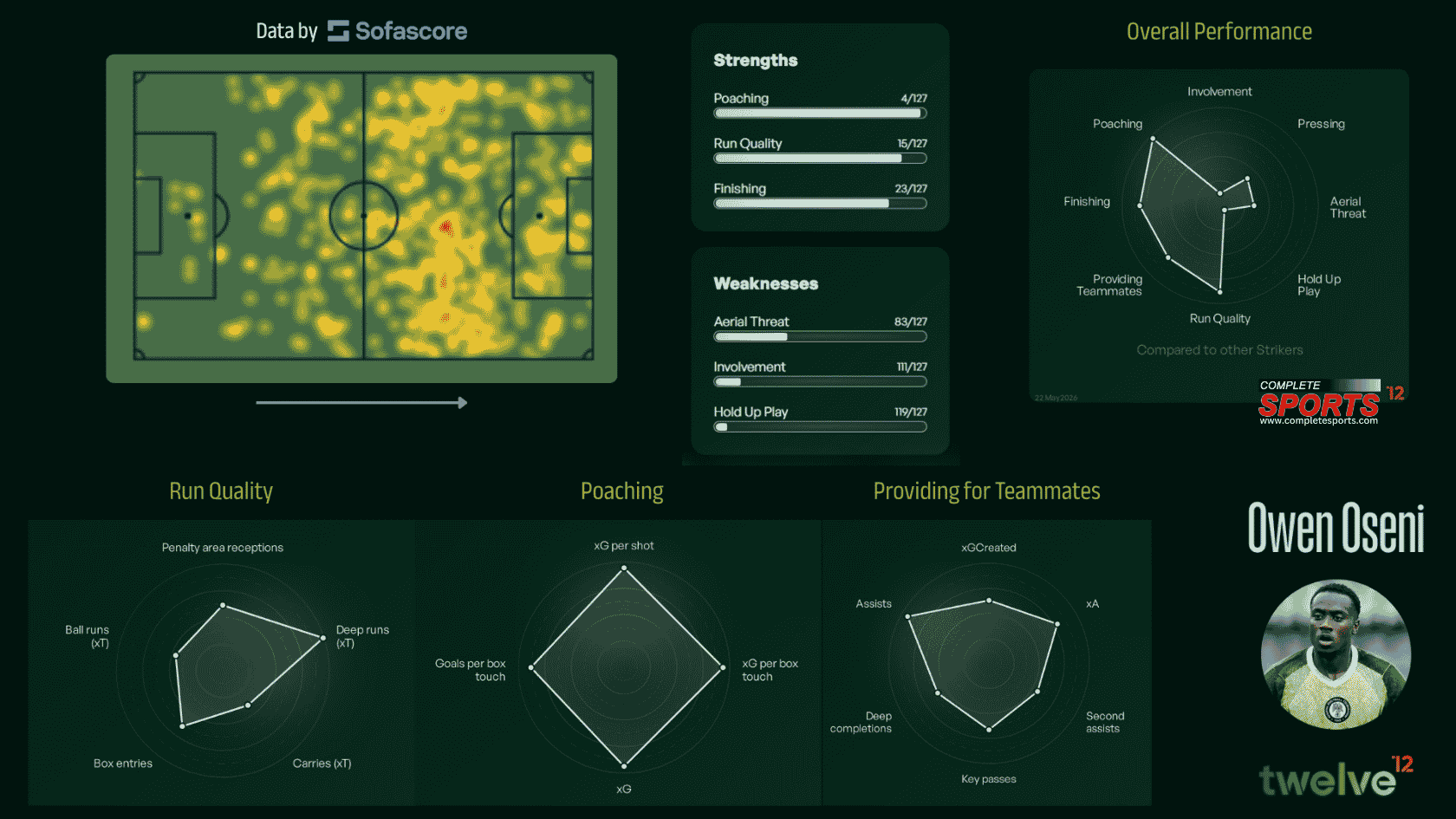
Oseni And Akor Adams Comparison Highlights Growth Potential
When comparing Oseni to Akor Adams, it becomes clear that Oseni would be a valuable asset to any team in La Liga due to his exceptional poaching ability.
At just 23 years old, he is still developing, which means he may further improve his game if he were to make the move. While Adams is a peak-aged player and does have superior strengths in hold-up play and involvement, he doesn’t finish as good as Oseni does.
Adams is, however, much more experienced than the Plymouth Argyle forward. Additionally, both players show similar abilities in traits like making quality runs and pressing the opposition but Oseni still has the potential to evolve given his youth.
What Azeez And Oseni Bring To Chelle’s Super Eagles
Looking at the tactical direction and squad evolution of the team, we can gauge how these call-ups influence the squad structure given their attacking profiles. The inclusion of Azeez and Oseni clearly suggests a deliberate attempt to diversify attacking options.
Together, they introduce contrasting but complementary attacking qualities that can be deployed in different phases of matches depending on tactical requirements. One expands access to dangerous areas through ball progression, while the other increases the probability of converting possession into goals once those areas are reached.
For the upcoming friendlies, Azeez appears more likely to feature consistently because his ball-carrying ability naturally fits games where Nigeria need progression from wide areas. Oseni’s role may be more situational, particularly in matches where the team requires penalty-box presence against tiring defensive lines.
If the Super Eagles are able to sustain pressure and create deliveries into dangerous areas, his movement inside the box suggests he may only need a single opportunity to influence the game.
Their current profiles may be team dependent and when they arrive at the Super Eagles camp, both of them may become completely different sets of players. However, some key parts will remain, and ultimately, the Super Eagles are clearly adding depth to the team’s attacking profile.

2 Comments
A winger has three jobs that contribute to team tactics:
1. Crossing the ball into penalty area either from the by-line or from any part of his wing
2. Cutback, cutting the ball back into penalty area
3. Inverting, cutting inside toward the center of the pitch
That is all a winger needs to do, everything else not connected with achieving these 3 tasks is superfluous. Ejuke and Chukwueze can do number 3 but definitely cannot do number 1, and only Chukwueze sometimes does number 2.
In a 90 minute match a good winger typically makes 4 to 8 cross attempts per 90 minutes, with 2-3 successful completions, in comparison Chukwueze and Ejuke make zero crosses, and predictably always invert.
Their style of play could be excused if they were not playing against the strength of the Super Eagles, With Osimhen, Onuachu, Akor, you have target men that are good in the air and expect to be supplied with crosses from the right. This becomes especially problematic when Ola Aina is not playing, because Bright cannot cross and Ola is the only one that consistently crosses the ball from the right.
Lookman and Bruno are both accomplished at crossing and supply most of the crosses in recent Super Eagles games from the left.
I don’t want to jinx the guy, but Femi Azeez can do all three!