


The Africa Cup of Nations has changed dramatically over the decades. Stadiums have grown bigger. Broadcasting has become wider and the competition balance sheets have hit record-breaking profits. However, one detail that often escapes attention is the match ball.
Every AFCON edition carries its own visual identity and the match ball sits at the centre of it. From the patterns used in the early 2000s to modern aerodynamically engineered designs, AFCON match balls tell their own story of football’s evolution on the continent.
Completesports.com‘s ALLI FESOMADE recalls and chronicles the evolution of CAF’s AFCON match balls.
Early 2000s AFCON
In the early 2000s, AFCON match balls followed the traditional stitched-panel structure that defined global football at the time. Thick seams, visible hexagons, and strong colour contrasts were common. African football at the time was built around physical duels and direct play, so they made the balls exactly for that.
Also Read: EXCLUSIVE: Why Super Eagles Were So Difficult To Break Down At AFCON 2025 – Data Analysis
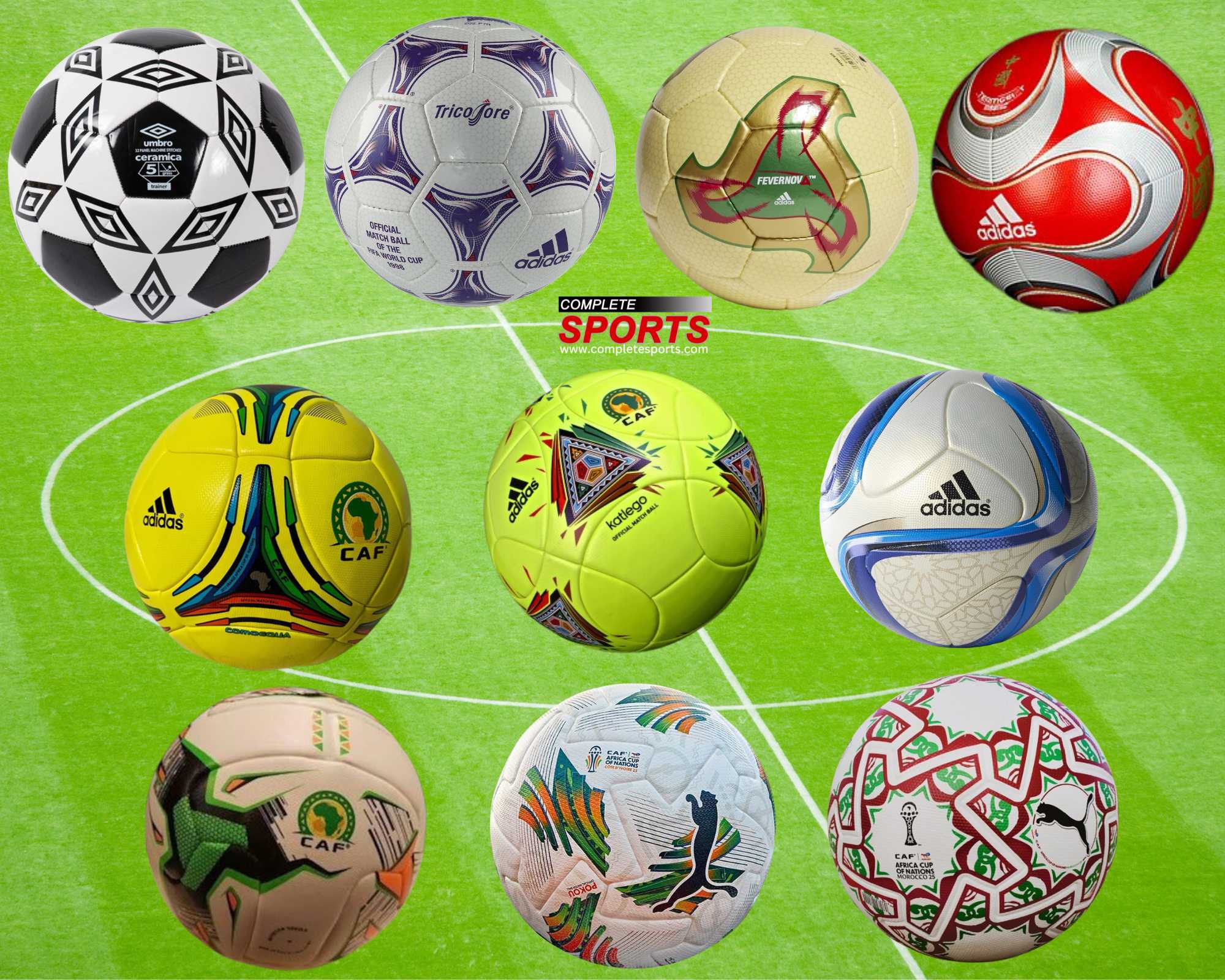
To kick off this era, Umbro’s Ceramica was reintroduced for the third consecutive edition as the official match ball. Adidas’ Tricolore, which was previously used at the 1998 World Cup, disrupted this flow in 2002 when the continent converged in Mali.
The AFCON 2004 match ball was called the Fevernova, which is the headline reference of this article. The Fevernova had a triangle-like shape on four hexagons disrupting the tango design that was common at the time. Fevernova reportedly drew complaints for being too light. In 2006, the sleek Teamgeist arrived with clean panels and modern aesthetics.
Wawa Aba took centre stage in 2008. The match ball was named after an Adinkra symbol meaning “seed of the wawa”. For the first time, how the ball performs was no longer the only focus for ball design or naming convention. African values were also considered alongside ball performance when naming the match balls.
The 2010/Beyond
By the 2010s, technology began to influence identity. The ball design across world football began implementing thermally bonded panels. Modern materials allowed for lighter construction and faster trajectory through the air. Balls in this era had improved consistency in flight and brighter colour palettes.
Tournament branding also became more intentional in this era and unveiled match balls continued incorporating national patterns and cultural references into their visual design. The Jabulani Angola was the first match ball of this era.
South Africa hosted the FIFA Mens world cup in 2010, and the Janbulani Angola match ball was a regional version of the famous Jabulani World Cup ball. Its erratic flight divided opinions, especially concerning the ball’s movement during long-range shooting and crossing events. The Jabulani Angola tied African football again directly to the biggest global football showpiece.
At the AFCON in 2012, the Comoequa match ball was introduced and it had its name grounded in African geography. It was named after Lake Comoé, which was a shared natural and cultural space between co-hosts Gabon and Equatorial Guinea.
Katlego followed in AFCON 2013, with its name drawn from a Sotho word meaning “success”. By AFCON 2015, the Marhaba match ball was named after an Arabic greeting, as the continent held the 30th edition of the Africa Cup of Nations. As part of a commercial shift, Mitre produced the Delta Hyperseam match ball for AFCON 2017 suitable for African playing conditions, ending Adidas’ long dominance.
AFCON 2019 and Beyond
In recent tournaments, the AFCON match ball has become both a technological product and a cultural statement. Panels are now fewer and engineered for aerodynamic stability. Surface textures enhance grip and control, especially in humid conditions.
Also Read: EXCLUSIVE: How Super Eagles’ Attack Has Evolved: Analysing Seven Editions Of AFCON Data
Umbro returned with the Neo Pro match ball in AFCON 2019 which was a performance-focused ball. The ball designed was suited to a faster, more modern football. In 2021, the Toghu match ball fully went the culture route. It was inspired by the traditional Cameroonian Toghu royal attire, from which it derived its name.
When Côte d’Ivoire stormed the continent in 2023, their triumph had Ivorian heritage written all over it. The Pokou match ball was unveiled as AFCON honoured its legends, naming the ball after Ivorian icon Laurent Pokou.
The official ball for the 2025 Africa Cup of Nations was called the ITRI, a Puma creation inspired by Morocco’s rich culture. The design featured intricate Zellij geometric art, star patterns and a red and green palette. The name itself honours the Moroccan flag’s star and the host nation’s heritage.
Modern AFCON balls are designed to travel faster, maintain truer flight paths, and offer better first-touch response. For attackers, that means sharper control in tight spaces. For goalkeepers, it means reacting to late movement at higher speeds.
AFCON Match Ball Culture
The AFCON match ball has become a visual signature of the tournament. Every edition’s goals, free kicks, and iconic moments are tied to a specific design because the ball is always there as part of the memory.
Modern balls are designed to travel faster, maintain truer flight paths, and offer better first-touch response. As technology continues to evolve, so too will the AFCON match ball. The ball is the one object every player touches, and in many ways, it quietly carries the history of African football with it.