











































































































































NPFL Survival Margins: Fine Lines Decide Relegation Battles
Relegation in the Nigeria Premier Football League (NPFL) is rarely decided by clear gaps in quality. Oftentimes it comes down to small margins. Across multiple seasons since the turn of the millennium, the difference between survival and relegation has been zero or one point, often settled by tiebreakers. Even in the widest cases, the safety margin has stretched to just three points.
At the core of every relegation battle is the idea of a survival threshold that often leaves everyone asking just how many points a team needs to stay up in a top-flight league. In European football, this concept is well established.
In this piece, Completesports.com ALLI FESOMADE examines the data to determine what that benchmark is in the NPFL today.
European Leagues Offer Context, Not Certainty
In the English Premier League, 40 points has long been treated as the benchmark for safety. But the data tells a more nuanced story. Historically, teams finishing 18th average around 35 points, and since the 1995-96 season, 36 points have ensured survival 60% of the time. That rate of survival increases to 80% for 38 points, 90% for 40 points and 100% for 43 or more points.
Also Read: NPFL: Remo Stars Must Win Remaining Five Games To Avoid Relegation — Abd’Allah
Ideally this should set a 36-point survival mark but as with all things probabilities, there’s always a chance something changes. In England, the 2025/26 season is on track to be the toughest to survive in 15 years. After GW34, 18th place in the EPL is projected to finish on 38 points, meaning 39 points would be enough to guarantee survival.
Other leagues show similar patterns. In La Liga, survival typically falls in the 38 to 40-point range, with 42 points offering strong security. In Serie A, recent trends have pushed survival even lower, with teams staying up in the low-to-mid 30s in several seasons.
Across these leagues, the conclusion is that survival is not tied to a fixed number but to a probability range based on historical outcomes. This is where the famous “40-point rule” comes from. It is not mathematical certainty but an act of risk management from the clubs and their analysts. The fans also want to know if their team has enough in them to hit the forty.
’48-Point Rule’: The Real Survival Benchmark
A clear example is Leicester City. At the start of their title-winning campaign, their initial target was simply to reach 40 points. Under Claudio Ranieri, that number served three purposes. It provided a safety buffer above the typical relegation line.
It set a pacing target of roughly one point per game. This known guide gave the squad a psychological milestone at which point survival could be assumed, considering they had only just been promoted.
Also Read: NPFL: Enyimba Won’t Be Derailed By Defeat At Rangers In Survival Push — Deutsch
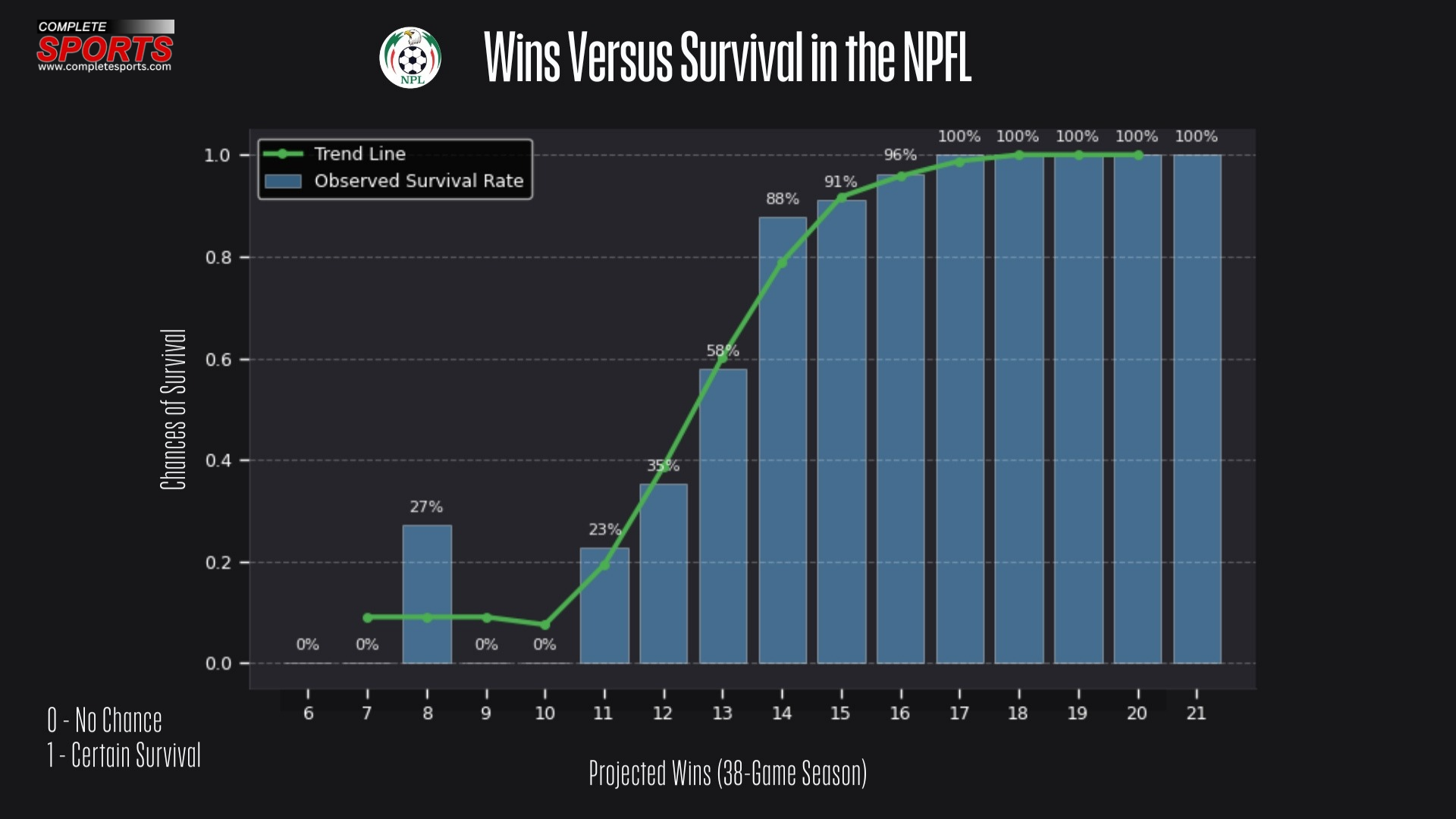
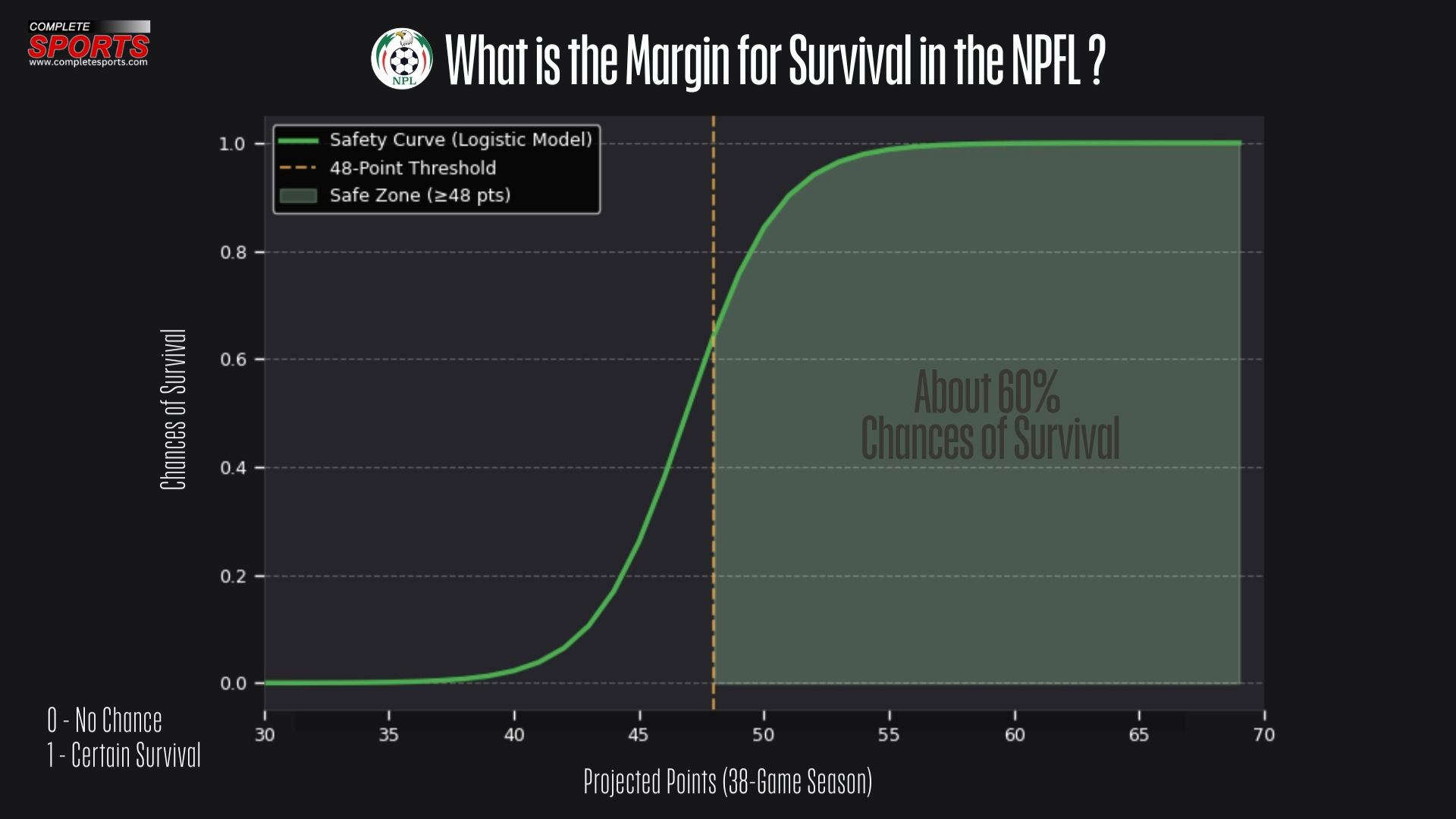
Now, the Nigeria Premier Football League (NPFL) operates on the same principle, just at a different scale. Like their European equivalents, there is no fixed safety number, but there is a clear survival zone and it is way higher. Modelling historical data shows that teams typically need between 48 and 52 points to stay up. This figure gives life to the NPFL’s ’48-point rule’.
When teams manage to hit that number, they have about a 60% chance of survival. Their odds go up to around 80% when they get to 52 points and it is almost a certainty when they cross 55 in points tally. There have been some occasional exceptions, as you would see in the subsequent paragraphs.
NPFL Data Trends: Lowest and Highest Survival Points
This 48-point mark, observed since the turn of the millennium, should ideally raise conversations about the structure and competitiveness of the league. Teams that approach this range consistently give themselves a strong chance of survival. Those that fall short enter a high-risk zone where outcomes become volatile as we have in the current 2025/26 NPFL season.
In a 38-Game NPFL campaign, the lowest points to not be relegated are 45 points (Dolphins in 15/16, Sunshine Stars & Wikki Tourists in 20/21) and 47 points (Ocean Boys & Shooting Stars in 10/11). Similarly, the highest points tally to be relegated is 50 points (Kwara United & ABS FC in 2013/14, Gombe in 14/15 and Shooting Stars in 17/18), per available data.
NPFL 2025/26 Season: Tight Table, High Survival Bar
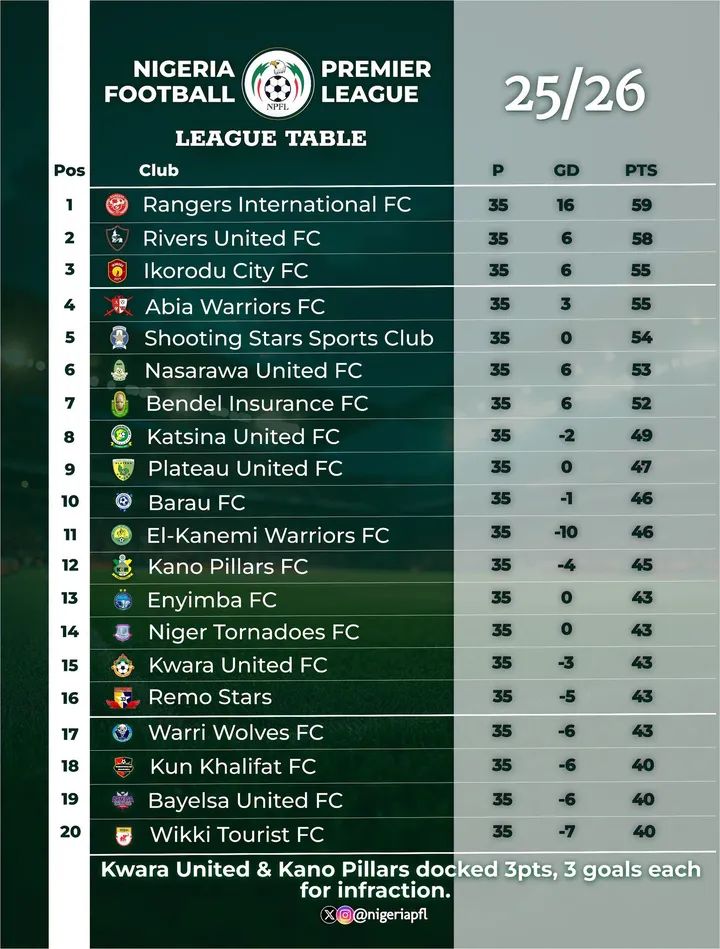
The 2025/26 season does not tell an entirely different story either. At first glance, the current league table can give a bloated impression because the highest-ranked relegation candidate (17th place) could still finish with as many as 52 points and interestingly, only six points separate the 8th-placed team from the 17th-placed team with three (3) games to go.
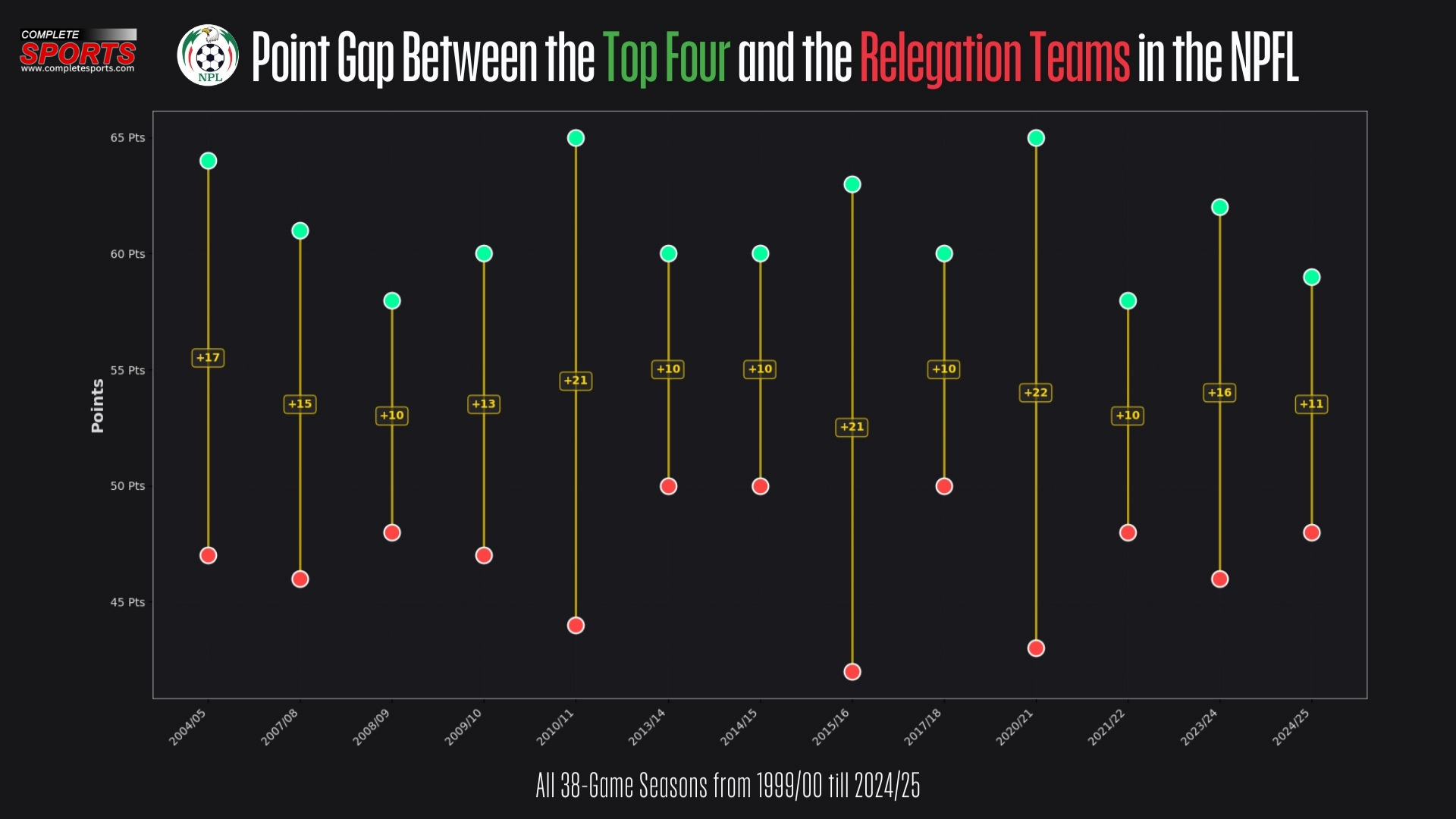
When we examine the Top Four and the Relegation Zone across 38-Game seasons since the 1999/00 season, fifty per cent of the time it is a 10-point difference. The average gap between both groups is around 14 points. At first that appears significant but over a full season, it translates to roughly four or five wins.
Also Read: NPFL: Warri Wolves Eye Survival As Abdallah Banks On Crucial Home Fixtures
This is not a massive divide in quality alone. It is more likely a difference in consistency. A handful of results can separate a team pushing for continental places from one fighting to stay up. This further suggests that the NPFL is a league where small edges accumulate over time.
The NPFL Knife-Edge: Where Survival Is Decided
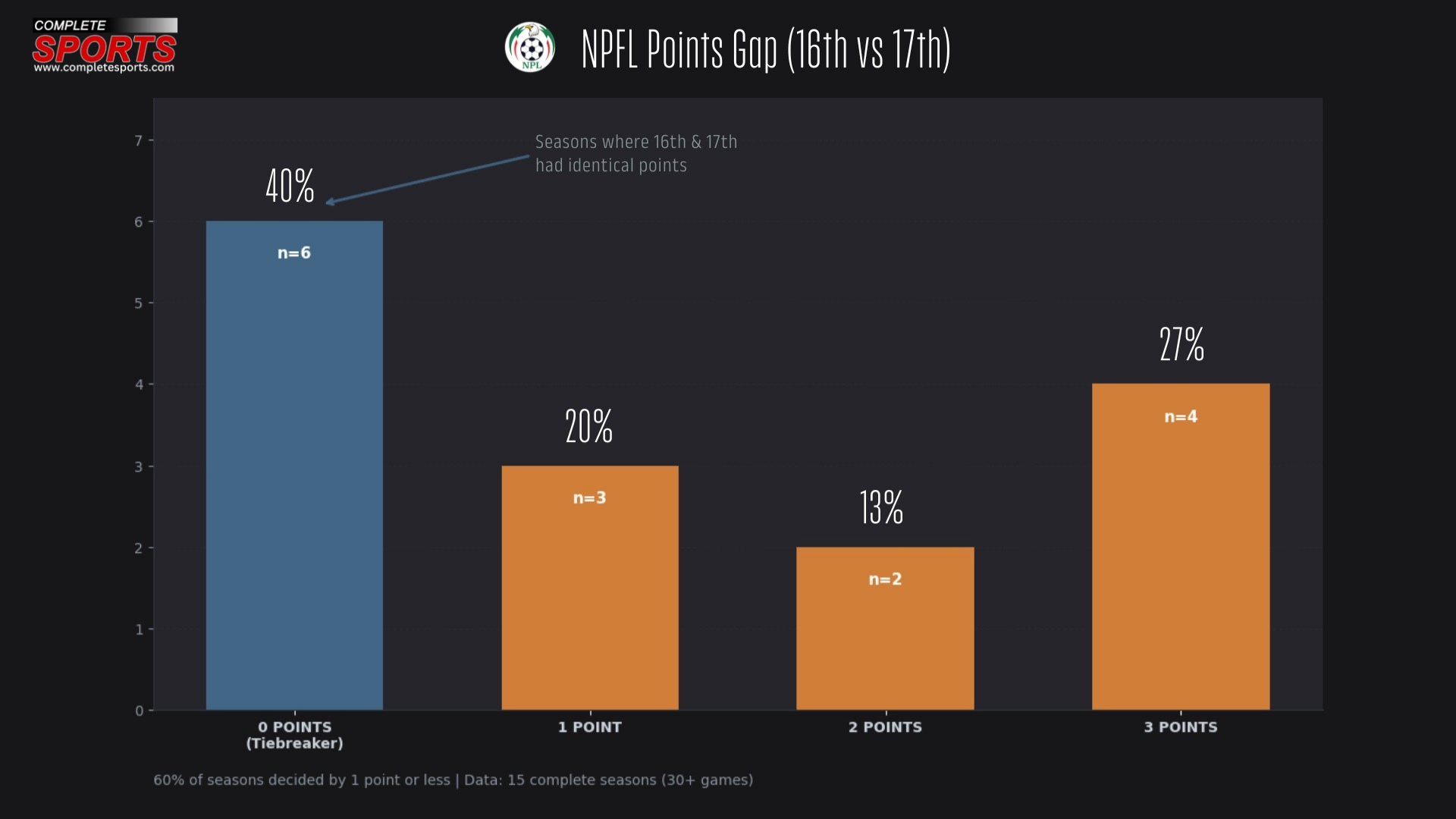
The real story, however, is at the bottom of the table, where the margins tighten to their extreme, as we are witnessing once again this season. In many 38-Game seasons, survival has been decided by zero or one point. In others, the gap has stretched to just two or three.
In practical terms, that means tiebreakers or one match result flipped can determine whether a team remains in the top flight. A single draw instead of a loss, or an avoidable mistake in the final minutes of a game, can be the difference between survival and relegation. This is the “knife-edge” reality of the NPFL survival race.
What Keeps Teams Up in the NPFL? Key Survival Factors
So, in an unforgiving NPFL, what is it that actually keeps teams up? The data points to a few consistent patterns. First is home performance. The NPFL has long been a home-driven league, and survival often depends on turning home fixtures into reliable points. Teams that win consistently at home often build a base that cushions poor away form.
Second is defensive discipline. Surviving teams tend to avoid heavy defeats and keep goal differences within manageable limits. Apparently, conceding fewer goals is often more valuable than scoring more.
The third key trait is Consistency. Relegated teams tend to have short bursts of performance followed by long losing runs. Teams that stay up tend to grind out results, even draws, and avoid extended slumps.
Finally, there is game-state control. Teams that hold onto leads and avoid conceding late goals accumulate marginal gains that add up over a season. Increasingly, these patterns can be modelled. Using metrics such as points per game, goal difference, and recent form, team analysts can estimate a team’s probability of survival as the season progresses.
Logistic regression models, for example, can translate performance trends into survival odds. The aim is not to predict exact outcomes but to identify risk levels early enough for teams to respond. If the league has a survival margin that’s that high, then it must be understood that relegation battles no longer require a reactive approach. They can be anticipated and actively prepared for.
.




2 Comments
What manner of league is this one na lol
With 3 games to go, 3 current relegation zone teams are on 40 points.
The current top team is merely using 19 points to surpass bottom team points haul.
AFTER 35 FREAKING GAMES.
“… interestingly, only six points separate the 8th-placed team from the 17th-placed team with three (3) games to go.”
In saner leagues, the gulf in class between say Arsenal (first) and Wolves (20th) in EPL is evident.
That means it is impossible for npfl to have “exceptional” talent because home fixtures, deservedly or not, are non negotiable wins.
And we want the exports from such whacked system to flood our national teams. As how na. When the pool is dysfunctional?
See data. And nothing has infact changed since 1999.
“When we examine the Top Four and the Relegation Zone across 38-Game seasons since the 1999/00 season, fifty per cent of the time it is a 10-point difference. The average gap between both groups is around 14 points.”
Why should we do well on the continent when the league “concept” is rubbish?
NFF that should champion quality reforms all round the beautiful game here has moved from one dumb administration to another.
The road is rough oh
The bottom teams in the NPFL can as well go and represent Nigeria in CAF competitions and the results would not be any different from what the champions record……..LMAOoooo.
I’ve said enough about this league and its products in times past already……I needn’t say more