

The year 2026 continues with great sports events and tournaments, and it is only March. With the Winter Olympics behind us and the Men’s ICC T20 World Cup entering the big final match, there is a lot that will still come, both in March and later in the year. While it was supposed to be the current month that we focus on in this article, when the 2026 iteration of the Women’s Africa Cup of Nations (WAFCON) was supposed to take place, things have changed.
Now moved to the middle of the summer, the growing and expanding tournament that puts the continent on the map once again, following the incredibly competitive and even controversial Men’s AFCON in January. Hopefully, it will be close to that, as African nations are quite passionate about their football; that much is a well known fact!
With this being said, this article serves as a guide on anything and everything regarding the upcoming event. Before the Men’s FIFA World Cup kicks off this summer, WAFCON is the biggest international event remaining. Join us as we explore the group outlook, talk about favorites and their odds to help you with your soccer betting, and even revisit the 2024 tournament that was the biggest one to date.
Preview and Basics
The upcoming edition of the Women’s Africa Cup of Nations easily promises to be one of the most significant in the competition’s history. With an expanded field, rising investment in women’s football across the continent, and qualification stakes for the next Women’s World Cup, the 2026 tournament is already a defining moment for the African women’s game and the sport in general. From established powerhouses to ambitious newcomers, the competition will gather the continent’s best players and teams for several weeks of high level football.
The tournament will be the 16th edition of the continental championship organized by the Confederation of African Football. It will be hosted in Morocco yet again, marking the third consecutive time the country has staged the competition, a first in the tournament’s history. Matches will take place across three major Moroccan cities of Rabat, Casablanca, and Fes, using four stadiums prepared for international competition. The tournament was originally scheduled for March 17 to April 3, 2026, but it has since been rescheduled mere days before it was supposed to start.
Now, it will run from July 25 to August 16, which will allow organizers more preparation time to accommodate scheduling challenges. For the first time, the competition will feature 16 teams rather than the traditional 12, yet again showing the rapid growth of women’s football across Africa. The event will also carry additional importance because it doubles as the African qualifying pathway for the 2027 FIFA Women’s World Cup in Brazil. The top four teams at WAFCON will qualify directly for the tournament, while two additional sides will advance to the inter confederation play offs. Simply put, there is a lot to play for.
Group Outlook and Title Favorites
A total of 16 national teams will compete in Morocco after emerging from a qualification process that ran from February to October 2025. The host nation qualified automatically, while the remaining teams earned their places through two rounds of home and away playoff ties across the continent. The final lineup includes the heavyweights of the continent, traditional powerhouses that are the favorites, as well as several rising programs in African women’s football. Qualified teams include Algeria, Burkina Faso, Cabo Verde, Cameroon, Côte d’Ivoire, Egypt, Ghana, Kenya, Mali, Morocco, Nigeria, Malawi, Senegal, South Africa, Tanzania, and Zambia.
The tournament will also see debuts for Cabo Verde and Malawi, whose qualification is one of the main results of the expansion. The group stage draw has produced several compelling matchups. Morocco, Algeria, Senegal, and Kenya make up Group A. South Africa faces Ivory Coast, Burkina Faso, and Tanzania in Group B. Nigeria, Egypt, Zambia, and Malawi form a highly competitive Group C. Group D includes Ghana, Cameroon, Mali, and Cabo Verde.
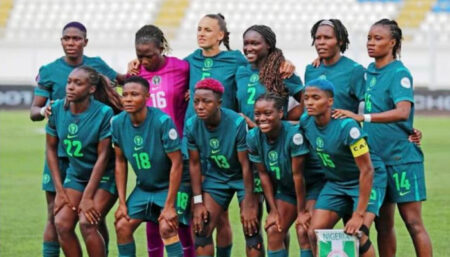
As always, Nigeria enters the tournament as the team to beat. The Super Falcons are the most successful side in the history of the competition, and it is not even close. They have won ten continental titles, and they arrive as defending champions after defeating Morocco in the 2024 final. Their pedigree, depth of talent, and tournament experience make them the benchmark for every challenger and the worst case scenario for any other team.
South Africa is another leading contender. The 2022 champions have developed one of the most balanced squads on the continent, one that combines tactical discipline with attacking flair. The country lives nad breaths football, and the fans are diehards. Much of the team’s attacking threat revolves around star forward Thembi Kgatlana, whose decisive goals in qualifying demonstrated her ability to influence big matches. Will she be able to replicate that at the biggest stage?
Host nation Morocco will also command attention, as home teams usually do. After reaching the final of the previous two editions on home soil and ending up disappointed in both, the Atlas Lionesses will look to use familiar stadiums and passionate home support to go one step further and finally win it. The controversy at the Men’s tournament could be an additional motif for the team to make their fans happy. Their rapid rise mirrors the broader investment in the country’s football development system.
Meanwhile, Zambia could emerge as the tournament’s dark horse, since there is always one team, the people’s champion, whom neutral fans and supporters of the underdogs adore. With a generation of dynamic attacking players and increasing international exposure, they have become one of the fastest improving teams in African women’s football. Ghana and Cameroon, both historically strong sides, also possess the pedigree to challenge deep into the knockout stages. The tournament is such that it allows for surprises and unlikely scenarios in the group stage, so expect the unexpected.
Read Also: How Laporta Stopped Messi’s Return To Barcelona –Xavi
Odds and Predictions
While the official odds are not yet out, mostly due to the rescheduling issues and there now being months before the tournament starts, predictions are available. It is possible to suggest which teams will fare better than the rest, and to even speculate about the eventual champions. Based on historical data, especially the 2022 and 2024 tournaments played in the same country and between similar teams, we can get close to what could happen.
Morocco, playing at home, should dominate group A. Their recent progress and strong domestic investment in women’s football give them a clear edge. Senegal has quietly improved and could edge Algeria for second place, especially if their physical midfield can control games. Kenya appears likely to struggle against the stronger North and West African sides. The projected finish would see Morocco first and Senegal second.
Group B features South Africa, the Ivory Coast, Burkina Faso, and Tanzania. South Africa remains one of the most tactically disciplined teams in Africa and should top the group comfortably. Ivory Coast possesses the attacking quality to secure second place, but Burkina Faso could make this a tight race if they stay defensively organized. Tanzania, while improving, may find the level too high. The expected and most likely outcome sees South Africa finishing first and the Ivory Coast second.
Group C is arguably the classic “group of death,” with Nigeria, Zambia, Egypt, and Malawi. Nigeria’s experience and depth make them the favorites to win the group, but Zambia’s explosive attack could push them close. Egypt has improved significantly in recent years, but may fall short of the two favorites. Malawi is likely to play the role of dangerous outsiders. The most probable scenario sees Nigeria finishing first and Zambia second, but anything could happen, including Nigeria surprising everyone and going 2nd, or missing out entirely.
Cameroon and Ghana both have deep histories in the competition and should battle for first place in Group D. Cameroon’s physical style and defensive structure might give them a slight edge, while Ghana’s attacking talent should be enough to secure second place. Mali is capable of causing an upset, but Cape Verde, a newcomer at this level, will likely find the step up challenging. Expect Cameroon first and Ghana second.
With those results, Morocco would face the Ivory Coast in a competitive but winnable match for the hosts. Nigeria would face Ghana in a classic West African derby, with Nigeria expected to prevail. South Africa against Senegal could be one of the most balanced ties of the quarterfinals, but South Africa would have the edge. Zambia against Cameroon would be a physical and open match, where Zambia’s attacking speed could decide it.
This projection would produce semi finals of Morocco versus Zambia and Nigeria versus South Africa. Morocco’s home advantage, strong defensive shape, and crowd support could help them edge Zambia in a close contest. The other semi final would likely be a tactical battle between Nigeria and South Africa, arguably the two strongest teams in the competition, and a final before the final. Nigeria has a slight advantage in a tight match.
The final would see Nigeria facing host nation Morocco. From a pure analytical standpoint, Nigeria would still be the slight favorite in the final. Their squad depth, physicality, and experience in high pressure games usually prove decisive in African tournaments. A narrow 2-1 victory for Nigeria is a realistic projection, giving the Super Falcons another continental title, record extending 11th.
Revisiting the 2024 Tournament
The 2024 Women’s Africa Cup of Nations was staged in Morocco and ultimately played from July 5 to 26 July 2025, after a scheduling delay, similar to what happened this time around. It delivered one of the most dramatic editions in the tournament’s history and expanded the reach and popularity of the sport. Twelve teams competed across six venues, producing a total of 66 goals in 26 matches and highlighting the continued growth of women’s football across Africa. Defending champions South Africa entered as one of the favorites, but the tournament quickly developed into a contest between established powers and emerging challengers. Morocco capitalized on the advantage of home crowds and pushed deep into the knockout stage.
Nigeria once again demonstrated its enduring dominance as the best team on the continent. After eliminating South Africa in the semi finals, the Super Falcons faced Morocco in a highly charged final in Rabat. The hosts appeared on course for a historic title when Ghizlane Chebbak and Sanaâ Mssoudy scored inside the opening 24 minutes for a seemingly easy rest of the way. However, Nigeria mounted a remarkable second half comeback. Esther Okoronkwo sparked the turnaround with a penalty and later assisted Folashade Ijamilusi’s equalizer before Jennifer Echegini struck the decisive 88th minute winner to seal a dramatic 3-2 victory and heartbreak for the local fans.
The triumph secured Nigeria’s record extending tenth WAFCON title and reinforced their long standing status as the continent’s benchmark in women’s football. Individually, Rasheedat Ajibade was named player of the tournament, while goalkeeper Chiamaka Nnadozie earned the best goalkeeper award after four clean sheets. Morocco’s Chebbak finished as top scorer with five goals, and Ghana claimed third place after defeating South Africa on penalties in the bronze medal match. Overall, it was an amazing tournament, but it could very well be topped this year.
Women’s Africa Cup of Nations FAQs
When was the first Women’s Africa Cup of Nations held?
The tournament was first held in 1991, initially called the African Women’s Championship, and later renamed to the Women’s Africa Cup of Nations in 2015.
Which country has won the most WAFCON titles?
The Nigerian women’s national football team is by far the most successful in WAFCON history, having won the tournament multiple times and dominating African women’s football for decades.
How often is WAFCON played?
The tournament is usually held every two years, bringing together the best women’s national teams in Africa.
How many teams compete in WAFCON?
The competition currently features 12 national teams, which qualify through regional and continental qualification rounds.
Why is WAFCON important for the FIFA Women’s World Cup?
WAFCON often acts as a qualification pathway for African teams to the FIFA Women’s World Cup. Top performing teams earn spots at the global tournament.
Who are some of the most famous players to emerge from WAFCON?
Stars like Asisat Oshoala, Perpetua Nkwocha, and Thembi Kgatlana gained continental recognition through standout performances in the tournament.
How has WAFCON helped grow women’s football in Africa?
The tournament has played a major role in increasing visibility, investment, and participation in women’s football across Africa, inspiring young athletes and helping national teams gain international recognition.