

Political Upheaval That Shaped Nigeria’s Sports Landscape
So, in July of 1976, we went to China and returned, our narrow escape from the jaws of death, only a few minutes and some miles away from landing in the middle of the worst earthquake in the history of China, receding in our minds.
On our return to Nigeria, the rest of that year, like the first half before it, became a launch pad into a great period of advancement in Nigerian football and in my life.
In the 6 months before the Olympics and China experiences, 1976 started with the political tragedy of Friday, February 13. A failed military coup attempt resulted in the death of General Murtala Muhammed, and the rise of General Olusegun Obasanjo, who succeeded him as Head of State.
Also Read: 1976: A Year Like No Other In My Sports Life! — Odegbami
Nigeria was, probably, the richest and, undoubtedly, the most powerful country in the continent of Africa. The country was so rich its sea ports were clogged with ships loaded with cargo of sand and cement imported, ostensibly, to fuel the expansive construction site for the fastest and most ambitious infrastructural development program in the West African sub-region! When Nigeria coughed, the rest of the continent caught cold.
AFCON Success And Olympic Qualification Boost Confidence
In the months before June of 1976, before I even joined the national team, the Green Eagles, enroute the Olympics, the team had participated in the African Cup of Nations in Dire Dawa, Ethiopia. They came back as heroes, in Third-place for the first time ever. The winners of the AFCON were Morocco.
Against all the odds, only a few weeks after AFCON, the Eagles played against the same Morocco over two legs, won on aggregate, and qualified for the 1976 Olympics.
It was a great achievement and a huge boost to the psyche of Nigerian players, elevating their self-belief and lifting their standard to new levels.
That’s how Nigeria’s football skyrocketed. It was a turning point personally for me in my football career.
Free from the ‘burdens’ of academic pursuit, a certificate in my pocket as minimum guarantee of survival for the rest of my life, I started to give football my full attention. In 1976, my career took off like a jet.
National Team Travels Mark Golden Era In Nigerian Sports
By August of 1976, brimming with confidence, I returned fully to the national team from our trips to Europe, Canada and China. The Eagles of that period and in that year may easily be the most travelled and most prepared national team in Nigeria’s football history.
That year’s Africa Cup Winners Cup competition was on. Shooting Stars FC, with 8 of the players being members of the national team, started to play at new levels.
Club And International Breakthrough
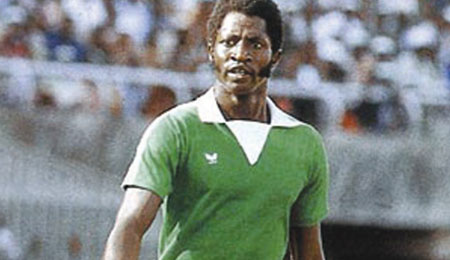
I played my first full international match for the Green Eagles against Sierra Leone in Freetown and later on home soil in Lagos. I was so impressive in both matches that I ended up with a nickname given by radio commentator Ernest Okonkwo. ‘Mathematical’ still sustains to this day, 50 years after!
Also Read: Leave Finidi George Alone! — Odegbami
In 1976, I started my goal-scoring spree playing both as a striker (for my club) and a winger (for the Green Eagles). Of the 16 goals scored by my club, Shooting Stars FC, during the Africa Cup winners Cup campaign, a secondary continental club trophy, I scored 7 of the goals in regulation time! Late Moses Otolorin, with thigh muscles the size of an elephant’s, scored 8!
I also started my goal-count for the Green Eagles, scoring the very first of my 23 goals in 5 years for Nigeria, in Lagos, in October 1976.
Continental Triumph Cements Nigeria’s Status In Sports
At the end of that year, I became the first Nigerian player to be listed amongst the top 10 players nominated for Africa’s Footballer of the Year Award by World Soccer Magazine, the publication that used to give the award in those days without any fanfare or ceremony.
In December of 1976, we lifted the Africa Cup winners Cup in faraway Yaoundé, Cameroon, against Tonnerre Kalala, a team that had Africa’s best player of that era, Roger Milla, in its arsenal. Roger was at his best and in his prime.
By year’s end, still undergoing my National Youth Service scheme, I bought my first car, laid the foundation of a new house, bought a giant stereo system, listened to BBC radio commentaries of that year’s Wimbledon Tennis Championships under the sweltering conditions of one of Europe’s warmest summers from a hotel room in Germany, and was baptized into the world of tennis. I became a fan of Bjorn Borg, winner that year as he defeated Ilie Nastasi in straight sets.