


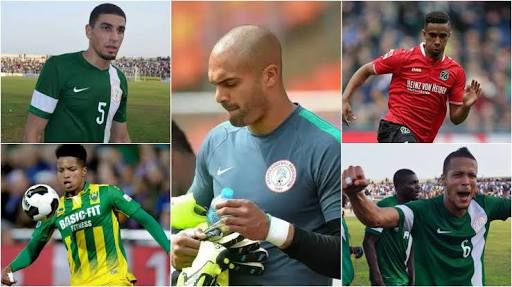
Representing the Super Eagles of Nigeria is a dream and a source of pride for many footballers of Nigerian descent, both at home and abroad. While some grow up within Nigeria’s footballing system, others are born overseas and choose to switch their international allegiance to don the green-and-white jersey.
Although the opportunity to play for Nigeria does not come to everyone, a select group of players have made that commitment — some after initially representing other countries at youth level. Their decisions have added talent and depth to the national team across various generations.
CompleteSports.com’s AUGUSTINE AKHILOMEN highlights 23 players who changed their international allegiance to play for their fatherland.
1. Victor Moses (England to Nigeria)
Having represented England at various youth levels (U16, U17, U19, and U21), Moses switched allegiance to Nigeria in 2012 and made a positive impact with the Super Eagles. He had expressed his commitment to represent the Super Eagles after meeting with the Nigeria Football Federation.
Moses made his Nigeria debut away to Rwanda in a 2013 Africa Cup of Nations qualifier in February 2012 and went on to make 37 appearances, scoring 12 goals for the national team.
He played an integral role as the Super Eagles won the 2013 Africa Cup of Nations under the late head coach Stephen Keshi. Moses scored twice and was named in the tournament’s CAF XI, as well as being crowned the Samsung Fair Player of the Tournament.
He also represented the Super Eagles in two FIFA World Cups.
Read Also:Ajibade, Okoronkwo, Nnadozie, Alozie Named In WAFCON 2024 Best X1
2. Reuben Agboola (England to Nigeria)
One of the first Europe-born players of Nigerian descent to represent the Super Eagles at international level, Agboola, who was born in Camden, London, had a big influence on the senior national team.
Agboola was first selected by coach Clemens Westerhof for Nigeria whilst with Sunderland, appearing in an Africa Cup of Nations qualifying match against Ghana on 13 April 1991. He featured at the 1992 AFCON, where he won a bronze medal with Nigeria after they defeated Cameroon in the third-place match.
He made a total of nine appearances for Nigeria, seven in the Nations Cup and two in World Cup qualifying matches.
3. Peter Osaze Odemwingie (Russia to Nigeria)
Also eligible to play for Russia and Uzbekistan, the former Bendel Insurance star pledged his allegiance to Nigeria and was a handful for most defenders.
Odemwingie made his debut for the Super Eagles on 4 May 2002, in a match against Kenya. He played for Nigeria over 60 times, including at two World Cups and four Africa Cup of Nations tournaments, as well as winning silver at the 2008 Olympics.
Odemwingie has also expressed his desire to encourage his children to play for Nigeria, despite their multinational background.
4. Leon Balogun (Germany to Nigeria)
Born to a Nigerian father and German mother, Balogun was called up by Nigeria for a March 2014 friendly against Mexico as a replacement for Joseph Yobo. He was injured after 20 minutes in a collision with signage on the touchline.
Balogun played for the age-group teams in Germany before he switched his international allegiance to the West African country, following a phone call with former head coach Stephen Keshi.
Balogun’s partnership and understanding with William Troost-Ekong made the Super Eagles’ defence very solid and difficult for teams to break down.
Read Also:CHAN 2024: Home Eagles’ Group Opponent Sudan Unveil Final Squad
5. William Troost-Ekong (Netherlands to Nigeria)
Still a key part of the current Super Eagles squad, Troost-Ekong was born to a Nigerian father and a Dutch mother and represented the Netherlands at age-grade level. Initially playing for Dutch youth teams, Troost-Ekong’s career path shifted after a motivating phone call from the late Nigerian football icon Stephen Keshi.
After switching allegiance, he made his debut for the Super Eagles of Nigeria on 13 June 2015, in a match against Chad in a 2017 Africa Cup of Nations qualifier. This marked the beginning of his international career with the Nigerian national team.
6. Brian Idowu (Russia to Nigeria)
He became a fan favourite when he netted a goal in his debut game against Argentina on 14 November, coming on as a half-time substitute for Ola Aina and scoring Nigeria’s third goal in a 4-2 win.
He was eligible to play for Russia because he was born in St. Petersburg (where his parents met while attending university; his father studied architecture, while his mother is a doctor), and his maternal grandmother, Olga, is Russian. But he decided to represent Nigeria and played in all three of his country’s matches at the 2018 World Cup in Russia.
Idowu’s decision to play for Nigeria came after he was initially overlooked by the Russian national team coach, Stanislav Cherchesov, despite his strong performances for Amkar Perm in the Russian Premier League.
Read Also:Onyedika, Arokodare Feature As Club Brugge Open League Campaign With Win Vs Genk
7. Tyronne Ebuehi (Netherlands to Nigeria)
Ebuehi was born in the Netherlands to a Nigerian father and Dutch mother and was eligible to play for both countries, but he chose to represent Nigeria.
He made his debut for the Super Eagles of Nigeria in a friendly match against Togo in June 2017. He was also part of the Nigerian squad at the 2018 FIFA World Cup.
8. Ola Aina (England to Nigeria)
An excellent defender who has consistently produced stunning performances for the Super Eagles, Aina has become a regular starter in the senior national team.
Aina’s decision to play for Nigeria was influenced by his desire to connect with his Nigerian roots and the lack of senior international opportunities with England.
Aina’s debut for the Super Eagles was in a World Cup qualifier against Zambia on 7 October 2017, where he came on as a substitute. This match also marked Nigeria’s qualification for the 2018 FIFA World Cup, making it a memorable debut for the young player.
Aina had previously represented England at various youth levels before switching his international allegiance to Nigeria.
9. Alex Iwobi (England to Nigeria)
The nephew of Nigerian icon Jay-Jay Okocha, Iwobi made his debut for the Super Eagles in 2015 against Congo, replacing Ahmed Musa in the 57th minute. Iwobi cited his Nigerian heritage and the warm reception he received when he trialled with the Nigerian U23 team as key factors in his decision, despite feeling comfortable with England.
Read Also: Oshoala Debunks Super Falcons’ Retirement Talks
He has featured for Nigeria at AFCON and the 2018 World Cup.
So far, Iwobi has earned 80 caps, scoring 10 goals, while Aina has made 40 appearances and provided three assists.
10. Carl Ikeme (England to Nigeria)
Eligible to represent England or Nigeria at international level, Ikeme chose to play for the Super Eagles and perfectly filled the void left by former goalkeeper Vincent Enyeama.
Ikeme was born in Sutton Coldfield, West Midlands, and made his international debut for Nigeria on 5 September 2015 against Tanzania in a 2017 Africa Cup of Nations qualification game.
However, his time with the Super Eagles was cut short after he was diagnosed with leukaemia. In all, he became Nigeria’s safest hand after Enyeama’s departure.
11. Shola Ameobi (England to Nigeria)
Ameobi switched his allegiance to Nigeria in 2011, preferring to play for the country of his birth. Ameobi, who played for England Under-21s, had not featured for the Three Lions, which made him eligible for the nationality switch.
He had been playing professionally for Newcastle for 11 years by then, eventually amassing 294 top-flight appearances for the Magpies.
He was selected in Nigeria’s squad for the 2014 World Cup, making two appearances as Nigeria exited in the round of 16.
12. Ademola Lookman (England to Nigeria)
The CAF Player of the Year was born in London and represented the Three Lions at different age-grade competitions, where he helped the team to win the 2017 FIFA U-20 World Cup, before switching allegiance to represent Nigeria at senior level.
He noted that switching his allegiance to Nigeria after representing England at youth level is one of the best choices of his career.
Read Also:Tottenham Eyeing Shock Move To Sign Arsenal Star
Lookman made his debut for Nigeria on 25 March 2022, in the first leg of the ill-fated World Cup qualifying series against Ghana.
The Atalanta forward has gone from being a so-called Premier League flop to being named Africa’s best player.
13. Calvin Bassey (England to Nigeria)
Another fantastic player who changed his international allegiance to play for Nigeria after being eligible to represent Italy and England as well.
He was born in Italy to Nigerian parents and raised in England. He ultimately chose to play for Nigeria, stating that the 2018 World Cup match between Nigeria and Argentina motivated him to switch.
Bassey made his debut on 25 March 2022, against Ghana. It’s nearly four years on, and he’s earned 29 caps for the Super Eagles.
14. Maduka Okoye (Netherlands to Nigeria)
Okoye made his debut for Nigeria in October 2019 in a friendly match against Brazil and cried tears of joy after the final whistle.
He could have represented the Netherlands senior national team, but he chose to play for the Super Eagles.
15. Felix Agu (Germany to Nigeria)
He recently switched allegiance to represent Nigeria ahead of Germany, where he plays for Bundesliga club Werder Bremen. Agu stated that his decision to switch to Nigeria is for him to connect with his roots.
Agu made his long-awaited Super Eagles debut in May against Jamaica in the 2025 Unity Cup and had an excellent performance.
He represented Germany at the U-19 level in only two friendly games before switching allegiance.
16. Efan Ekoku (England to Nigeria)
Born in London, Ekoku made his debut against Georgia and went on to make 20 appearances for Nigeria.
He was a member of the Nigerian team that won the 1994 Africa Cup of Nations and played at the 1994 World Cup.
Read Also:Air Peace, NIIA Honour Late Sports Icons Chukwu, Rufai, Bassey, Effiong, Nwakpa With Night Of Tributes
17. Cyril Dessers (Belgium to Nigeria)
Still trying to find his feet in the Super Eagles, Dessers, who was born in Belgium to a Belgian father and a Nigerian mother, switched allegiance to represent Nigeria instead of Belgium.
Dessers made his debut for the Super Eagles in 2020 in an international friendly game against Tunisia in Austria.
He admitted that his decision to play for Nigeria was due to his limited chances to represent Belgium at international level.
18. Jordan Torunarigha (Germany to Nigeria)
Having represented Germany at various youth levels, Torunarigha switched to playing for Nigeria at senior level. He made the switch after meeting with the Nigeria Football Federation.
He made his international debut for the Super Eagles in the laboured 3-2 win against Mozambique in an international friendly game in 2023.
19. Joe Aribo (England to Nigeria)
Aribo, who was born in London, made his bow for Nigeria in September 2019, not long after joining Rangers from Charlton.
He made his debut for the Super Eagles in the exciting 2-2 draw against a very solid Ukraine team.
Aribo had only spent four minutes on his international debut when he put the Eagles one goal ahead with a tap-in from an Alex Iwobi assist.
20. Tunji Banjo (Republic of Ireland to Nigeria)
Banjo was eligible to play for Nigeria through his father, and he took this option, making his international debut against Tunisia in Lagos in 1980 at just 20 years old. He would go on to win a total of seven caps for Nigeria.
As one of the first generation of foreign-born professional players to don the green jersey, Banjo helped bridge the gap between Nigerian and European football.
Read Also:Super Falcons To Hold Trophy Parade In Abuja Monday
21. Hope Akpan (England to Nigeria)
Akpan pledged his allegiance to represent the Nigeria national team in 2013 and was subsequently handed his first call-up in October 2014 by coach Stephen Keshi.
He made his debut for the Super Eagles against Sudan in an Africa Cup of Nations qualifying game in Uyo and played the full match.
22. Semi Ajayi (England to Nigeria)
Semi Ajayi was born in Crayford, England, to Nigerian parents and chose to represent the Super Eagles at international level.
Ajayi’s international career with Nigeria began with a call-up in August 2018 for the 2019 Africa Cup of Nations qualifiers.
He made his debut against Seychelles, coming on as a substitute. He has been a regular member of the Super Eagles squad since then, including being part of the team that finished as runners-up in the 2023 Africa Cup of Nations in Côte d’Ivoire.
23. Josh Maja (England to Nigeria)
After changing allegiance in 2019, Maja made his international debut on 10 September in a 2–2 friendly against Ukraine, replacing Victor Osimhen in added time.
He chose to represent the Super Eagles after the Nigeria national team manager, Gernot Rohr, requested that he play for Nigeria.

3 Comments
Nice article that encourages others to take this great step and see great possibilities.
where’s Abbey George, Danny shitu, Sodje, Seou Aluko, Nathan Tella etc
Tom and fisayo bashirus,
Etuhu, Victor anichebe, akpoguma, Gabriel osho, Sebastian osigwe, gift orban,
Bright Dike, Fernando adi, osayi Samuel, tosin kehinde.