


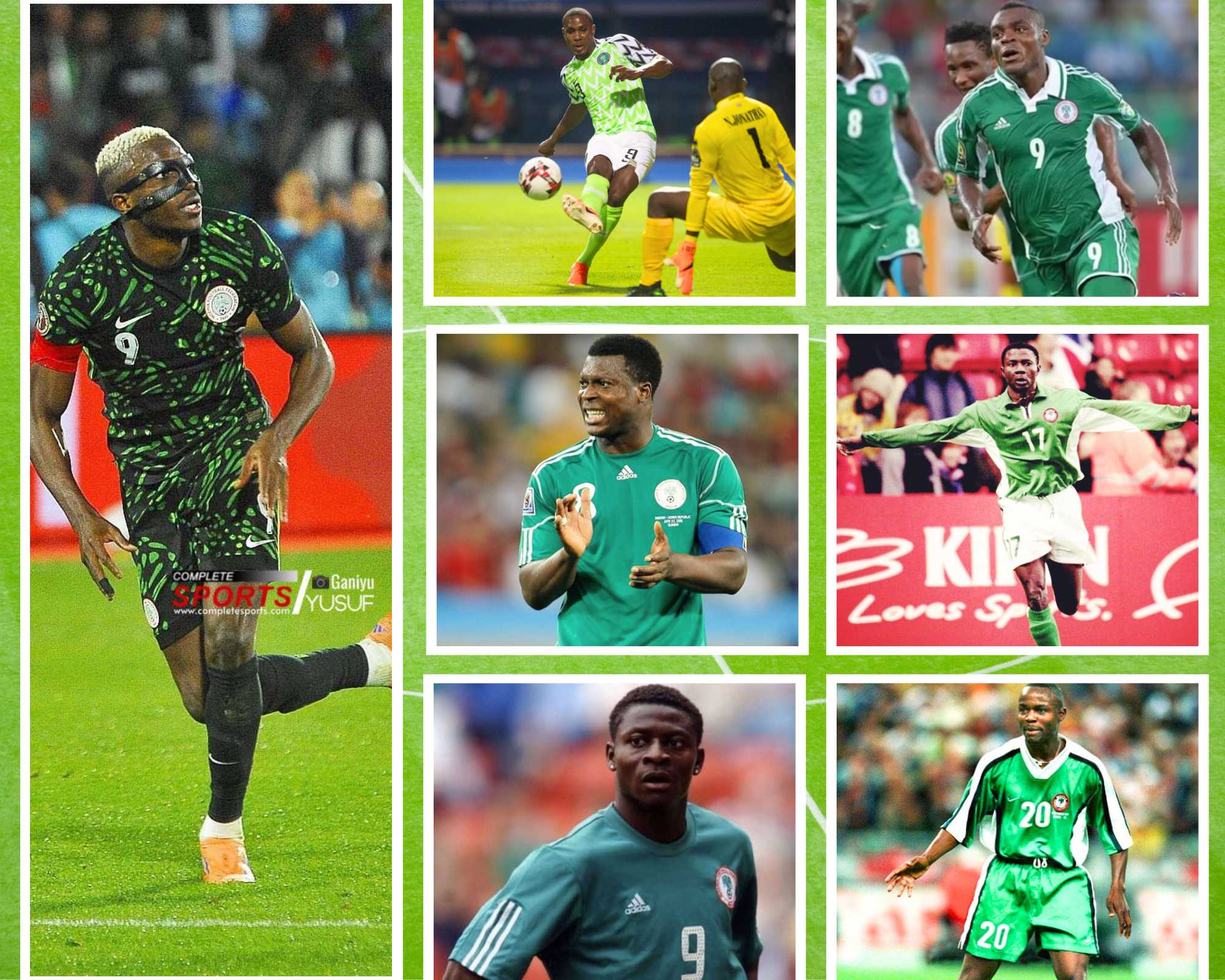
Nigeria’s Super Eagles’ story has always revolved around their sharp attack, but one position that consistently sets tongues wagging and shifts the tide is the centre-forward role — the famously renowned “Number 9” position.
There are several directions this piece could take, but for the sake of conciseness, we will limit our focus to the Super Eagles’ Number 9s at the Africa Cup of Nations since 2000.
From the ruthless dominance of the 1990s to the relentless modern intensity of today, the Super Eagles’ Number 9 has been a core part of every AFCON squad announcement.
When we focus on AFCON editions in the post-millennium era, one surprising pattern emerges: Nigeria have not always been a striker-dependent team.
Also Read: 10 Nigerian Footballers Who Switched Clubs During 2025/2026 January Transfer Window
For context, out of the 91 AFCON goals recorded by the Super Eagles in the last 26 years of the tournament, recognised strikers — or Number 9s — have accounted for just over 35 per cent. In fact, in 2004, no recognised striker found the back of the net. It was largely the wingers and midfielders running the show, with Austin ‘Jay-Jay’ Okocha finishing as a joint top scorer with four goals.
In this piece, Completesports.com’s ALLI FESOMADE discusses the top five Super Eagles strikers across the different AFCON tournaments held during that period
7. Victor Ikpeba
The best years of Victor Ikpeba in a Super Eagles jersey came before the turn of the millennium, but he remained relevant during Nigeria’s run to the AFCON 2000 Final. Ikpeba was more of a support striker rather than a traditional No. 9, and as the curtain fell on an illustrious career, he was part of Nigeria’s silver-winning campaign.
He scored two brilliant second-half goals within six minutes in a 4-2 group-stage victory over Tunisia. In that match, he operated centrally, scoring the opener from a little give-and-go that set him free in the box. His movement inside the box and timing of runs showed experience at the highest level. The 2000 team was not striker-dependent and goals were distributed across multiple players.
Victor Ikpeba contributed roughly 16 per cent of the goals tally. By 2000, Ikpeba was already an established figure in African football. He had won the African Footballer of the Year award and previously lifted the AFCON title.
Also Read: Super Eagles Brace For Ghana, Côte d’Ivoire Test In African Nations League
Unlike some of the explosive forwards who followed him, he was a season veteran, experienced, tactically aware and comfortable operating within a creative, midfield-driven side. He represented a transitional version of the Nigerian Number 9.
6. Obafemi Martins
Next, we have Oba Goal himself. Obafemi Martins brought something different to Nigeria’s AFCON attack. He had raw pace, explosive finishing and big-game temperament. He scored three goals across two different AFCON tournaments. Martins played a key role in Nigeria’s third-place finishes during his time with the Super Eagles.
In 2006 when the continent gathered in Egypt, Martins was Nigeria’s top scorer. He scored twice against Senegal within 10 minutes. His third and final goal at the continental showpiece came against Mozambique in the 2010 edition. All of Martin’s goals at the Africa Cup of Nations came in the group stages.
Obafemi Martins had the ability to stretch defences and his cleverness upfront complemented Nigeria’s creative midfielders, making him a constant threat in transition. At the club level, Martins had a successful career, rising to prominence with Inter Milan, winning Serie A titles and earning global recognition.
He also enjoyed successful spells in the Premier League with Newcastle United and Birmingham City before moving to the MLS, where he became one of the league’s standout forwards. Though injuries sometimes disrupted his international rhythm, his impact during his AFCON years was undeniable.
5. Julius Aghahowa
For those who watched him play, the name Julius Aghahowa brings a nostalgic feeling because of his goal celebrations. Oftentimes when he scored, he dazzled the audience with delectable flips. Beyond the flips, he recorded memorable performances in 2000 and 2002, scoring a total of six goals across those tournaments.
Though he never won the AFCON title, he earned the Golden Boot honour in 2002 netting 60 percent of Nigeria’s total goals at the tournament. Julius Aghahowa scored against four different opponents, one of the highest spread of goals scored since 2000.
Also Read: Super Eagles Set For March Friendly Against Jordan
Aghahowa was an explosive catalyst who provided firepower in the early 2000s. Three of his six goals in that timeframe came against Senegal. His brace against Senegal in the year 2000 remains a classic memory. In that timeframe, Julius Aghahowa scored at two different tournament editions, scoring three goals in each edition (2000 and 2002).
His tally of six goals is one of the highest returns for any Super Eagles Number 9 and Aghahowa’s record of three goals per edition is also one of the highest tallies recorded by a Number 9 in a single edition.
Speaking briefly on the club side, his career included stints in Europe, particularly with Shakhtar Donetsk in Ukraine but it was his explosive pace and acrobatic finishes that made him one of Nigeria’s most exciting forwards of his generation.
4. Yakubu Aiyegbeni
The early 2010s introduced a different kind of No. 9. Yakubu Aiyegbeni represented the Super Eagles across tournament editions between 2002 and 2010 and scored four goals in multiple appearances at the tournament.
His most explosive campaign was the 2008 edition in Ghana, where he scored two of Nigeria’s three goals at the tournament, contributing 66 percent of the team’s output in that edition. He scored against three different oppositions, scoring more times against the Republic of Benin in the timeframe considered.
Yakubu Aiyegbeni had an unmissable in-box presence and soon became the designated penalty taker of the team. He was also capable of converting limited chances. He scored in three different editions and was one of the most reliable presence in his days.
He was also one of the under-celebrated centre-forwards in Super Eagles history. Asides, goalscoring, he had his ways of influencing games. Yakubu’s record shows his efficiency at the highest level, especially as part of an Afcon squad.
Internationally, Yakubu scored 21 goals in 58 appearances for Nigeria, placing him among the country’s top scorers. He also enjoyed a prolific club career, playing for clubs such as Portsmouth, Middlesbrough, Everton and Blackburn Rovers.
His club consistency translated seamlessly to international football, where he was often Nigeria’s most dependable penalty-box presence.
3. Emmanuel Emenike
When Nigeria lifted the AFCON title again in 2013, Emmanuel Emenike was one of six different Super Eagles who shared eleven goals between them. That tally is the second highest distribution of goalscorers in a single edition, eclipsed only by the eight goalscorers recorded in 2025.
Emmanuel Emenike scored four goals in the 2013 tournament, a significant contribution, but just 36 percent of Nigeria’s total goals. His strikes against Burkina Faso, Zambia and Cote d’Ivoire were vital to Nigeria’s success.
Emenike brought physicality and explosiveness. He could score from range, attack crosses and finish transitions.
His long-range free kick and knockout-stage contributions were decisive. He scored against a total of four different teams, including two blistering freekicks against Cote d’Ivoire and Mali in the knockout stages.
Also Read: UCL: Galatasaray Must Be Flawless Against Juventus — Osimhen
Though he did not score in multiple Afcon editions, Emenike was the focal point of an unforgiving Super Eagles attacking structure. In his time at the helm, it brought huge relief to see the Number 9 role flourish again although it was an era of short-lived success because the Super Eagles went on to miss successive Afcon tournaments.
Regardless, Emmanuel Emenike’s performances earns him a noteworthy mention in this story.
2. Odion Jude Ighalo
Odion Ighalo is another name that the Nigerian football fans fell in love with in the 2010s. If one striker reintroduced individual dominance to Nigeria’s AFCON attack, it was Odion Ighalo.
At AFCON 2019 in Egypt, Ighalo scored five goals and that amounted to 55 percent of Nigeria’s total nine goals in that tournament. Though the Super Eagles settled for an eighth Bronze medal, Ighalo won the Golden Boot and delivered in key moments, including a brace against Cameroon in the Round of 16.
Odion Ighalo’s wonderful finish against Burundi from an Ola Aina backheel pass remains a highlight reel today, as Ighalo scored the matchwinner in a game where it didn’t seem like much was happening for the Super Eagles.
Like Emmanuel Emenike, Ighalo also only scored in one edition of the Africa Cup of Nations, his goals as well came in high profile ties and against a total of four different teams.
He was the last recognized centre forward that recognizably thrived in the Number 9 role before the era of breakout star Victor Osimhen began.
1. Victor Osimhen
Now we arrive at Victor Osimhen. Osimhen first appeared at AFCON 2019 as an understudy. By AFCON 2023, he was the key man of a silver-winning Nigerian attack. Fast forward to AFCON 2025, he had established himself as Nigeria’s attacking leader.
For a role that seems to be constantly evolving, Victor Osimhen stands as one of the best Number 9s in world football currently.
Victor Osimhen’s era as a Number 9 looks different. At AFCON 2023, he scored just once as Nigeria reached the final. In 2025, he scored three goals, including a brace against Mozambique, contributing 21 percent of Nigeria’s 14 goals. Unlike Yekini, Emenike or Ighalo,
Osimhen’s value extends beyond raw output. His pressing, aerial dominance, workrate and ability to occupy defenders creates space for others to operate. He combines traditional role definition with highly demanding modern football intelligence.
Victor Osimhen spearheads the new generation of Nigerian attack and is currently on the heels of Rasheed Yekini for Super Eagles all-time goalscoring record.
Playing in an era where Nigeria has a lot of options upfront, Osimhen has become a key attacking figure for Nigeria and is also a big game player having this huge effect on games the Super Eagles play. Whenever Victor Osimhen plays, Nigerians are full of belief.
At the club level, He won the Serie A Golden Boot and scored the goal that ended Napoli’s 33-year wait for a league title before moving to Galatasaray to dominate the Turkish league as well.
Victor Osihmen has scored four goals against three oppositions and at two different editions of Africa Cup of Nations. Victor Osimhen was also deservedly crowned Africa’s Footballer of the Year in December 2023, becoming the first Nigerian to win the honor since Nwankwo Kanu in 1999 and the first Number 9 to do so since Victor Ikpeba in 1997.

3 Comments
Rashidi yekini should be number 1…
Emenike, ikpeba, should even be ahead of osimhen….
What has osimhen used his no 9 role to achieve for his country(super eagles)?
Those guys won us trophies with their number 9 talent and put our country on the world stage (world cup) demolishing football super powers with their number 9 roles…
That is how you do ranking of this manner…go to anywhere in the world that is how world renowned journalist do players ranking of this sort….
I would replace Victor Ikpeba with Agali.
Siasia nko?
Abi dem don forget the Bayelsa Bomber?