


The Rise of Night Football in Nigeria
Football in Nigeria has never been more visible. From the Nigeria Professional Football League (NPFL) to continental competitions, the sport continues to grow in reach, ambition, and audience. One of the more telling shifts in recent years has been the increasing number of matches played in the evening or under artificial light.
This trend is driven by two practical realities. First, daytime temperatures across much of Nigeria make afternoon matches physically demanding for players and uncomfortable for fans in open stands. Second, broadcasting schedules — particularly for matches with pan-African or international audiences — increasingly favour evening kickoffs to align with viewership windows.
Yet as night football becomes the norm, one factor quietly shapes the quality of every match played after sunset: the standard of stadium lighting. It is an element that rarely features in post-match discussion, but its influence on player performance, referee accuracy, and fan experience is more significant than most people realise.
The Impact of Poor Lighting on Match Quality
When stadium lighting falls short, the consequences extend well beyond dim stands. Players are the first to feel it. Tracking a fast-moving ball under inconsistent or insufficient light creates genuine perceptual challenges. Depth perception — critical for judging the flight of a cross or timing a tackle — becomes unreliable when shadows cut across sections of the pitch.
Referees face similar difficulties. Shadow zones and glare pockets can obscure incidents in real time, contributing to missed calls that frustrate players, coaches, and supporters alike. These are not marginal errors; in tightly contested matches, a single misjudgement can alter outcomes.
For fans inside the stadium, poor visibility of the football diminishes the spectacle. Watching play develop across a poorly lit pitch is visually tiring, and the atmosphere suffers as a result. The impact on broadcast quality is equally significant. Cameras struggle to maintain clarity when light levels are uneven, resulting in footage that appears washed out or inconsistent—a problem that becomes more pronounced as broadcasters move toward HD and 4K transmission standards.
In short, inadequate stadium lighting does not just affect aesthetics. It affects match quality at every level of the game.
Read Also: Why Heated Ski Gloves Are A Must Have For Skiing And Snowboarding
How Modern Stadium Lighting Systems Work
The technology behind professional football lighting has advanced considerably over the past decade. The most significant shift has been the widespread transition from traditional metal halide fixtures to LED-based systems. This change has altered not just the quality of light produced, but the consistency and control with which it can be delivered.
Metal halide lamps, once the standard across most African stadiums, require a warm-up period before reaching full brightness and tend to produce uneven output as they age. LED systems, by contrast, deliver instant, stable illumination from the moment they are switched on. Their output does not degrade at the same rate, meaning light levels remain consistent throughout a match and across a stadium’s operational lifespan.
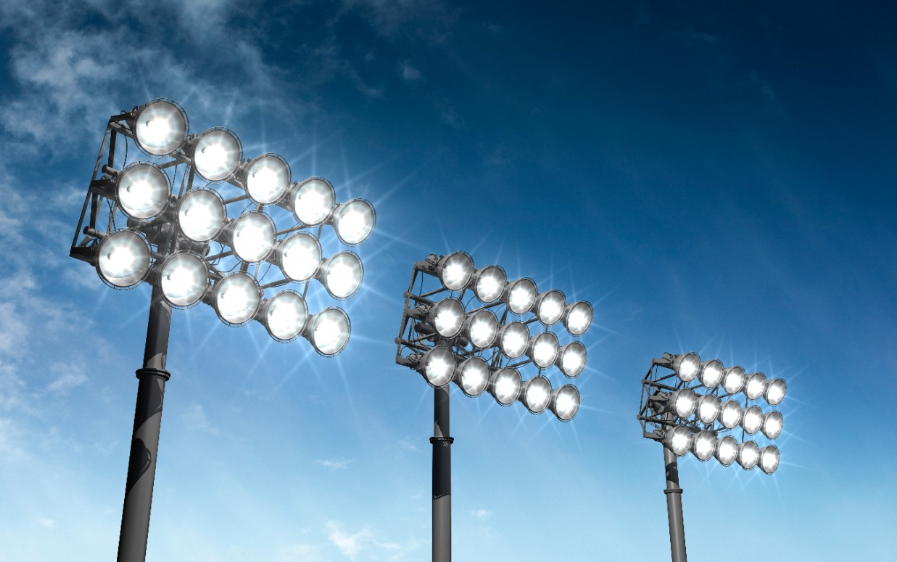
Modern stadiums increasingly rely on high mast lighting systems to deliver uniform brightness across the pitch. These tall mast structures — typically positioned around the stadium perimeter — are designed to project light at carefully calculated angles that minimise shadow formation and reduce glare for players looking upward to receive the ball. The height of the masts is not incidental; it directly determines the coverage area and the uniformity of illumination across the playing surface.
For large stadiums with expansive seating tiers, this kind of structured, elevated lighting approach is the most effective way to ensure that every part of the pitch receives adequate, consistent light — regardless of the time of match or atmospheric conditions.
Standards Behind Professional Football Lighting
Lighting a football stadium is not simply a matter of installing powerful fixtures and pointing them at the pitch. Professional football is governed by technical standards that define what acceptable lighting actually means — and those benchmarks are more precise than many stakeholders in Nigerian football may appreciate.
Governing bodies such as FIFA and the Confederation of African Football (CAF) set specific requirements for stadiums hosting sanctioned competitions. These requirements address several measurable dimensions of light quality. Lux levels — the unit used to measure illuminance — must meet minimum thresholds that vary depending on the match category, from domestic league fixtures to international competitions. Uniformity ratio, which describes how evenly light is distributed across the playing surface, is equally important; a pitch that is bright in some areas and dim in others fails the standard regardless of its peak lux reading.
Broadcast requirements introduce an additional layer of complexity. HD and 4K cameras demand higher and more consistent light levels than the human eye alone requires. A stadium that appears adequately lit to supporters in the stands may still produce footage that is technically insufficient for modern broadcast production.
For a deeper understanding, this football stadium lighting standards guide outlines the key benchmarks used in professional venues, covering the technical criteria that stadium operators and developers need to meet when upgrading or commissioning new lighting infrastructure.
The broader point is this: lighting compliance is not a box-ticking exercise. It is a functional requirement that directly determines whether a stadium is fit for purpose at the level of competition it intends to host.
Implications for Stadium Development in Nigeria
Nigeria’s sports infrastructure has undergone notable development in recent years, with several state governments and the Federal Government investing in stadium renovation and construction projects. These efforts reflect a broader ambition: to position Nigerian football — and African football more broadly — as competitive on the international stage.
Lighting sits at the centre of that ambition. To host FIFA-sanctioned matches, CAF competitions, or even attract high-profile friendly fixtures, Nigerian stadiums must meet defined technical standards. Lighting is one of the most visible areas where existing venues often fall short of those requirements.
Beyond international hosting rights, the benefits of improved stadium lighting extend into the domestic league. Better-lit venues improve the overall matchday experience for supporters, making evening fixtures more accessible and more enjoyable. This has a direct bearing on attendance, fan engagement, and the NPFL’s long-term commercial health.
There is also a reputational dimension. African leagues have historically struggled to attract sustained broadcast interest from international media partners. Consistent, broadcast-grade LED stadium lighting is one of the more practical steps that Nigerian clubs and stadium administrators can take to address that gap.
The gradual adoption of modern LED lighting systems across upgraded Nigerian venues reflects growing awareness of this reality among infrastructure planners and sporting administrators.
Lighting as a Competitive Advantage
Stadium lighting has moved well beyond its original role as a basic utility. In the context of modern football — where player performance is measured in fractions, broadcast quality is scrutinised in 4K, and fan experience determines long-term engagement — lighting is now a performance variable in its own right.
For Nigerian football, the implications are significant. Improving stadium lighting standards is not simply about meeting international requirements; it is about creating the conditions for better football to be genuinely played, seen, and experienced.
Looking ahead, the direction of travel is toward smarter, more energy-efficient systems that can be dynamically adjusted for different match categories, training sessions, or broadcast configurations. These developments make football lighting an active tool in stadium management rather than a fixed infrastructure element.
Nigeria has the footballing talent and the growing institutional will to compete at the highest levels of African and global football. Ensuring that the stadiums hosting that talent are equipped with lighting infrastructure that meets professional standards is one of the more concrete steps toward making that ambition a reality.